

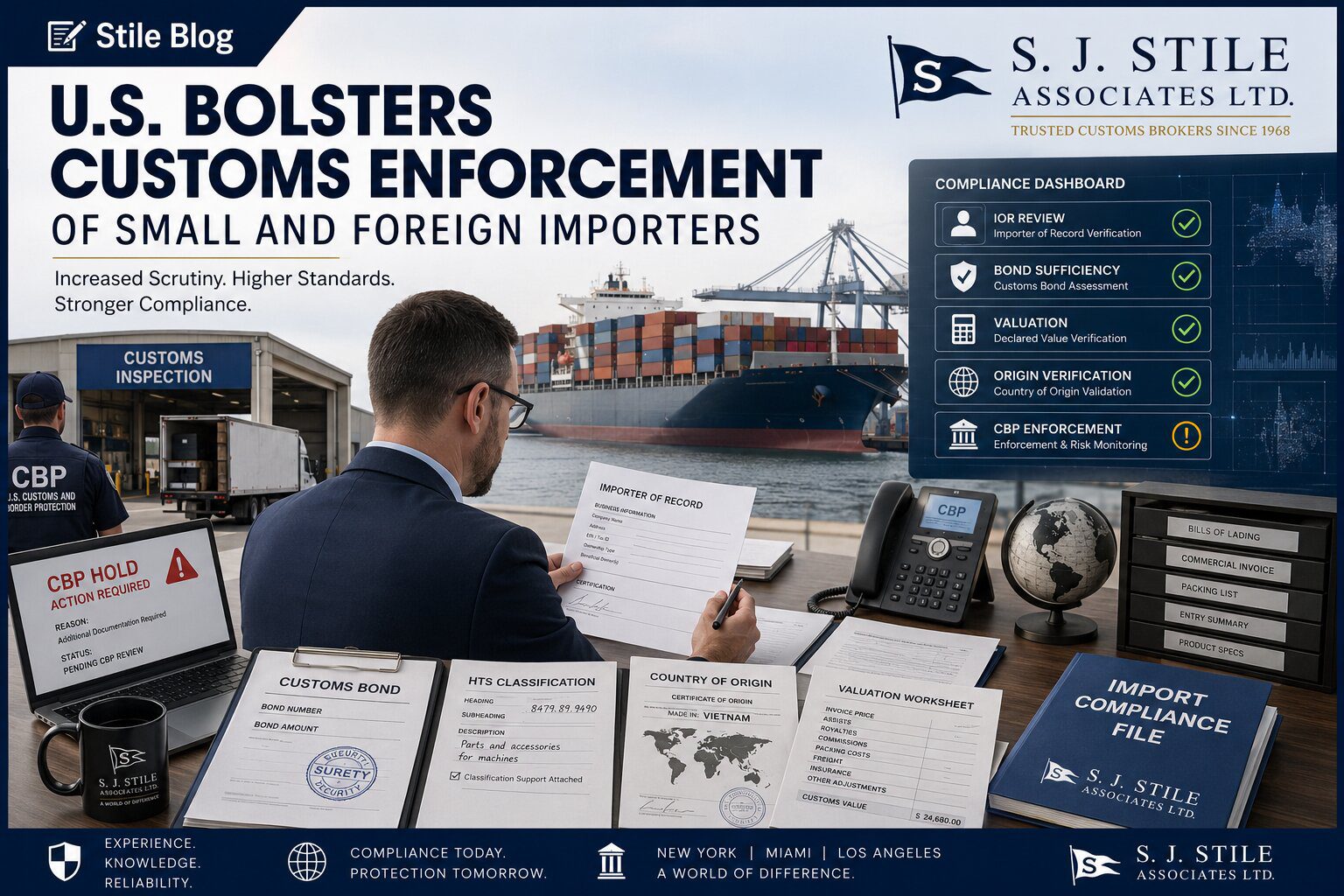
“Strengthening Customs Enforcement,” signed June 3, 2026.
A new Executive Order titled “Strengthening Customs Enforcement” directs the Department of Homeland Security and U.S. Customs and Border Protection to tighten the rules governing importers of record, foreign importers, customs bonds, importer disclosures, and enforcement penalties. The order gives DHS and CBP specific deadlines to revise importer eligibility rules, enhance importer vetting, update the importer registry, and establish stronger disclosure and certification requirements.
For importers, this is more than a policy announcement. It signals a new enforcement environment where CBP may require more proof of who is responsible for the shipment, whether the importer has a real U.S. presence, whether the importer has sufficient domestic assets or bonding, and whether the declared classification, value, origin, and product details are accurate.
The order places special attention on foreign importers of record, small or unfamiliar importers, shell-company concerns, undervaluation, misclassification, illegal transshipment, forced-labor enforcement, and duty evasion. It also directs CBP to establish heightened import disclosure requirements, including information about supply chains, production methods, foreign tax identifiers, global business identifiers, and documentation submitted to foreign customs authorities before export to the United States.
For small and foreign importers, the message is clear: CBP wants greater transparency, stronger accountability, and better documentation before cargo enters the United States. Importers that rely on foreign sellers, Delivered Duty Paid arrangements, unfamiliar suppliers, or incomplete documentation may face more questions, more holds, and more pressure to prove compliance.
That is why importers should act now. Before a shipment is delayed, before CBP issues a request for information, and before a penalty problem develops, companies should review their importer-of-record structure, customs bond sufficiency, HTS classification support, country-of-origin documentation, valuation records, supplier paperwork, and internal compliance file.
What the New Executive Order Targets
The executive order focuses heavily on importers of record, commonly known as IORs.
The importer of record is the party legally responsible for making sure the goods are properly entered into the United States. That includes declaring the correct classification, value, country of origin, quantity, duty rate, and admissibility information.
The new enforcement push appears focused on several risk areas:
| Area of Concern | Why CBP Cares |
| Foreign importers of record | CBP may have difficulty confirming legal responsibility, assets, ownership, and enforceability |
| Small or infrequent importers | These importers may be less known to CBP and may have weaker compliance systems |
| Shell companies | CBP wants to know whether an importer is a real operating business |
| Undervaluation | Lower declared values reduce duty payments |
| Misclassification | Incorrect HTS codes can reduce duties or avoid restrictions |
| Country of origin concerns | Goods may be routed through third countries to avoid tariffs |
| DDP structures | Overseas sellers may control duty payment and valuation, sometimes creating compliance risk |
| Low-value shipments | De minimis and informal entry activity has been a major enforcement focus |
The White House fact sheet states that the order directs DHS and CBP to increase enforcement of customs laws, including a proposed 50 percent minimum penalty floor limiting CBP’s discretion to reduce assessed penalties for importers who violate customs laws.
That is significant. If implemented aggressively, importers may face less room to negotiate down penalties after violations are found.
Why Small and Foreign Importers Are Under More Scrutiny
For years, CBP has faced a growing challenge. Global e-commerce, foreign sellers, offshore supply chains, low-value shipments, and complex duty structures have made it harder to identify the true party responsible for an import transaction.
Some foreign sellers may act as the importer of record, while the U.S. buyer receives the goods without fully understanding the declared value, HTS classification, or country of origin. Other importers may rely on suppliers or overseas agents to prepare documents without verifying accuracy.
That can create problems.
CBP expects importers to exercise reasonable care. CBP’s Reasonable Care publication explains that importers are responsible for using care when entering merchandise, including providing accurate information and maintaining proper documentation.
In practice, reasonable care means an importer should be able to answer basic but critical questions:
- Who is the legal importer of record?
- Is the importer a real business with a physical presence and accountable ownership?
- What is the correct HTS classification?
- What is the correct country of origin?
- How was the value determined?
- Are assists, royalties, commissions, or discounts properly handled?
- Are documents consistent between the export country and the U.S. entry?
- Is the transaction structured to avoid duties improperly?
If the importer cannot answer these questions, CBP may view the transaction as higher risk.
Foreign IORs and Informal Entries
One of the most important parts of the new enforcement direction involves foreign importers of record.
According to public reporting and the White House order, foreign IORs may face additional limits, including restrictions on using informal entries for low-value shipments. Informal entries are typically used for lower-value shipments and are often less burdensome than formal entries.
This matters because many foreign sellers use U.S. import channels to deliver goods directly to customers, retailers, warehouses, or e-commerce platforms.
CBP has already been increasing focus on low-value shipments. The agency’s e-commerce guidance states that duty-free treatment for low-value shipments valued at or under $800 was suspended for all countries effective August 29, 2025.
That shift dramatically changed the compliance burden for small parcel, e-commerce, and low-value import programs. Goods that once moved with less documentation may now require greater customs scrutiny, tariff collection, and entry accuracy.
Why Customs Holds May Increase
Customs brokers and importers have reported more frequent customs holds, especially where CBP sees risk indicators such as unfamiliar suppliers, shifting origins, unusual values, new importers of record, or tariff-sensitive products.
CBP does not publicly disclose every inspection or hold, but the trend is consistent with the current enforcement environment. The executive order directs DHS and CBP to develop enhanced methods to fight duty evasion and other customs noncompliance.
Several factors may be driving more holds:
| Factor | Impact |
| Higher tariffs | More financial incentive to undervalue, misclassify, or shift origin |
| End of broad de minimis treatment | More shipments need customs processing and duty review |
| Advanced data analytics | CBP can identify unusual patterns more efficiently |
| Foreign seller models | CBP may question who truly controls the transaction |
| DDP arrangements | Overseas sellers may manage duties without full U.S. buyer visibility |
| Country of origin shifts | New sourcing from Southeast Asia may trigger origin verification |
CBP’s proposed de minimis enforcement changes in 2025 also reflected concern that some low-value shipments were being used to avoid duties or evade trade enforcement measures.
DDP Shipments, A Growing Compliance Risk
Delivered Duty Paid, or DDP, can be convenient for U.S. buyers because the foreign seller handles transportation, customs clearance, duties, and delivery.
But convenience can create risk.
If the seller controls the customs entry, the U.S. buyer may not know:
- What value was declared.
- What HTS code was used.
- What country of origin was declared.
- Whether the correct duties were paid.
- Whether the importer of record is financially accountable.
- Whether the documents match the actual transaction.
If CBP later questions the shipment, the cargo owner, consignee, broker, or importer of record may face delays, holds, requests for information, penalties, or post-entry problems.
For importers, the lesson is simple: DDP does not eliminate compliance risk. It may hide it.
What Importers Should Do Now
Importers should not wait for CBP to issue a request for information, customs hold, audit, or penalty notice. The best response is to strengthen the compliance file before a problem occurs.
1. Confirm the Importer of Record
Importers should confirm who is acting as the IOR for every shipment.
Ask:
| Question | Why it Matters |
| Who is listed as importer of record? | This party is legally responsible |
| Is the IOR domestic or foreign? | Foreign IORs may face more scrutiny |
| Does the IOR have real business activity? | CBP may question shell entities |
| Is beneficial ownership clear? | Helps validate product identityNew disclosure requirements may require more transparency |
| Is the bond sufficient? | Higher bonding requirements may become more important |
2. Review Customs Bond Sufficiency
The executive order references higher bonding requirements for importers of record. Customs bonds protect the government if duties, taxes, fees, or penalties are not paid.
Importers should review whether their bond is adequate based on:
- Import volume.
- Duty exposure.
- Tariff increases.
- AD/CVD exposure.
- Entry frequency.
- Risk profile.
- Use of foreign IOR structures.
A bond that was sufficient years ago may no longer be sufficient if tariffs have increased or import volume has grown.
3. Strengthen HTS Classification Controls
Misclassification is one of the most common customs risks.
Importers should maintain:
- HTS classification worksheets.
- Product descriptions.
- Material composition.
- Technical specifications.
- Photos or catalogs.
- Prior rulings, if applicable.
- Broker classification notes.
- Internal approval records.
CBP expects importers to exercise reasonable care, and proper classification documentation is one of the strongest ways to demonstrate that care.
4. Verify Country of Origin
Country of origin is now one of the most sensitive customs issues.
Importers should confirm:
- Where the goods were manufactured.
- Whether substantial transformation occurred.
- Whether any third-country processing changed origin.
- Whether the supplier documentation is consistent.
- Whether the declared origin matches the commercial invoice, packing list, certificate, and production records.
This is especially important when goods are sourced from countries that may be used as transshipment points to avoid higher tariffs.
5. Validate Customs Value
Undervaluation is specifically mentioned as a noncompliance concern in the executive order.
Importers should confirm that customs value properly accounts for:
 Valuation Element Valuation Element | Review Needed |
| Invoice Price | yes |
| Assists | yes |
| Royalties | yes |
| Commisions | yes |
| Packing Costs | yes |
| Discounts | yes |
| Related Party Pricing | yes |
| Freight and insurance treatment | yes |
| DDP deductions | yes |
If a foreign seller or overseas agent prepares the invoice, the U.S. importer should still verify that the value is correct for U.S. customs purposes.
6. Keep a Complete Compliance File
The order calls for more detailed documentation, including information about supply chain, product specifications, and records provided to customs agencies in the country of origin.
A strong compliance file should include:
- Commercial invoice.
- Packing list.
- Arrival notice.
- Bill of lading or airway bill.
- Entry summary.
- HTS classification support.
- Country of origin support.
- Valuation worksheet.
- Purchase order.
- Proof of payment.
- Supplier certifications.
- Product specifications.
- Broker instructions.
- Internal review notes.
- Prior rulings or binding rulings, if any.
Good documentation can be the difference between a manageable CBP inquiry and a serious compliance issue.
What Customs Brokers Should Expect
Customs brokers may see more pressure in several areas.
More Questions Before Entry
Brokers may need to ask importers for more information before filing entries, especially when the importer is new, foreign, infrequent, or using a complex transaction structure.
More Holds and CBP Requests
Importers may receive more requests for documents, product details, ownership information, value support, and origin evidence.
More Broker Due Diligence
Brokers may need stronger procedures for identifying high-risk importers, reviewing foreign IOR structures, and documenting importer instructions.
More Compliance Conversations
Importers may need education on reasonable care, entry responsibility, classification, valuation, and origin before cargo arrives.
This is where a knowledgeable customs broker becomes extremely valuable. A broker does not replace the importer’s legal responsibility, but a good broker helps importers understand what CBP expects and how to prepare properly.
How S. J. Stile Associates Helps Importers Prepare
S. J. Stile Associates Ltd., Trusted Customs Brokers Since 1968, helps importers navigate the increasingly complex U.S. customs environment.
In an enforcement climate focused on importer identity, documentation, duty accuracy, and supply chain transparency, importers need more than basic entry filing. They need a customs partner that understands how CBP thinks, what documentation matters, and where risk can appear before cargo is delayed.
S. J. Stile Associates supports importers with:
- Customs brokerage.
- Entry preparation.
- Import documentation review.
- HTS classification support.
- Country of origin review.
- Valuation guidance.
- Customs compliance coordination.
- FDA, USDA, FWS, FCC, EPA, DOT, and other agency coordination when applicable.
- Cargo tracking and communication.
- Practical guidance for importers facing increased scrutiny.
With offices in New York, Miami, and Los Angeles, S. J. Stile Associates helps importers manage shipments through key U.S. gateways while maintaining a strong focus on compliance, communication, and customer service.
Practical Importer Checklist
Before your next shipment, ask these questions:
If the answer to several of these questions is “no,” the importer may be exposed.
| Compliance Question | Yes / No |
| Do we know who the importer of record is? | |
| Is the IOR domestic or foreign? | |
| Do we have proof of ownership and business activity? | |
| Is our customs bond sufficient? | |
| Is the HTS classification documented? | |
| Is the country of origin verified? | |
| Is the value correct for customs purposes? | |
| Are supplier documents consistent? | |
| Are DDP shipments being reviewed carefully? | |
| Do we have a complete compliance file? | |
| Do we have written broker instructions? | |
| Are we prepared for a CBP request for information? |
If the answer to several of these questions is “no,” the importer may be exposed.
Conclusion
The new executive order signals a stronger enforcement posture toward small importers, foreign importers of record, shell companies, low-value shipments, undervaluation, misclassification, and duty evasion.
For importers, the safest strategy is not to wait for a customs hold or penalty. The safest strategy is to prepare now.
That means reviewing importer of record structures, strengthening documentation, confirming classification and origin, validating customs value, reviewing bonds, and working closely with an experienced customs broker.
In today’s trade environment, compliance is no longer just paperwork. It is cargo protection, financial protection, and business continuity.
FAQ Section
1. What is an Importer of Record, or IOR?
The Importer of Record is the party legally responsible for ensuring that imported goods are properly declared to U.S. Customs and Border Protection. This includes the correct HTS classification, country of origin, customs value, duty payment, and required documentation.
2. Why is CBP increasing scrutiny of small and foreign importers?
CBP is focusing more closely on small, infrequent, and foreign importers because these parties may be harder to verify, may lack established compliance history, or may be involved in transactions where ownership, valuation, country of origin, or duty responsibility is unclear.
3. What is a foreign Importer of Record?
A foreign Importer of Record is an importer located outside the United States that acts as the responsible party for goods entering the U.S. Foreign IORs may face more scrutiny because CBP may want stronger proof of identity, ownership, business activity, financial responsibility, and compliance accountability.
4. Can a foreign company still import into the United States?
Yes, foreign companies may still be able to import into the United States, but they should be prepared for stricter documentation requirements, stronger identity verification, proper customs bonds, and increased review of business structure, ownership, and shipment details.
5. What is a customs bond and why does it matter?
A customs bond is a financial guarantee that helps ensure duties, taxes, fees, and penalties owed to CBP will be paid. If CBP increases bonding requirements, importers may need to review whether their current bond amount is sufficient based on import volume, duty exposure, and risk profile.
6. What types of shipments are more likely to receive customs holds?
Shipments may receive more attention if they involve unfamiliar importers, foreign IORs, unusual valuation, tariff-sensitive products, country of origin changes, DDP arrangements, incomplete documents, or goods sourced from regions associated with transshipment concerns.
7. What is a DDP shipment and why can it create customs risk?
DDP means Delivered Duty Paid. In this structure, the seller usually handles shipping, customs clearance, duties, and delivery. The risk is that the U.S. buyer may not know what value, HTS code, country of origin, or importer information was declared to CBP.
8. What documents should importers keep in their compliance file?
Importers should keep commercial invoices, packing lists, bills of lading, arrival notices, entry summaries, HTS classification support, country of origin documents, valuation worksheets, purchase orders, proof of payment, supplier certifications, and broker instructions.
9. How can importers reduce the risk of customs delays?
Importers can reduce risk by confirming the correct importer of record, reviewing customs bond sufficiency, validating HTS classification, verifying country of origin, confirming customs value, maintaining complete records, and working closely with an experienced customs broker.
10. Can a customs broker prevent all CBP holds?
No. A customs broker cannot guarantee that CBP will not hold or examine cargo. However, an experienced customs broker can help importers prepare accurate documentation, identify compliance risks, respond to CBP inquiries, and reduce avoidable delays.
11. What should small importers do now?
Small importers should review their customs process immediately. They should confirm who is acting as importer of record, make sure their bond is adequate, verify product classification and origin, maintain complete documentation, and avoid relying blindly on overseas suppliers or sellers.
12. How can S. J. Stile Associates help?
S. J. Stile Associates Ltd. helps importers manage customs brokerage, import documentation, classification support, country of origin review, valuation questions, PGA coordination, cargo tracking, and compliance communication. With experience since 1968, Stile helps importers navigate a stricter customs enforcement environment with confidence.
Steven Heid
President of S J Stile Associates
S. J. Stile Associates Ltd.
Trusted Customs Brokers Since 1968
New York, Miami, Los Angeles
A World of Difference
The Stile Associates Advantage
- More than 55 years of continuous industry experience
- Family leadership with modern trade vision
- Licensed Customs Brokers and compliance professionals
- CTPAT certified supply chain security
- Full service customs and logistics solutions
- Technology driven visibility and control
- Dedicated, personalized client service
- Nationwide U.S. coverage with global support
Choosing S.J. Stile Associates means partnering with a customs broker that understands the realities of today’s trade environment and is fully invested in protecting your business.
Contact S.J. Stile Associates today to learn how we can strengthen your compliance posture and streamline your supply chain.


We’re not just a broker; we’re your strategic compliance partner.
Since 1968, our clients have trusted us to:
- Navigate regulatory shocks
- Deliver personal service from our NYC, Miami, and LA offices
- Build resilient import strategies that drive growth
In this new trade era, trust is everything , and that’s why importers stay with Stile for years.

Call to Action
At Stile Associates, we combine over 55 years of experience with the latest technology to keep your imports compliant and efficient.
Contact us today to explore how AI-driven solutions can optimize your customs operations.


📣 Final Call to Action:
Ready to take control of your shipping costs?
Let’s talk. Contact Stile Associates for a free consultation and let our experts audit your current process, to help you streamline your operations, stay compliant, and save money.

💼 Choose Stile, Your Smartest Move in Global Trade
Whether you’re shipping across the country or across continents, Stile Associates is your strategic partner for building a smarter, more resilient supply chain.
📍 Since 1968, we’ve been delivering peace of mind and performance. Let’s take your logistics to the next level together.
🌐 Visit us at www.stileintl.com
📩 Or contact: stevenheid@stileintl.com
Stile Associates – Trusted. Proven. Personal.
Stile Real Time Cargo Tracking with Global Visibility.

