

Introduction
Import compliance does not end when cargo is released or when duties are paid. For U.S. importers, the entry file remains part of the company’s customs compliance position for years after importation.
CBP recordkeeping rules are important because an importer may later need to support the classification, value, country of origin, free trade claim, antidumping or countervailing duty position, partner government agency admissibility, or special tariff treatment declared at entry. If records are incomplete, difficult to retrieve, or inconsistent with the entry summary, the importer may face delays, additional scrutiny, penalty exposure, or difficulty responding to CBP inquiries.
CBP states that entry records generally must be kept for five years, and 19 CFR Part 163 sets out customs recordkeeping obligations for parties involved in import transactions.
Regulatory and Policy Context
The core customs recordkeeping framework comes from 19 U.S.C. 1508, 19 U.S.C. 1509, and 19 CFR Part 163.
Under 19 U.S.C. 1508, importers and other parties involved in customs transactions are required to make, keep, and render records connected to import activity. Under 19 U.S.C. 1509, CBP has authority to examine records and witnesses when determining the correctness of an entry, duty liability, taxes and fees, penalties, or compliance with customs laws.
The regulations in 19 CFR Part 163 identify who must maintain records, what entry records must be available, how long records must generally be retained, and how CBP may request production.
CBP’s public guidance also explains that importers must continue to maintain entry records even if CBP returns documents or waives production at the time of entry.
What CBP Expects Importers to Understand
CBP expects importers to be able to support the declarations made at entry. This means the importer should not rely only on the broker’s transmission, the invoice, or the shipment folder.
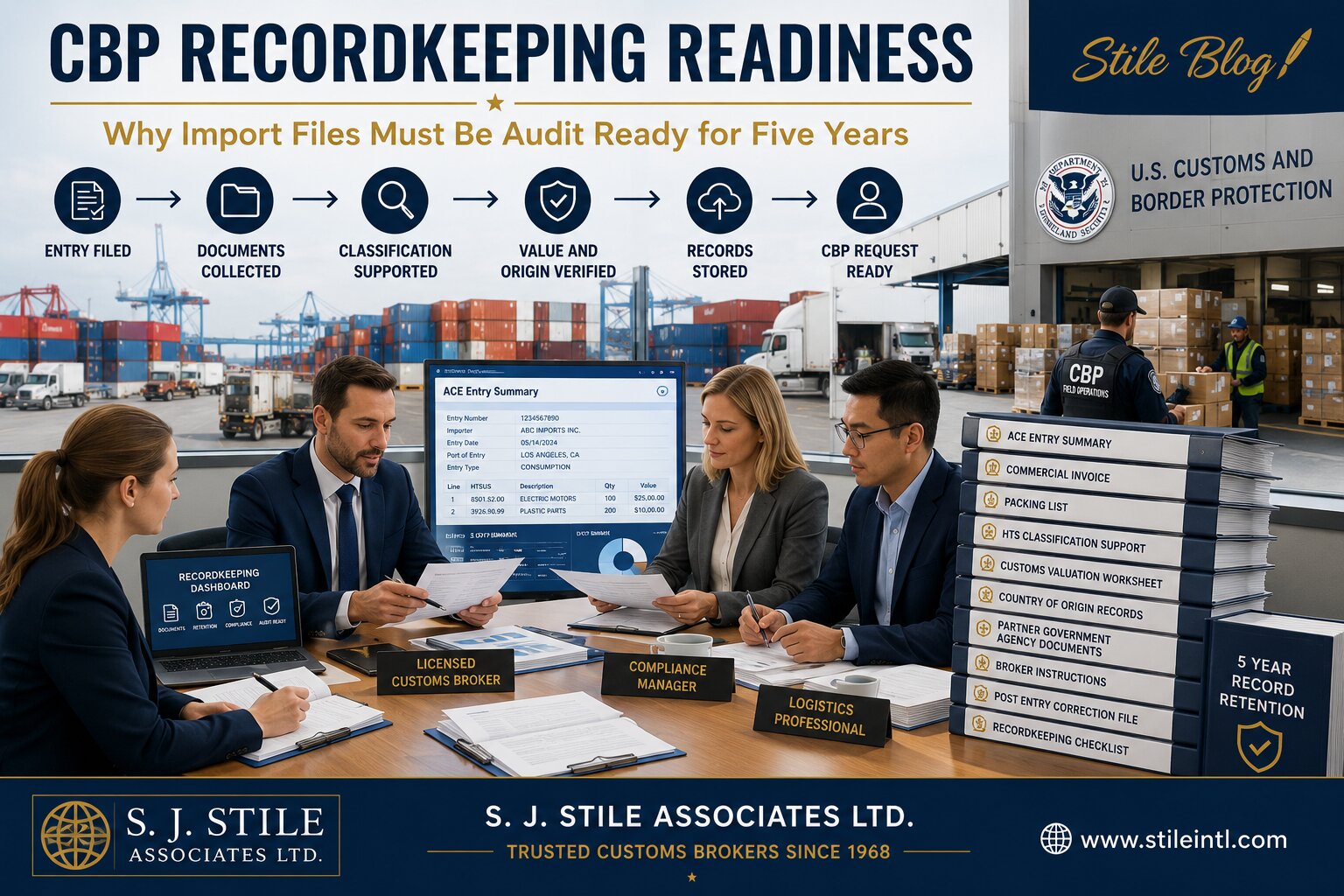
A complete import compliance file should generally support:
- The identity of the importer of record
- The declared HTS classification
- The customs value and valuation method
- The country of origin
- Any special tariff program or trade agreement claim
- Any Section 301, Section 232, antidumping, countervailing, or other special duty treatment
- Any partner government agency requirement
- The commercial documents used to prepare the entry
- The internal review or approval supporting the declaration
- Any post entry correction, protest, refund claim, or CBP communication
The practical issue is not only whether the records exist. The issue is whether the importer can retrieve the right records quickly, match them to the correct entry, and explain the basis for the declared information.
Common Compliance Gaps
Importers often discover recordkeeping weaknesses only after CBP asks a question. Common gaps include:
1. Missing classification support
Many companies can produce a commercial invoice, but cannot produce the analysis supporting the HTS code. This creates risk when CBP asks why a product was classified a certain way.
2. Incomplete valuation records
Declared customs value may depend on assists, royalties, commissions, tooling, related party pricing, or post import adjustments. If those records are not retained with the entry file, the company may struggle to support the declared value.
3. Weak country of origin documentation
Invoices may show a seller or ship from location, but those documents may not prove origin. Importers should retain supplier certifications, production records, bills of materials, origin analysis, or other support where origin affects duty, admissibility, marking, or special tariff treatment.
4. Poor record matching
A company may have records, but they may be stored by purchase order, vendor, shipment reference, or accounting number rather than entry number. If records cannot be matched to the entry, the compliance value of the file is reduced.
5. Broker file dependency
Customs brokers maintain records required by law and regulation, including broker records under 19 CFR Part 111 and applicable recordkeeping rules. However, the importer remains responsible for its own compliance position. The broker’s file may not include internal pricing records, supplier communications, engineering documents, origin support, or management approvals.
6. No post entry file update
If an entry is corrected through a Post Summary Correction, protest, prior disclosure, refund claim, or other post entry action, the file should reflect the final compliance position. Keeping only the original filing documents may create confusion later.
Practical Steps for Importers
1. Build an entry file checklist
Importers should define the minimum documents required for each entry type. At a minimum, the file should include the commercial invoice, packing list, bill of lading or air waybill, entry summary, broker instructions, classification support, valuation support, origin support, and any agency documents.
2. Store records by entry number and internal reference
The entry number should be a primary filing reference. Internal references such as purchase order, shipment number, vendor, customer number, or SKU should be secondary search fields.
3. Keep classification decisions with the file
The file should show who selected or approved the HTS code, what product information was reviewed, and whether a ruling, prior entry history, engineering specification, or tariff note was considered.
4. Separate invoice value from customs value
Accounting value and customs value are not always the same. Importers should retain documentation explaining additions, exclusions, assists, royalties, rebates, discounts, and related party considerations where applicable.
5. Retain origin support beyond the invoice
Origin support should be strong enough to explain why the declared country of origin was used. This is especially important for products affected by marking rules, trade remedies, free trade claims, forced labor review, or partner agency admissibility.
6. Review broker instructions
The importer should periodically review the instructions given to the customs broker. Old instructions, outdated tariff codes, missing special tariff guidance, or unclear valuation instructions can create repeat errors.
7. Test retrieval before CBP asks
A practical internal test is simple: select several entries from the past year and confirm whether the company can retrieve a complete support file within a short period. If records are difficult to locate internally, they may be difficult to produce under CBP review.
How S. J. Stile Associates Can Help
S. J. Stile Associates Ltd. can assist importers by helping organize the customs documentation process before an issue becomes urgent.
Our role may include reviewing entry documentation, identifying missing support, helping align broker instructions with importer compliance requirements, assisting with classification and valuation documentation, and helping importers prepare organized files for CBP inquiries.
A strong recordkeeping process protects both the importer and the customs entry process. It also helps the broker file accurate entries based on complete, current, and supportable information.
FAQs
How long should importers keep customs entry records?
CBP guidance and 19 CFR Part 163 generally require entry records to be kept for five years. Certain specific programs or claims may have additional requirements, so importers should review the applicable rule for the transaction.
Is the customs broker responsible for keeping all records?
Customs brokers have their own recordkeeping obligations, but importers should not rely only on the broker’s file. The importer may hold records the broker does not have, such as valuation support, supplier origin documents, product specifications, purchase contracts, or internal approvals.
What happens if CBP asks for records and the importer cannot produce them?
CBP may request records to determine the correctness of an entry, duty liability, penalties, or compliance with customs laws. Failure to maintain or produce required records can create compliance exposure.
Should importers keep records electronically?
Electronic records may be acceptable if they are complete, reliable, accessible, and capable of being produced when required. Importers should make sure digital files are searchable, backed up, protected, and tied to the correct entry.
What records are most important for classification?
Importers should retain product descriptions, specifications, material composition, use information, catalog sheets, technical drawings, tariff analysis, prior rulings if applicable, and the reason the selected HTS provision was used.
Should importers review old entries?
Yes. Periodic review of prior entries can identify repeated classification, valuation, origin, or documentation issues. Early detection gives the importer more options to correct errors and strengthen future filings.
References
- U.S. Customs and Border Protection, Recordkeeping, Informed Compliance Publication.
- Electronic Code of Federal Regulations, 19 CFR Part 163, Recordkeeping.
- Electronic Code of Federal Regulations, 19 CFR 163.2, Persons Required to Maintain Records.
- Electronic Code of Federal Regulations, 19 CFR 163.3, Entry Records.
- Electronic Code of Federal Regulations, 19 CFR 163.4, Record Retention Period.
- U.S. Code, 19 U.S.C. 1508, Recordkeeping.
- U.S. Code, 19 U.S.C. 1509, Examination of Books and Witnesses.
- CBP Help Center, Entry Summary Record Keeping.
The Stile Associates Advantage
- More than 55 years of continuous industry experience
- Family leadership with modern trade vision
- Licensed Customs Brokers and compliance professionals
- CTPAT certified supply chain security
- Full service customs and logistics solutions
- Technology driven visibility and control
- Dedicated, personalized client service
- Nationwide U.S. coverage with global support
Choosing S.J. Stile Associates means partnering with a customs broker that understands the realities of today’s trade environment and is fully invested in protecting your business.
Contact S.J. Stile Associates today to learn how we can strengthen your compliance posture and streamline your supply chain.


We’re not just a broker; we’re your strategic compliance partner.
Since 1968, our clients have trusted us to:
- Navigate regulatory shocks
- Deliver personal service from our NYC, Miami, and LA offices
- Build resilient import strategies that drive growth
In this new trade era, trust is everything , and that’s why importers stay with Stile for years.

Call to Action
At Stile Associates, we combine over 55 years of experience with the latest technology to keep your imports compliant and efficient.
Contact us today to explore how AI-driven solutions can optimize your customs operations.


📣 Final Call to Action:
Ready to take control of your shipping costs?
Let’s talk. Contact Stile Associates for a free consultation and let our experts audit your current process, to help you streamline your operations, stay compliant, and save money.

💼 Choose Stile, Your Smartest Move in Global Trade
Whether you’re shipping across the country or across continents, Stile Associates is your strategic partner for building a smarter, more resilient supply chain.
📍 Since 1968, we’ve been delivering peace of mind and performance. Let’s take your logistics to the next level together.
🌐 Visit us at www.stileintl.com
📩 Or contact: stevenheid@stileintl.com
Stile Associates – Trusted. Proven. Personal.
Stile Real Time Cargo Tracking with Global Visibility.

