

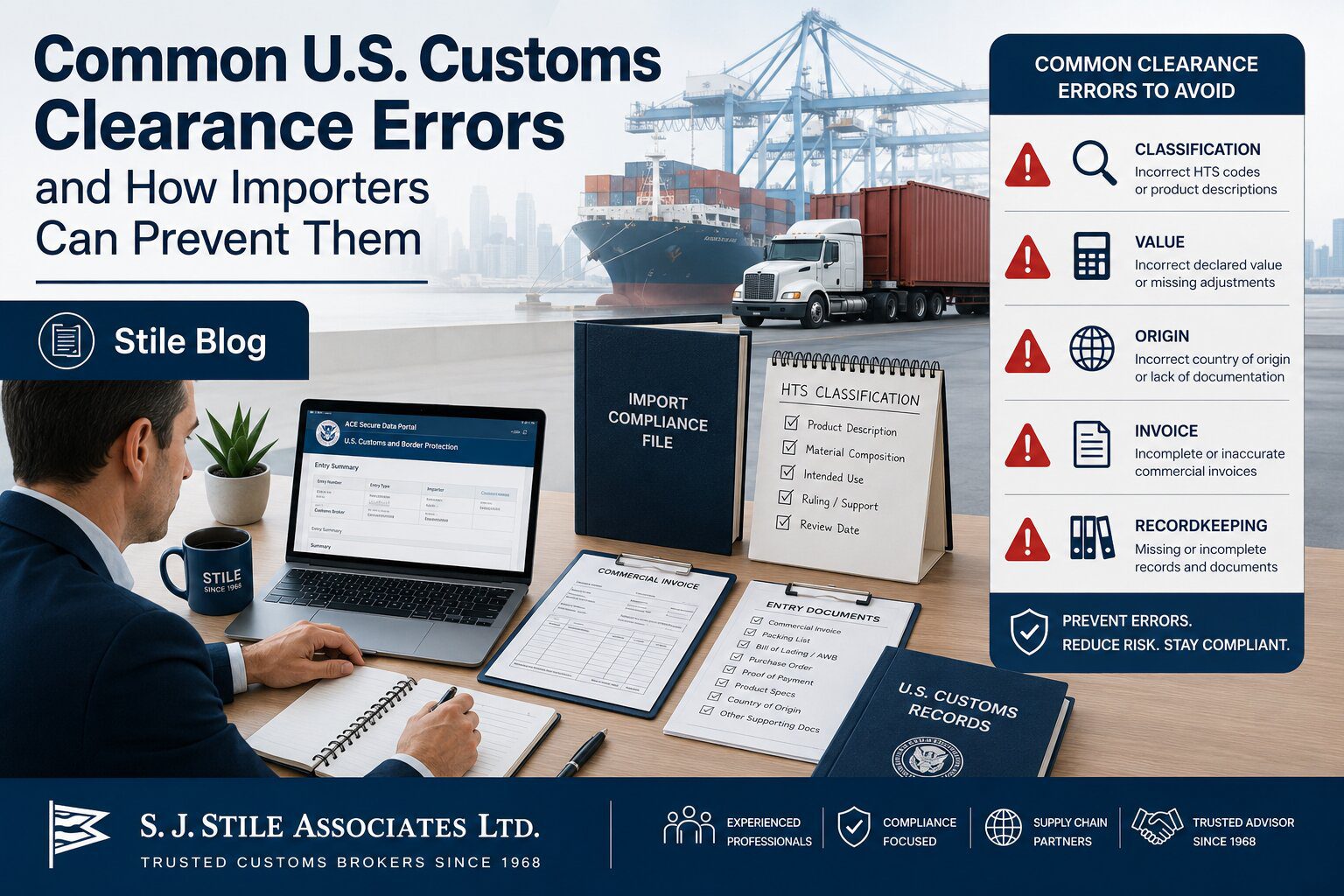
INTRODUCTION
U.S. customs clearance is not only a logistics step. It is a regulated compliance process that depends on accurate data, complete documentation, proper classification, correct valuation, admissibility review, and timely recordkeeping.
Many import problems do not begin at the port. They begin earlier, when a purchase order is issued, a supplier prepares an invoice, a product is classified incorrectly, a shipment is described too generally, or an importer assumes that the customs broker can fix incomplete information at the last minute.
CBP expects importers to exercise reasonable care when entering merchandise into the United States. That means importers must take an active role in ensuring that the information submitted to CBP is accurate, supportable, and properly documented. CBP maintains Informed Compliance Publications to help the trade community understand customs requirements, including classification, valuation, and recordkeeping expectations.
For importers, the most common clearance errors can lead to delayed releases, exams, requests for information, duty corrections, post entry amendments, penalties, or audit exposure. For customs brokers, incomplete or inaccurate importer data creates filing risk and may delay the broker’s ability to transmit a compliant entry.
REGULATORY AND POLICY CONTEXT
U.S. import entries are governed by customs laws, CBP regulations, the Harmonized Tariff Schedule of the United States, and agency specific requirements that may apply depending on the commodity.
Several core compliance areas affect nearly every import transaction:
Classification
Imported merchandise must be classified under the correct HTSUS provision. CBP’s tariff classification guidance explains that classification determines duty rates, eligibility for special tariff treatment, quota issues, admissibility requirements, and potential reporting obligations.
Valuation
Imported goods must be declared with the proper customs value. CBP’s customs valuation guidance explains valuation principles that affect declared value, including transaction value and circumstances where additions or adjustments may apply.
Recordkeeping
Importers and other parties involved in import transactions are subject to customs recordkeeping requirements under 19 CFR Part 163. The regulation sets forth requirements for maintaining, producing, inspecting, and examining records related to customs transactions.
Entry Records
The appendix to 19 CFR Part 163 identifies key entry records and reminds the importing community that parties involved in import activity must make, keep, and produce records related to declarations, entries, and other customs activities.
These requirements show why customs clearance should not be treated as a routine paperwork function. It is a compliance process that requires coordination among purchasing, finance, logistics, compliance, the supplier, and the customs broker.
1. Incorrect HTS Classification
Why This Error Happens
HTS classification errors are among the most common and consequential customs clearance mistakes. Importers may rely on supplier descriptions, old classifications, internet searches, or prior entries without confirming whether the product has changed.
Common causes include:
- Using a generic description, such as “parts,” “accessories,” or “tools”
- Reusing an HTS code from a different product
- Failing to review material composition
- Ignoring product function or principal use
- Not updating classifications after product redesigns
- Assuming the supplier’s tariff code is valid for U.S. import purposes
Why It Matters
Classification affects duty rates, special tariff programs, admissibility, quota, antidumping and countervailing duty exposure, and other government agency reporting. A small classification error can create a significant duty difference or trigger a CBP review.
CBP’s tariff classification materials are designed to help the trade community understand how classification is applied under the HTSUS.
How Importers Can Prevent It
Importers should maintain a controlled HTS database that includes:
- Product description
- HTS number
- Basis for classification
- Rulings, if applicable
- Product specifications
- Material composition
- Photos or technical sheets
- Review date
- Responsible reviewer
For higher risk products, importers should consider requesting a binding ruling from CBP before importation.
2. Incomplete or Inaccurate Commercial Invoices
Why This Error Happens
Commercial invoices are often prepared by foreign suppliers, but the importer remains responsible for ensuring that the invoice supports a compliant entry. Problems arise when invoices are too vague, inconsistent, or missing required details.
Common invoice weaknesses include:
- Vague product descriptions
- Missing country of origin
- Incorrect quantities
- Incorrect unit prices
- Missing currency
- Unclear assists or tooling charges
- Incorrect Incoterms
- Missing manufacturer information
- No part numbers or model numbers
- Descriptions that do not match packing lists or purchase orders
Why It Matters
The commercial invoice is one of the primary documents used to prepare the customs entry. If the invoice is unclear, the broker may not have enough information to classify, value, or report the shipment properly.
CBP guidance on invoice value emphasizes that importers should refer to CBP valuation regulations and Informed Compliance Publications when determining what value should be declared.
How Importers Can Prevent It
Importers should give suppliers written invoice instructions before shipment. A good invoice should include:
- Full product description
- HTS support information, when available
- Country of origin
- Manufacturer name
- Seller name
- Buyer name
- Quantity and unit of measure
- Unit price and total price
- Currency
- Terms of sale
- Related party status, if applicable
- Freight, insurance, packing, tooling, assists, or other charges, if applicable
The invoice should describe the goods as they actually are, not only as the supplier markets them.
3. Incorrect Country of Origin
Why This Error Happens
Country of origin errors occur when importers rely only on the country of export, the supplier’s location, or the final shipping point. Origin is not always the same as the country from which the goods are shipped.
Common problems include:
- Assuming the seller’s country is the origin
- Assuming the port of export is the origin
- Failing to analyze manufacturing steps
- Not documenting substantial transformation
- Ignoring special marking rules
- Not reviewing origin when suppliers change factories
Why It Matters
Country of origin affects marking, duty treatment, trade remedies, free trade agreement eligibility, forced labor review, admissibility, and other government agency requirements. An origin error can create financial exposure and supply chain risk.
How Importers Can Prevent It
Importers should obtain origin support from suppliers, including:
- Manufacturer name and address
- Country where each major production step occurs
- Bill of materials
- Production flow chart
- Origin certification, when applicable
- Explanation of substantial transformation, when relevant
Importers should review origin again whenever sourcing changes.
4. Declared Value Errors
Why This Error Happens
Valuation errors often occur because the invoice price is treated as the customs value without asking whether adjustments are required.
Common valuation issues include:
- Assists
- Tooling
- Molds
- Dies
- Engineering work
- Royalties or license fees
- Packing costs
- Selling commissions
- Related party transactions
- Rebates or post import price adjustments
- Non dutiable charges that are not separately identified
Why It Matters
Customs value is the basis for calculating duties, taxes, and fees. If the declared value is understated, the importer may owe additional duties and may face penalty exposure. If value is overstated, the importer may overpay duties and lose money unnecessarily.
CBP’s customs valuation guidance explains the importance of proper valuation and provides CBP’s position on valuation principles for the trade community.
How Importers Can Prevent It
Importers should review valuation with finance and purchasing, not only logistics. A customs valuation review should ask:
- Are buyer and seller related?
- Are there assists?
- Are royalties paid?
- Are tooling or design costs supplied free or at reduced cost?
- Are freight and insurance properly separated?
- Are post import adjustments expected?
- Are rebates or discounts documented?
- Is the invoice consistent with payment records?
This review should be documented and updated when purchasing terms change.
5. Missing Partner Government Agency Requirements
Why This Error Happens
Some shipments require review by other U.S. government agencies, not only CBP. Importers may overlook these requirements when they focus only on duty and transportation.
Depending on the product, agencies may include:
- FDA
- USDA
- EPA
- CPSC
- DOT
- FCC
- Fish and Wildlife Service
- Other regulatory agencies
Why It Matters
A shipment can be correctly classified and still be delayed or refused if another agency requirement is missing. Product admissibility depends on the product, intended use, labeling, ingredients, certifications, registration status, and agency specific filing rules.
How Importers Can Prevent It
Importers should create a product admissibility checklist before importation. The checklist should identify:
- Product category
- Agency jurisdiction
- Registration requirements
- Labeling requirements
- Certification requirements
- Prior notice or filing requirements
- Required product codes
- Supporting documentation
- Responsible internal department
For regulated products, importers should review agency requirements before the purchase order is issued.
6. Poor Recordkeeping
Why This Error Happens
Recordkeeping failures often happen when documents are scattered across departments, email inboxes, brokers, freight forwarders, accounting systems, and supplier portals.
Common gaps include:
- Missing commercial invoices
- Missing packing lists
- Missing purchase orders
- Missing proof of payment
- Missing bills of lading or airway bills
- Missing origin documents
- Missing classification support
- Missing valuation support
- Missing communication with suppliers
- No centralized record retention process
Why It Matters
CBP may request records after entry. If the importer cannot produce them, the importer may be exposed to additional scrutiny, liquidated damages, penalties, or audit risk depending on the facts.
19 CFR Part 163 sets forth customs recordkeeping requirements and procedures for maintaining and producing records.
How Importers Can Prevent It
Importers should maintain an entry file for each shipment. At minimum, the file should include:
- Entry summary
- Commercial invoice
- Packing list
- Bill of lading or airway bill
- Arrival notice
- Purchase order
- Proof of payment
- Classification support
- Valuation support
- Origin support
- Agency documentation, if applicable
- Broker communications
- Any CBP notices or release messages
The recordkeeping process should be organized, searchable, and accessible to responsible compliance personnel.
7. Late or Incomplete Responses to CBP Requests
Why This Error Happens
When CBP issues a request for information, importers may not know who is responsible for gathering the response. Delays occur when documents are held by multiple departments or foreign suppliers.
Common problems include:
- No internal owner for CBP responses
- Supplier delays
- Missing backup documentation
- Inconsistent explanations
- Broker not given enough information
- Responses submitted without legal or compliance review
- Failure to track deadlines
Why It Matters
A weak response can turn a routine inquiry into a broader compliance issue. CBP may question classification, value, origin, admissibility, or recordkeeping depending on the facts.
How Importers Can Prevent It
Importers should establish a CBP response procedure that includes:
- Immediate internal escalation
- Assigned response owner
- Document checklist
- Broker coordination
- Supplier contact process
- Compliance review before submission
- Deadline tracking
- Retention of the full response package
The importer should respond factually, completely, and consistently with entry records.
8. Failure to Review Broker Instructions
Why This Error Happens
Many importers send documents to the broker without written instructions. The broker may receive a commercial invoice and packing list but no explanation of classification, value, origin, special programs, or agency requirements.
Why It Matters
A customs broker can prepare the entry based on information supplied by the importer, but the importer remains responsible for exercising reasonable care. If the broker receives incomplete information, the entry may be filed with avoidable errors.
How Importers Can Prevent It
Importers should provide written broker instructions covering:
- Correct importer of record
- HTS classification
- Country of origin
- Declared value
- Manufacturer
- Related party status
- Applicable trade programs
- Antidumping or countervailing duty review
- Partner government agency requirements
- Special handling notes
- Contact person for questions
A strong importer and broker relationship depends on clear, timely, and accurate data.
9. Ignoring Antidumping and Countervailing Duty Risk
Why This Error Happens
Importers may not know whether a product is subject to antidumping or countervailing duties. Supplier descriptions may not identify scope risk, and HTS numbers alone may not always resolve the issue.
Why It Matters
Antidumping and countervailing duty exposure can be significant. If an importer fails to identify applicable duty orders, the entry may be incorrect and the importer may face substantial duty liability.
How Importers Can Prevent It
Importers should review high risk products for:
- Product description
- Material composition
- Country of origin
- Manufacturer
- Exporter
- Scope language
- Prior entries
- Supplier changes
- CBP or Commerce instructions, when applicable
Importers should not rely only on the supplier’s statement that a product is not covered.
10. Weak Internal Controls
Why This Error Happens
Customs compliance often sits between multiple departments. Purchasing negotiates suppliers, logistics moves cargo, finance pays invoices, and compliance or the broker files entries. If these departments do not communicate, errors occur.
Why It Matters
CBP expects importers to maintain controls that support accurate customs declarations. Weak internal controls can lead to repeated errors, inconsistent filings, and difficulty responding to CBP inquiries.
How Importers Can Prevent It
Importers should create internal controls for:
- Product setup
- Supplier onboarding
- Classification review
- Origin review
- Valuation review
- Invoice approval
- Broker instruction approval
- Entry review
- Post entry corrections
- Recordkeeping
- Periodic audits
These controls should be practical, documented, and assigned to responsible personnel.
11. Common Compliance Gaps
Importers should pay close attention to the following recurring gaps:
- Product descriptions are too vague for classification.
- Supplier invoices do not include enough customs data.
- Country of origin is assumed instead of documented.
- Assists, tooling, royalties, or related party issues are not reviewed.
- Records are not centralized or easy to retrieve.
- Broker instructions are informal or inconsistent.
- Regulated product requirements are reviewed too late.
- CBP requests are handled reactively.
- Product changes are not communicated to the broker.
- No one reviews entries after filing.
These issues are preventable when customs compliance is built into the import process before goods are shipped.
12 Practical Steps for Importers
1. Build a Product Master File
Maintain a product database with HTS, origin, valuation notes, agency flags, and supporting documents.
2. Standardize Supplier Invoice Requirements
Give suppliers written invoice instructions and reject invoices that do not meet customs requirements.
3. Review High Risk Products Before Shipment
Identify products with classification complexity, origin sensitivity, FDA or USDA requirements, or trade remedy exposure.
4. Provide Written Broker Instructions
Do not rely only on invoice documents. Give the broker clear instructions for classification, value, origin, and agency filing.
5. Conduct Periodic Entry Reviews
Review a sample of entries for accuracy. Compare entry data to invoices, purchase orders, product files, and payment records.
6. Maintain Complete Records
Keep records in a centralized system. Confirm that entry packages can be retrieved quickly if CBP asks for them.
7. Train Internal Departments
Purchasing, finance, logistics, and compliance should understand how their work affects customs declarations.
8. Correct Errors Promptly
When an error is discovered, evaluate whether a post entry correction, protest, prior disclosure, or other corrective action may be appropriate.
How S.J. Stile Associates Can Help.
S. J. Stile Associates Ltd. assists importers by helping organize the customs clearance process around accurate data, complete documentation, and practical compliance controls.
Our team can support importers with:
- Entry preparation and customs brokerage
- HTS classification review
- Import documentation review
- Broker instruction procedures
- Recordkeeping support
- CBP request coordination
- Duty and entry data review
- Import compliance guidance
- Supply chain visibility and communication
As a customs broker, Stile’s role is to help importers move freight efficiently while supporting compliance with CBP requirements. The strongest results occur when importers and brokers work together before problems arise.
FAQs.
What is the most common customs clearance error?
One of the most common errors is using an incorrect or unsupported HTS classification. Classification affects duty rates, admissibility, special tariff programs, and potential enforcement exposure.
Can the customs broker choose the HTS code for the importer?
A broker may assist with classification, but the importer must exercise reasonable care and provide accurate product information. The importer should maintain support for the classification used.
Why does CBP care about commercial invoice details?
The commercial invoice supports classification, valuation, origin, and entry reporting. If the invoice is vague or incomplete, the entry may be inaccurate or delayed.
Is country of export the same as country of origin?
Not always. Country of origin depends on where the goods were made or substantially transformed. The shipping country may only be the export location.
What records should importers keep?
Importers should retain entry documents, invoices, packing lists, transport documents, purchase orders, payment records, classification support, valuation support, origin support, and agency documents when applicable.
What happens if CBP asks for records and the importer cannot provide them?
Failure to produce records may create compliance exposure. The specific consequence depends on the facts, the type of record, and the applicable regulation.
How can importers reduce clearance delays?
Importers can reduce delays by preparing accurate invoices, confirming HTS classification, documenting origin and value, identifying agency requirements before shipment, and giving the broker complete instructions.
When should an importer review customs data?
Ideally, before shipment. Importers should also review entries after filing to detect errors and correct them promptly.
9. References
- U.S. Customs and Border Protection, Focused Assessment Program.
- U.S. Customs and Border Protection, Reasonable Care, Informed Compliance Publication.
- U.S. Customs and Border Protection, Recordkeeping, Informed Compliance Publication.
- Electronic Code of Federal Regulations, 19 CFR Part 163, Recordkeeping.
- Electronic Code of Federal Regulations, 19 CFR 163.4, Record Retention Period.
- U.S. Customs and Border Protection, CTPAT Trade Compliance Handbook, internal control and self testing guidance.
The Stile Associates Advantage
- More than 55 years of continuous industry experience
- Family leadership with modern trade vision
- Licensed Customs Brokers and compliance professionals
- CTPAT certified supply chain security
- Full service customs and logistics solutions
- Technology driven visibility and control
- Dedicated, personalized client service
- Nationwide U.S. coverage with global support
Choosing S.J. Stile Associates means partnering with a customs broker that understands the realities of today’s trade environment and is fully invested in protecting your business.
Contact S.J. Stile Associates today to learn how we can strengthen your compliance posture and streamline your supply chain.


We’re not just a broker; we’re your strategic compliance partner.
Since 1968, our clients have trusted us to:
- Navigate regulatory shocks
- Deliver personal service from our NYC, Miami, and LA offices
- Build resilient import strategies that drive growth
In this new trade era, trust is everything , and that’s why importers stay with Stile for years.

Call to Action
At Stile Associates, we combine over 55 years of experience with the latest technology to keep your imports compliant and efficient.
Contact us today to explore how AI-driven solutions can optimize your customs operations.


📣 Final Call to Action:
Ready to take control of your shipping costs?
Let’s talk. Contact Stile Associates for a free consultation and let our experts audit your current process, to help you streamline your operations, stay compliant, and save money.

💼 Choose Stile, Your Smartest Move in Global Trade
Whether you’re shipping across the country or across continents, Stile Associates is your strategic partner for building a smarter, more resilient supply chain.
📍 Since 1968, we’ve been delivering peace of mind and performance. Let’s take your logistics to the next level together.
🌐 Visit us at www.stileintl.com
📩 Or contact: stevenheid@stileintl.com
Stile Associates – Trusted. Proven. Personal.
Stile Real Time Cargo Tracking with Global Visibility.

