

Introduction
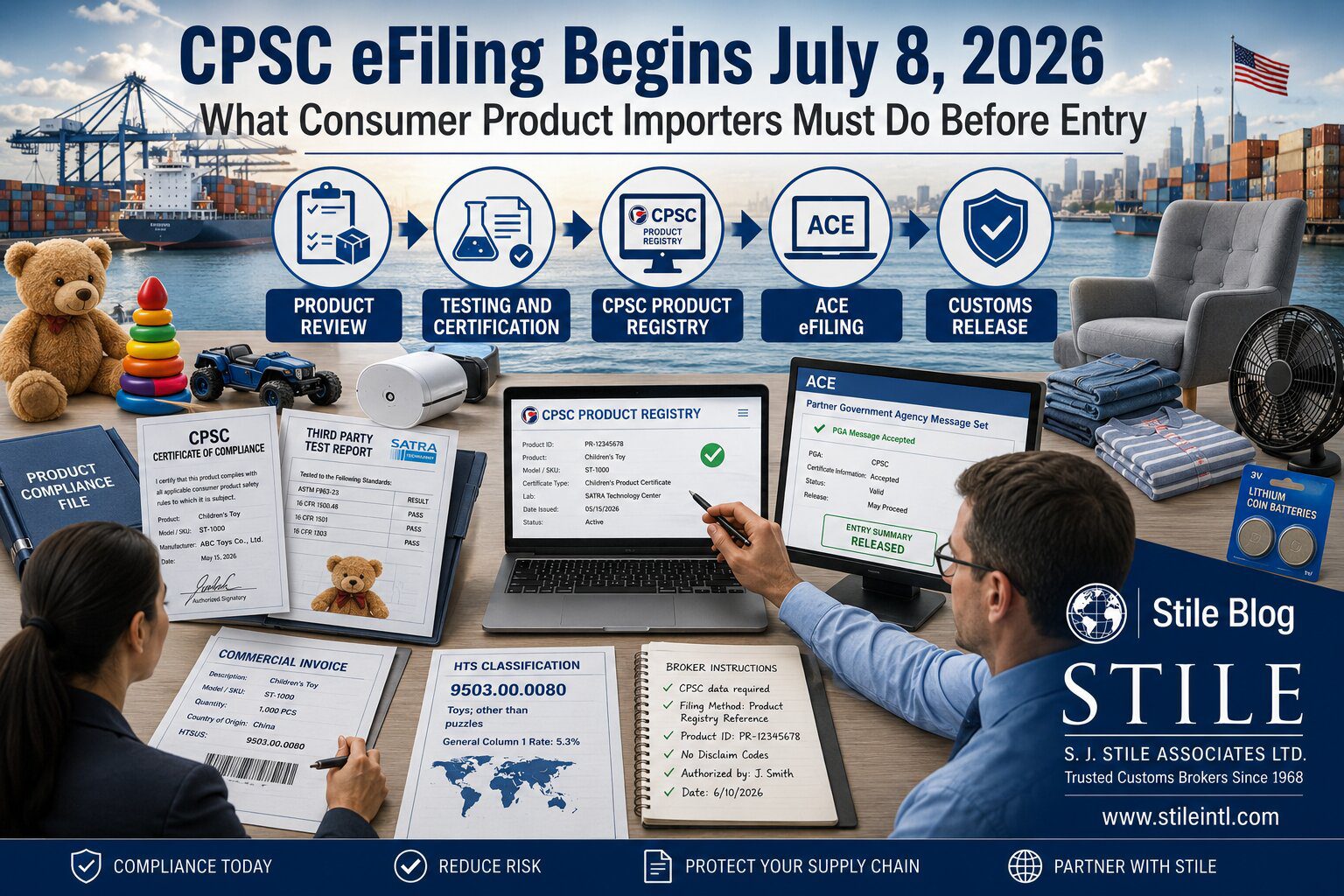
Beginning July 8, 2026, importers of many consumer products regulated by the U.S. Consumer Product Safety Commission will be required to electronically transmit Certificate of Compliance information through U.S. Customs and Border Protection’s Automated Commercial Environment.
This is not simply a new data field for customs brokers. It represents a significant change in how product safety certification information must be connected to an import entry.
Importers must determine whether their products are subject to a CPSC rule, ban, standard, or regulation. They must also determine whether certification is required, identify the applicable safety requirements, maintain valid testing support, prepare accurate certificate data, and make that information available for electronic transmission at entry.
A customs broker may transmit the CPSC Partner Government Agency data through ACE, but the importer remains responsible for the underlying product compliance determination and certificate information.
Companies that wait until cargo is already in transit may encounter missing certificates, inconsistent product identifiers, incomplete laboratory information, inaccurate disclaimers, rejected transmissions, or shipment delays.
Regulatory and Policy Context
The Consumer Product Safety Act requires manufacturers, including importers, and certain private labelers to certify that covered products comply with applicable consumer product safety requirements.
The CPSC final rule revises 16 CFR Part 1110 and implements electronic filing of Certificate of Compliance information for imported regulated consumer products. The rule applies to parties required to issue certificates for products or substances regulated by the CPSC that are imported for consumption or warehousing, or distributed in U.S. commerce.
For most covered imports, the electronic filing requirements apply beginning:
July 8, 2026
For covered products imported into a Foreign Trade Zone and subsequently entered for consumption or warehousing, the requirements apply beginning:
January 8, 2027
The September 2025 Federal Register correction clarified that the final rule becomes effective July 8, 2026, while preserving the separate applicability date for Foreign Trade Zone merchandise. The correction did not substantively change the compliance dates.
Products Potentially Affected
The rule can affect imported consumer products subject to CPSC administered safety requirements, including certain:
- Children’s products
- Toys
- Clothing and textiles
- Furniture
- Mattresses
- Household products
- Recreational products
- Electronic consumer products
- Products containing button cell or coin batteries
- General use products subject to a CPSC safety rule
- Products subject to bans, standards, labeling rules, or special packaging requirements
Not every consumer product requires a certificate. The applicability determination depends on the product, its intended use, applicable CPSC authority, age grading, materials, design, and regulatory coverage.
An HTS classification alone does not determine whether certification is required.
What CPSC and CBP Expect
1. The importer must determine whether certification is required
The importer should identify every CPSC rule, ban, standard, or regulation applicable to the finished product.
For general use products, certification may be supported by testing or a reasonable testing program. Children’s products generally require testing by a CPSC accepted third party laboratory, subject to the applicable statutory and regulatory requirements.
CPSC guidance explains that importers of covered general use products must issue a General Certificate of Conformity. The certificate must identify the product and cite each applicable consumer product safety rule.
2. Certificate information must correspond to the finished product
The final rule focuses on the finished product certificate and the party responsible for certifying the finished product.
A certificate should describe the product with enough specificity to connect the certification to that product and no other. Product identifiers used in the certificate, purchase order, commercial invoice, inventory system, Product Registry, and customs entry should be consistent.
A broad certificate covering materially different products may not provide sufficient support.
3. Certificate data must be available before entry filing
CPSC certificate information may be transmitted through the ACE Partner Government Agency Message Set.
CPSC identifies two principal filing methods:
- Full PGA Message Set
- The filer transmits the required Certificate of Compliance data through ACE as part of the entry process.
- Product Registry and Reference PGA Message Set
- Certificate data is entered in the CPSC Product Registry. The entry transmission then references the certificate information stored in the registry.
CPSC states that the filing may be completed by an importer or broker through ACE. The selected method should be established before the shipment arrives.
4. The importer must provide accurate filing instructions
The customs broker cannot independently determine all product safety requirements from an invoice description or HTS number.
Before transmission, importers should provide:
- The finished product identifier
- The applicable CPSC rule citations
- The certifying party
- The date and place of manufacture
- The date and place of testing
- The testing laboratory information, when applicable
- Contact information for the individual maintaining test records
- The Product Registry reference, when that filing method is used
- Written instructions concerning any applicable disclaim code
These instructions should be based on a documented product compliance review.
5. Disclaimers must be supported
A disclaimer may be appropriate when a product is not subject to a certification requirement. However, it should not be used merely because certificate data is unavailable.
CPSC’s January 2026 guidance identifies approximately 600 HTS codes that the agency believes are likely to include products subject to a mandatory standard or otherwise considered higher risk. CPSC expressly states that this list does not include every HTS code for which an electronic certificate may be required.
The agency also emphasizes that the importer remains responsible for filing a certificate whenever certification is required.
Therefore, the absence of an HTS code from the CPSC guidance list does not automatically establish that the product is outside CPSC jurisdiction.
Common Compliance Gaps
Treating eFiling as a broker only requirement
The broker may transmit the data, but the broker normally does not manufacture the product, select the materials, manage laboratory testing, or determine which safety rules apply.
The importer must control the compliance analysis and the supporting records.
Waiting until cargo arrives
Importers may discover at entry that they do not have the required laboratory report, certificate, product identifier, or regulatory citation.
Product compliance should be completed before shipment, preferably before the purchase order is finalized.
Relying only on the HTS number
The same HTS provision may include products with different designs, uses, age grades, or regulatory requirements.
CPSC coverage must be evaluated at the product level.documents produced in the ordinary course of business are important to applicability review submissions.
Using inconsistent product numbers
The model number on the laboratory report may not match the commercial invoice, certificate, purchase order, or customs entry.
Unexplained differences can make it difficult to establish that testing applies to the imported merchandise.
Using outdated test reports
A product may have changed since the original testing. Changes in materials, components, dimensions, suppliers, manufacturing facilities, or design may affect whether prior testing remains applicable.
Incomplete certificate information
A certificate may exist but omit required elements, contain incorrect rule citations, or fail to identify the relevant testing information.
A PDF labeled “certificate” is not automatically compliant.
Unsupported disclaim codes
An importer may instruct a broker to disclaim CPSC data without documenting why certification is not required.
An unsupported disclaimer can create enforcement and audit exposure.
Assuming suppliers are responsible
Foreign manufacturers and suppliers may provide test reports or technical information, but the U.S. importer may remain the party legally responsible for certification.
Commercial contracts do not eliminate federal importer obligations.
Failing to coordinate with the customs broker
Even when the importer has valid certificate information, the broker must receive it in a structured and usable format before entry transmission.
Practical Steps for Importers
Step 1. Create a complete product inventory
Develop a list of all imported consumer products, including:
- SKU
- Model number
- Product description
- Intended user
- Age grade
- Materials
- Country of origin
- Manufacturer
- Factory location
- HTS classification
- CPSC requirements
- Certificate type
- Testing status
- Product Registry status
The inventory should cover active merchandise and products expected to arrive after July 8, 2026.
Step 2. Map applicable CPSC requirements
For each product, determine whether it is subject to:
- A consumer product safety rule
- A children’s product requirement
- A flammability standard
- A lead or phthalates requirement
- A labeling requirement
- A product ban
- A special packaging requirement
- A button cell or coin battery requirement
- Another statute administered by the CPSC
The basis for the determination should be documented.
Step 3. Validate testing and certification records
Confirm that the certificate:
- Identifies the correct finished product
- Contains all required elements
- Cites the correct safety rules
- Is supported by appropriate testing
- Identifies the correct manufacturer and production location
- Reflects the current product design
- Can be connected to the imported SKU and model number
Importers should also verify whether the testing laboratory is properly recognized or accepted when third party testing is required.
Step 4. Select the filing method
Determine whether the company will use:
- The Full PGA Message Set, or
- The CPSC Product Registry with a reference filing
Companies with repeated imports of the same products may find the Product Registry useful, provided the certificate information is properly maintained.
Step 5. Establish Product Registry controls
Where the Product Registry is used, establish controls governing:
- Account ownership
- User access
- Product creation
- Certificate updates
- Product identifier standards
- Record review
- Changes to manufacturing or testing information
- Removal of obsolete certificate records
CPSC provides importer, broker, software developer, Product Registry, and implementation resources through its eFiling document library.
Step 6. Send test transactions to the customs broker
Importers should not assume their current customs entry process is ready.
Coordinate with the broker to confirm:
- Whether its ABI software supports the CPSC Message Set
- Which data format the broker requires
- How Product Registry references will be transmitted
- How disclaimers will be documented
- Who will resolve CPSC data errors
- How corrected information will be communicated
- Whether test entries can be completed before July 8
Step 7. Create written broker instructions
Develop a standard instruction record for each product or SKU. It should state:
- Whether CPSC data is required
- Which filing method applies
- Which certificate or Product Registry reference should be used
- Which disclaim code applies, when appropriate
- Who approved the determination
- When the determination was last reviewed
Step 8. Add supplier notification requirements
Purchase orders and supplier agreements should require timely delivery of:
- Test reports
- Product specifications
- Bills of materials
- Manufacturing location information
- Production dates
- Applicable warning labels
- Packaging information
- Certificates
- Notice of product or factory changes
Suppliers should be prohibited from making material product changes without notifying the importer.
Step 9. Establish an exception process
The company should have a defined procedure when:
- Certificate data is missing
- The product identifier does not match
- Testing is outdated
- The supplier changed the product
- The laboratory information is incomplete
- CPSC applicability is uncertain
- The entry receives an ACE error
- The shipment is selected for review
The procedure should identify who has authority to place the shipment on hold.
Step 10. Conduct a readiness review before July 8
Management should request a formal readiness report covering:
- Product population reviewed
- Products requiring certificates
- Products requiring additional testing
- Product Registry completion
- Broker testing status
- Missing documentation
- High risk suppliers
- Open classification questions
- Written procedures
- Employee training
Importer and Broker Responsibilities
The importer and customs broker have connected but separate responsibilities.
Importer responsibilities
The importer should:
- Determine whether the product is regulated
- Identify applicable safety requirements
- Obtain and maintain valid testing support
- Issue or control the appropriate certificate
- Provide accurate certificate data
- Approve filing instructions
- Maintain records
- Notify the broker of changes
Customs broker responsibilities
The customs broker should:
- Follow authorized importer instructions
- Transmit the required CPSC data through ACE
- Maintain appropriate entry and communication records
- Notify the importer of transmission errors or inconsistencies
- Avoid making unsupported product compliance assumptions
- Exercise responsible supervision and control over brokerage operations
The broker’s transmission does not replace the importer’s product safety compliance program.
Management Considerations
CPSC eFiling should be treated as a cross functional implementation, not solely as a customs department project.
The following groups may need to participate:
- Product compliance
- Customs compliance
- Purchasing
- Quality assurance
- Legal
- Information technology
- Logistics
- Finance
- Supplier management
- Customs brokerage providers
A certificate error can begin with product design, laboratory testing, supplier communication, master data, or purchase order controls long before the customs entry is filed.
Management should assign clear ownership and escalation authority.r review submissions and has published related importer resources.
How S. J. Stile Associates Can Help
S. J. Stile Associates Ltd. can work with importers to prepare their customs entry processes for CPSC eFiling.
Our role may include:
- Reviewing the importer’s CPSC filing instructions
- Coordinating ACE PGA data requirements
- Confirming the filing method to be used
- Supporting Product Registry reference transmissions
- Identifying missing or inconsistent entry data
- Testing ABI transmission workflows
- Establishing standardized communication procedures
- Documenting importer authorization and filing instructions
- Escalating CPSC transmission errors before cargo release is disrupted
Product testing, legal determinations, and certification responsibilities remain with the appropriate importer, manufacturer, laboratory, or qualified product safety professional. Our objective is to help ensure that approved compliance information is transmitted accurately and consistently through the customs entry process.
Frequently Asked Questions
When does CPSC eFiling become mandatory?
For most covered imported consumer products, the requirements apply beginning July 8, 2026.
For covered products imported into a Foreign Trade Zone and subsequently entered for consumption or warehousing, the requirements apply beginning January 8, 2027.
Does every imported consumer product require a certificate?
No. Certification is required when a product is subject to a CPSC rule, ban, standard, or regulation that carries a certification requirement.
Each product must be reviewed individually.
Is the customs broker responsible for creating the certificate?
Generally, no. The broker may transmit certificate data, but the importer or other legally responsible certifying party must determine the applicable requirements and provide accurate information.
Can an importer continue using paper or PDF certificates?
The underlying certificate may be maintained electronically or in another compliant form, but imported products subject to the rule will also require electronic submission of certificate information through ACE.
Merely sending a PDF certificate to a customs broker does not necessarily satisfy the eFiling transmission requirement.
What is the CPSC Product Registry?
The Product Registry is a CPSC system where certificate information can be stored. At entry, the filer may transmit a reference to previously registered certificate data instead of transmitting the complete certificate data set each time.
Is use of the Product Registry mandatory?
CPSC identifies both a Full PGA Message Set filing method and a Product Registry reference method. Importers should select the method that fits their product volume, systems, and compliance controls.
Can the importer use an HTS list to determine whether eFiling applies?
The HTS list can assist with screening, but it is not conclusive. CPSC states that its approximately 600 code guidance list does not encompass every HTS code for which an electronic certificate may be required.
The importer remains responsible for the final determination.
What happens when a product does not require certification?
An appropriate disclaimer may be transmitted when permitted. The importer should document the legal and factual basis for the disclaimer and provide clear instructions to the broker.
Can one certificate cover several products?
A certificate must identify the product clearly enough to establish what it covers. Materially different finished products may require separate certificates.
Importers should avoid certificates that are so broad that the tested or certified product cannot be matched to the imported merchandise.
What should an importer do when a product changes?
The importer should determine whether the change affects regulatory coverage, testing, certification, or Product Registry information.
Changes in materials, design, dimensions, components, suppliers, factories, or intended users should trigger a compliance review.
Should importers test their filing process before July 8?
Yes. Importers should coordinate with their customs broker and software providers before the applicability date. Testing can identify missing fields, unsupported software configurations, inconsistent identifiers, and communication problems before a live shipment is affected.
Conclusion
The July 8, 2026 CPSC eFiling requirement changes how importers must connect product safety compliance to customs entry processing.
Successful implementation depends on more than software. It requires accurate product determinations, valid testing, complete certificates, consistent product identifiers, controlled Product Registry information, written broker instructions, and reliable communication among importers, suppliers, laboratories, software providers, and customs brokers.
Importers should complete their product reviews and broker coordination before affected merchandise reaches a U.S. port.
References
CPSC, eFiling Frequently Asked Questions
https://www.cpsc.gov/FAQ/eFiling-Frequently-Asked-Questions-FAQ
Covers certificate requirements, testing information, exclusions, implementation, and the July 8, 2026 compliance date.
Federal Register, Certificates of Compliance, Final Rule
https://www.federalregister.gov/documents/2025/01/08/2024-30826/certificates-of-compliance
Contains the final amendments to 16 CFR Part 1110 and the electronic filing requirements.
CPSC, Main eFiling Program Page
https://www.cpsc.gov/eFiling
Provides separate resources for importers, customs brokers, and software developers.
CPSC, eFiling Document Library
https://www.cpsc.gov/eFiling-Document-Library
Includes implementation guides, webinars, technical documents, Product Registry guidance, and filing instructions.
CPSC, eFiling Resources for Importers
https://www.cpsc.gov/efiling/importers
Includes the Quick Start Guide, Product Registry Guide, citation codes, HTS flagging list, and CATAIR materials.
CPSC, eFiling Resources for Customs Brokers
https://www.cpsc.gov/efiling/brokers
Provides filing resources specifically intended for brokers transmitting CPSC data through ACE.
CPSC, Guidance and HTS List for Electronic Filing of Certificates, PDF
https://www.cpsc.gov/s3fs-public/CPSC-Guidance-and-HTS-List-for-Filing-of-Electronic-Certificates-6B-Cleared.pdf
Provides CPSC guidance concerning HTS flagging and emphasizes that the importer remains responsible for determining when certification is required.
CPSC, eFiling Quick Start Guide, PDF
https://www.cpsc.gov/s3fs-public/eFiling_Quick_Start_Guide_V1-1.pdf
Provides a practical implementation overview for businesses preparing for mandatory eFiling.
CPSC Product Registry
https://www.cpsc.gov/eFiling-CPSC-Product-Registry
Explains how importers can store certificate information for use with the Reference PGA Message Set.
CPSC, Product Registry User Guide, PDF
https://www.cpsc.gov/s3fs-public/eFiling_Product_Registry_User_Guide_V3.pdf
Provides instructions for managing certificate information in the CPSC Product Registry.
CPSC, General Certificate of Conformity Guidance
https://www.cpsc.gov/Business–Manufacturing/Testing-Certification/General-Certificate-of-Conformity
Explains GCC requirements for applicable general use consumer products.
CPSC, Children’s Product Certificate FAQ
https://www.cpsc.gov/FAQ/CPC
Explains testing and certification requirements for children’s products.
CPSC, Certificates of Compliance and eFiling Effective Dates
https://www.cpsc.gov/Business–Manufacturing/Business-Education/Business-Guidance/Certificates
Confirms the following dates:
- General imported products, July 8, 2026
- Domestically manufactured products, July 8, 2026
- Covered merchandise entered from a Foreign Trade Zone, January 8, 2027
The Stile Associates Advantage
- More than 55 years of continuous industry experience
- Family leadership with modern trade vision
- Licensed Customs Brokers and compliance professionals
- CTPAT certified supply chain security
- Full service customs and logistics solutions
- Technology driven visibility and control
- Dedicated, personalized client service
- Nationwide U.S. coverage with global support
Choosing S.J. Stile Associates means partnering with a customs broker that understands the realities of today’s trade environment and is fully invested in protecting your business.
Contact S.J. Stile Associates today to learn how we can strengthen your compliance posture and streamline your supply chain.


We’re not just a broker; we’re your strategic compliance partner.
Since 1968, our clients have trusted us to:
- Navigate regulatory shocks
- Deliver personal service from our NYC, Miami, and LA offices
- Build resilient import strategies that drive growth
In this new trade era, trust is everything , and that’s why importers stay with Stile for years.

Call to Action
At Stile Associates, we combine over 55 years of experience with the latest technology to keep your imports compliant and efficient.
Contact us today to explore how AI-driven solutions can optimize your customs operations.


📣 Final Call to Action:
Ready to take control of your shipping costs?
Let’s talk. Contact Stile Associates for a free consultation and let our experts audit your current process, to help you streamline your operations, stay compliant, and save money.

💼 Choose Stile, Your Smartest Move in Global Trade
Whether you’re shipping across the country or across continents, Stile Associates is your strategic partner for building a smarter, more resilient supply chain.
📍 Since 1968, we’ve been delivering peace of mind and performance. Let’s take your logistics to the next level together.
🌐 Visit us at www.stileintl.com
📩 Or contact: stevenheid@stileintl.com
Stile Associates – Trusted. Proven. Personal.
Stile Real Time Cargo Tracking with Global Visibility.

