

1. Introduction
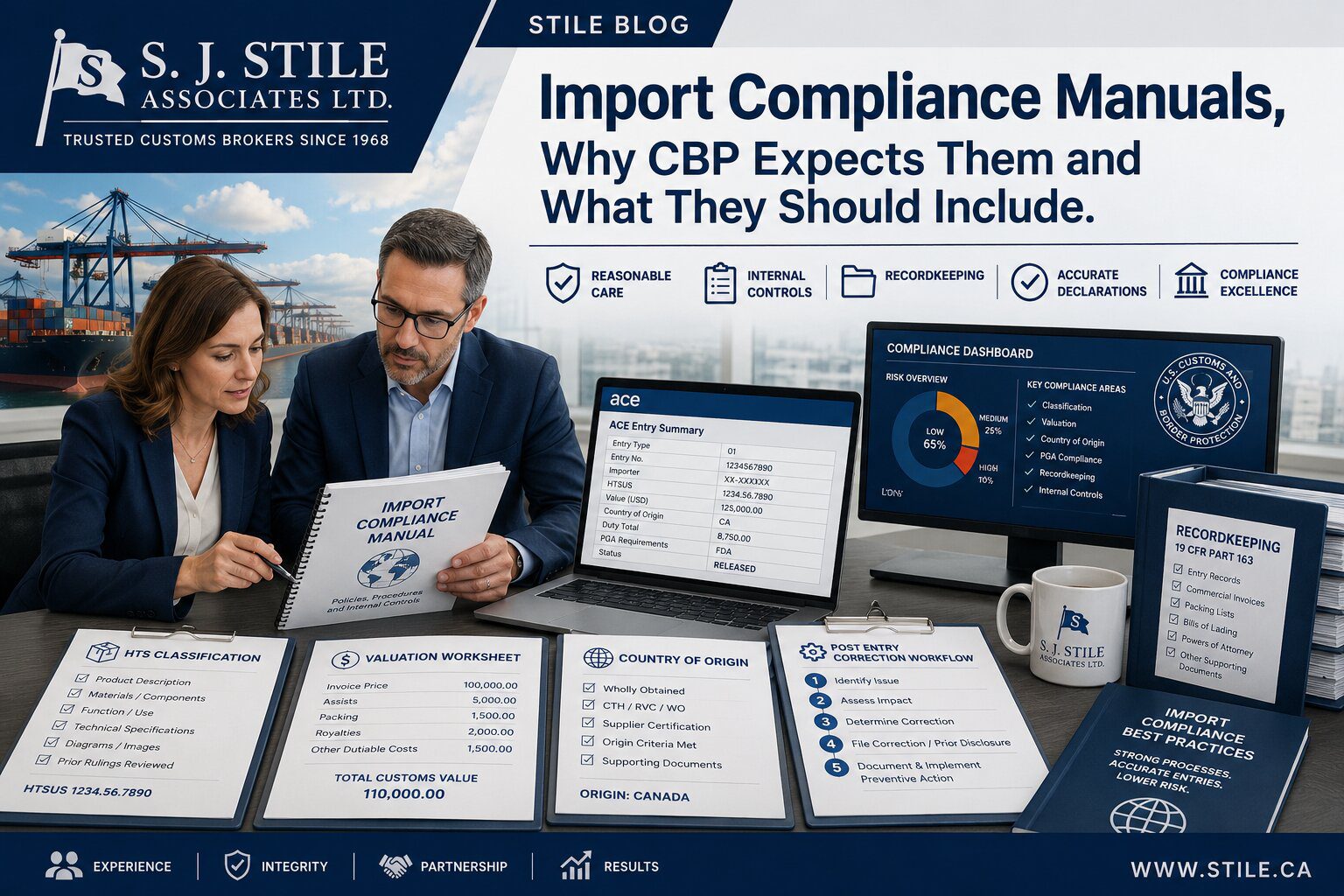
An import compliance manual is not just an internal binder or shared folder. It is the importer’s written operating system for customs compliance.
CBP expects importers to exercise reasonable care when entering merchandise into the United States. That responsibility includes providing accurate information for release, classification, valuation, country of origin, admissibility, duty payment, and required documentation. The importer of record remains responsible even when a licensed customs broker prepares and files the entry on its behalf. Under 19 U.S.C. 1484, entry documentation or information may be filed by the owner, purchaser, or a properly designated licensed customs broker, but the importer’s compliance obligation remains central to the process.
A well written import compliance manual helps prove that the company has a controlled process. It shows who is responsible, what documents are required, how decisions are made, how errors are corrected, and how records are retained. For importers, this can reduce operational disruption, improve broker communication, and support a stronger compliance position if CBP asks questions.
2. Regulatory and Policy Context
CBP’s compliance framework is built around reasonable care, recordkeeping, internal controls, and the accuracy of customs declarations.
CBP’s Reasonable Care guidance explains that importers are expected to know what they import, understand classification, valuation, origin, marking, admissibility, and other import requirements, and seek assistance when needed. CBP’s Informed Compliance Publications provide public guidance on major import compliance topics, including reasonable care, recordkeeping, tariff classification, valuation, and rules of origin.
Recordkeeping is also a legal requirement. 19 CFR Part 163 sets out the rules for maintaining, producing, inspecting, and examining customs records. The regulation states that persons covered by the rule must be prepared to produce entry records demanded by CBP, including records normally kept in the ordinary course of business.
CBP’s audit approach also emphasizes internal controls. CBP describes a Focused Assessment as a comprehensive audit involving an assessment of the importer’s internal control over import activities.
This is why an import compliance manual matters. CBP may not use the exact phrase “every importer must have a manual” as a universal standalone requirement, but CBP clearly expects importers to have reliable procedures, responsible personnel, records, controls, and correction processes. A written manual is one of the most practical ways to organize and demonstrate those controls.
3. What CBP Expects Importers to Control
An effective import compliance manual should explain how the importer manages the core areas that affect entry accuracy and admissibility.
3.1 Importer of Record Responsibility
The manual should identify who within the company is responsible for import compliance. This should include management oversight, operational contacts, accounting contacts, purchasing contacts, product classification contacts, and the person authorized to work with the customs broker.
The manual should also explain the company’s process for granting, reviewing, and updating customs powers of attorney.
3.2 HTS Classification
CBP expects importers to use reasonable care when classifying merchandise. The manual should include:
- Who determines HTS codes.
- What product information is required.
- How technical specifications are collected.
- When legal review or binding ruling support is needed.
- How classification decisions are documented.
- How classification changes are communicated to the broker.
Classification should not be based only on supplier descriptions or prior entries without review. Product changes, material changes, component changes, and use changes can affect classification.
3.3 Customs Valuation
The manual should explain how the company determines customs value. This includes invoice price, assists, royalties, packing costs, proceeds, related party issues, and deductions where applicable.
A common compliance weakness is treating the commercial invoice as the full customs value without reviewing whether additional dutiable costs exist.
3.4 Country of Origin and Marking
The manual should explain how country of origin is determined, who reviews origin claims, and how marking requirements are verified before shipment.
This is especially important when products involve multiple countries, foreign processing, assembly operations, or preferential trade claims.
3.5 Partner Government Agency Requirements
Many imports require review by agencies other than CBP, including FDA, USDA, EPA, DOT, FCC, CPSC, or other regulators depending on the product.
The manual should identify which product lines may trigger agency requirements and what documentation must be provided before shipment.
3.6 Recordkeeping
The manual should explain where customs records are stored, who has access, how long they are retained, and how the company responds to CBP requests.
Under 19 CFR Part 163, covered parties must maintain and produce customs records when required. CBP’s recordkeeping rules also include an appendix listing records commonly required for entries, such as entry documentation, invoices, packing lists, bills of lading, bond information, powers of attorney, and other supporting records.
3.7 Broker Communication
A customs broker can only file accurately when the importer provides accurate, complete, and timely information.
The manual should define:
- What documents must be sent to the broker.
- Who is authorized to approve entries.
- How the importer communicates classification, value, origin, and PGA instructions.
- How discrepancies are escalated.
- How entry summaries are reviewed after filing.
This protects both the importer and the broker.
4. What an Import Compliance Manual Should Include
A strong manual should be practical, not theoretical. It should match the importer’s actual business model, product lines, suppliers, and internal staffing.
4.1 Company Import Compliance Policy
This section should state the company’s commitment to accurate customs declarations, reasonable care, recordkeeping, and timely correction of errors.
4.2 Roles and Responsibilities
Include a responsibility matrix showing who handles:
- Product classification.
- Supplier documentation.
- Commercial invoice review.
- Customs valuation.
- Origin review.
- PGA documentation.
- Broker communication.
- Entry summary review.
- Record retention.
- Post entry corrections.
4.3 Product Master Data Controls
The manual should describe how product data is created, reviewed, approved, and updated. This includes item numbers, descriptions, HTS codes, origin, manufacturer, value components, duty rates, and PGA indicators.
4.4 Classification Procedure
Include a step by step classification procedure. The procedure should require product descriptions, materials, function, technical specifications, images, catalogs, and prior ruling review where appropriate.
4.5 Valuation Procedure
This section should explain how customs value is reviewed beyond the invoice. It should address assists, tooling, molds, engineering work, royalties, license fees, packing, rebates, related party transactions, and currency issues.
4.6 Origin and Marking Procedure
The manual should explain how origin is determined, how marking is checked, and how supplier certifications are reviewed.
4.7 Free Trade Agreement and Preference Claim Procedure
If the company claims preferential duty treatment, the manual should explain how certificates or supporting documents are obtained, reviewed, stored, and renewed.
The manual should also state that preference claims should not be made only because a supplier says the product qualifies. The importer should maintain support for the claim.
4.8 PGA Compliance Procedure
Identify regulated products and required documentation. Examples may include FDA product codes, USDA permits, FCC declarations, EPA statements, DOT compliance documents, or other agency specific records.
4.9 Entry Review Procedure
The manual should require review of entry summaries for high risk fields, including importer number, HTS code, value, quantity, origin, manufacturer, duty rate, special tariff programs, antidumping and countervailing duty indicators, and PGA declarations.
4.10 Post Entry Correction Procedure
The manual should explain how the company identifies and corrects entry errors before liquidation when possible. It should also explain escalation for liquidation, protests, prior disclosures, or legal review when needed.
4.11 Recordkeeping Procedure
The manual should identify the company’s record retention location, format, backup process, access controls, and response procedure for CBP requests.
4.12 Training Procedure
The manual should require periodic training for employees involved in purchasing, logistics, compliance, accounting, product development, and receiving.
4.13 Internal Audit Procedure
The manual should include periodic testing of entries. This can include sampling entries to verify classification, value, origin, invoices, packing lists, PGA data, and broker instructions.
4.14 Corrective Action Procedure
When errors are found, the company should document:
- What happened.
- Which entries were affected.
- Root cause.
- Duty impact.
- Correction method.
- Preventive action.
- Responsible person.
- Completion date.
5. Common Compliance Gaps
Many importers have informal knowledge but no written process. That creates risk when employees leave, suppliers change, product lines expand, or CBP asks for support.
Common gaps include:
- No written classification procedure.
- HTS codes assigned by suppliers without importer review.
- Product master data not updated after product changes.
- No process to identify assists, royalties, or related party valuation issues.
- No documented origin review.
- Preference claims made without adequate support.
- PGA requirements discovered only after cargo arrival.
- Entry summaries not reviewed after filing.
- Customs records stored across email inboxes without a retention system.
- No written process for post entry corrections.
- No periodic internal audit.
- No documented training for staff involved in import activity.
These gaps can create delayed cargo, additional duty exposure, penalties, broker delays, audit issues, and poor visibility for finance teams.
6. Practical Steps for Importers
Importers should treat the compliance manual as a living control document. It should be reviewed and updated when laws change, suppliers change, products change, internal systems change, or CBP identifies an issue.
Recommended Action Plan
- Create a product compliance profile
- List all imported products, HTS codes, origins, suppliers, manufacturers, PGA flags, duty rates, and special tariff indicators.
- Map the import process
- Document every step from purchase order to entry filing and record retention.
- Assign ownership
- Identify who owns classification, valuation, origin, broker instructions, and entry review.
- Standardize broker instructions
- Give the broker complete written instructions, not only invoices and packing lists.
- Review high risk entries
- Focus on high value shipments, new products, new suppliers, related party transactions, preference claims, and regulated products.
- Create a correction process
- Make sure employees know how to escalate errors before liquidation whenever possible.
- Test the process
- Perform periodic internal reviews and keep evidence of the review.
- Train employees
- Purchasing, logistics, finance, and product teams should understand how their work affects customs compliance.
7. How S. J. Stile Associates Can Help
S. J. Stile Associates Ltd. helps importers strengthen entry accuracy through professional customs brokerage support, document review, entry processing, cargo coordination, and practical compliance communication.
A broker cannot replace the importer’s responsibility for reasonable care, but a knowledgeable broker can help importers identify missing information, flag inconsistencies, improve documentation flow, and reduce preventable entry errors.
For importers building or updating an import compliance manual, Stile can help align operational workflows with customs entry requirements by supporting:
- Entry documentation review.
- HTS and invoice communication workflows.
- Broker instruction procedures.
- PGA documentation coordination.
- Entry summary review practices.
- Post entry issue escalation.
- Recordkeeping process improvement.
The goal is not to create paperwork for its own sake. The goal is to build a repeatable import process that supports compliance, cargo movement, and duty accuracy.
8. FAQs
1. Is an import compliance manual legally required?
CBP does not impose one universal rule saying every importer must maintain a document titled “Import Compliance Manual.” However, importers are legally responsible for reasonable care, accurate entry information, and recordkeeping. A written manual is one of the clearest ways to organize and demonstrate those controls.
2. Who should own the import compliance manual?
Ownership should usually sit with compliance, logistics, trade compliance, or finance leadership. However, purchasing, accounting, product development, and warehouse teams should be included because their information affects classification, valuation, origin, and admissibility.
3. Should small importers have a manual?
Yes. A small importer may not need a complex manual, but it should still have written procedures for broker communication, classification support, invoice review, origin, recordkeeping, and correction of errors.
4. How often should the manual be updated?
At least annually, and whenever there are material changes in products, suppliers, countries of origin, tariff programs, internal systems, or CBP requirements.
5. Should the customs broker write the manual?
The importer should own the manual because the importer owns the compliance responsibility. A customs broker can help identify practical entry requirements and documentation workflows, but the company’s internal procedures must reflect how the importer actually operates.
6. What is the biggest mistake importers make?
The biggest mistake is assuming that sending invoices to the broker is enough. The broker also needs accurate classification support, valuation details, origin information, PGA documents, and instructions for special tariff programs or special duty exposure.
7. Can a compliance manual reduce penalties?
A manual alone does not guarantee penalty protection. However, a current, followed, and documented compliance process can help show that the importer had controls in place and acted responsibly. Under 19 U.S.C. 1592, penalties may apply for material false statements, omissions, or acts caused by fraud, gross negligence, or negligence.
9. References
- U.S. Customs and Border Protection, Reasonable Care, Informed Compliance Publication.
- U.S. Customs and Border Protection, Informed Compliance Publications.
- 19 U.S.C. 1484, Entry of Merchandise, U.S. Code, Office of the Law Revision Counsel.
- 19 CFR Part 163, Recordkeeping, eCFR.
- 19 CFR 163.3, Entry Records, eCFR.
- Appendix to 19 CFR Part 163, Interim (a)(1)(A) List, eCFR.
- CBP, Focused Assessment Program.
- 19 U.S.C. 1592, Penalties for Fraud, Gross Negligence, and Negligence, U.S. Code, Office of the Law Revision Counsel.
- 19 CFR Part 111, Customs Brokers, eCFR.
The Stile Associates Advantage
- More than 55 years of continuous industry experience
- Family leadership with modern trade vision
- Licensed Customs Brokers and compliance professionals
- CTPAT certified supply chain security
- Full service customs and logistics solutions
- Technology driven visibility and control
- Dedicated, personalized client service
- Nationwide U.S. coverage with global support
Choosing S.J. Stile Associates means partnering with a customs broker that understands the realities of today’s trade environment and is fully invested in protecting your business.
Contact S.J. Stile Associates today to learn how we can strengthen your compliance posture and streamline your supply chain.


We’re not just a broker; we’re your strategic compliance partner.
Since 1968, our clients have trusted us to:
- Navigate regulatory shocks
- Deliver personal service from our NYC, Miami, and LA offices
- Build resilient import strategies that drive growth
In this new trade era, trust is everything , and that’s why importers stay with Stile for years.

Call to Action
At Stile Associates, we combine over 55 years of experience with the latest technology to keep your imports compliant and efficient.
Contact us today to explore how AI-driven solutions can optimize your customs operations.


📣 Final Call to Action:
Ready to take control of your shipping costs?
Let’s talk. Contact Stile Associates for a free consultation and let our experts audit your current process, to help you streamline your operations, stay compliant, and save money.

💼 Choose Stile, Your Smartest Move in Global Trade
Whether you’re shipping across the country or across continents, Stile Associates is your strategic partner for building a smarter, more resilient supply chain.
📍 Since 1968, we’ve been delivering peace of mind and performance. Let’s take your logistics to the next level together.
🌐 Visit us at www.stileintl.com
📩 Or contact: stevenheid@stileintl.com
Stile Associates – Trusted. Proven. Personal.
Stile Real Time Cargo Tracking with Global Visibility.

