

1. Introduction
A common question from importers is simple but important:
Can we correct the HTS code on an entry after the merchandise has already been picked up?
In many cases, the answer is yes. The fact that the cargo has been released or picked up does not automatically prevent correction. The more important compliance question is whether the entry summary has already liquidated.
HTS classification drives duty rates, Section 301 duties, antidumping or countervailing duty exposure, PGA requirements, admissibility flags, and statistical reporting. A wrong HTS code can create duty underpayment, overpayment, CBP inquiry risk, or future audit exposure.
For importers, the issue is not only how to fix one entry. The larger question is whether the company has a reliable process to detect classification errors, correct them timely, document the reason for the correction, and prevent the same error from repeating.
2. Regulatory and Policy Context
2.1 Release of merchandise is not the end of the entry process
When imported merchandise is released, the importer may physically receive the goods, but the customs entry process may still be open. CBP’s entry summary process continues after release, and entry summary information may be subject to review and correction before liquidation.
CBP describes a Post Summary Correction, commonly called a PSC, as a mechanism that allows the trade to electronically correct entry summary data that was already presented to and accepted by CBP through ACE.
2.2 Liquidation is the key dividing line
Liquidation is a critical concept in customs compliance. Under 19 CFR Part 159, liquidation means the final computation or ascertainment of duties on entries for consumption or drawback entries.
In practical terms, liquidation is the point where CBP finalizes the duty calculation for the entry, unless further legal remedies apply.
2.3 After liquidation, protest is generally the correction path
CBP states that the options available depend on the liquidation status of the entry summary, and that once liquidation has occurred, the available option for relief is generally a protest.
CBP’s ACE Protest FAQ explains that a 514 protest may be filed within 180 days after liquidation under 19 U.S.C. 1514(c)(3).
3. What Importers Need to Understand
The importer should not ask only, “Was the merchandise picked up?”
The importer should ask:
- Was the entry summary already filed?
- Was the entry summary accepted in ACE?
- Has the entry liquidated?
- Did the HTS error cause underpaid duty or overpaid duty?
- Does the new HTS code affect PGA requirements, special tariffs, quota, AD/CVD, or admissibility?
- Do we have documentation supporting the corrected classification?
The correction method depends on the answer.
| Situation | Likely Correction Method | Compliance Note |
| Merchandise released, entry not liquidated | Post Summary Correction | Usually the normal path before liquidation |
| Entry liquidated, within protest period | CBP states PEAs cannot be filed in ACE | Protest |
| Entry liquidated, protest period expired | Limited options | Requires careful review |
| HTS correction increases duty | PSC or protest, depending on status | Importer should act promptly |
| HTS correction produces refund | PSC before liquidation, protest after liquidation | Current practical method for many ACE correctionsMust support the claim |
| HTS correction affects PGA data | Additional review needed | May require agency specific correction handling |
4. What CBP Expects
CBP expects importers to use reasonable care when classifying merchandise. That means importers should not rely only on short commercial descriptions such as “parts,” “accessories,” “kits,” or “samples.” HTS classification usually requires technical facts about the merchandise.
A correction should be supported by records. CBP’s recordkeeping regulations in 19 CFR Part 163 set forth requirements and procedures for maintaining, producing, inspecting, and examining customs records.
For an HTS correction, importers should maintain documents such as:
| Record | Why it Matters |
| Commercial Invoice | Supports product description, value, and seller information |
| Packing List | Support quantity and shipment structure |
| Product Specification Sheet | Support Material, function, and use |
| Images or Catalog pages | Helps validate product identity |
 Prior Classification History Prior Classification History | Shows whether the issue is isolated or recurring |
| HTS classification analysis | Explain why the corrected HTS is appropiate |
| Duty impact worksheet | Shows whether additional duty or refund is involved |
| Broker Communication | Documents instructions and correction timing |
| Binding ruling, if available | Strong support when applicable |
CBP regulations also provide that persons required to maintain customs records must render those records for examination and inspection by Customs.
5. Common Compliance Gaps
5.1 Assuming pickup means the entry is final
This is one of the most common misunderstandings. Cargo release means the goods can move, but it does not necessarily mean the entry is final. The liquidation status controls the correction path.
5.2 Waiting too long to review classification
If the importer discovers the HTS error after liquidation, the correction process becomes more formal and time sensitive. If the protest period is missed, relief may become much more difficult.
5.3 Correcting the HTS without supporting analysis
A correction should not be made casually. CBP may ask why the new classification is correct. Importers should be ready to explain the legal and factual basis.
5.4 Ignoring duty impact
A changed HTS code may affect:
- Normal duty
- Section 301 duties
- Section 232 duties
- AD/CVD exposure
- Quota
- PGA flags
- Special program eligibility
- Country of origin marking issues
5.5 Treating the issue as only a broker problem
The customs broker can transmit the correction, but the importer is usually the party with the product knowledge. The importer should provide accurate descriptions, specifications, composition, intended use, and supporting documentation.
5.6 Failing to identify repeat errors
If one entry has the wrong HTS code, prior entries may also be affected. Importers should review whether the same product was imported under the same incorrect classification in previous shipments.
6. Practical Steps for Importers
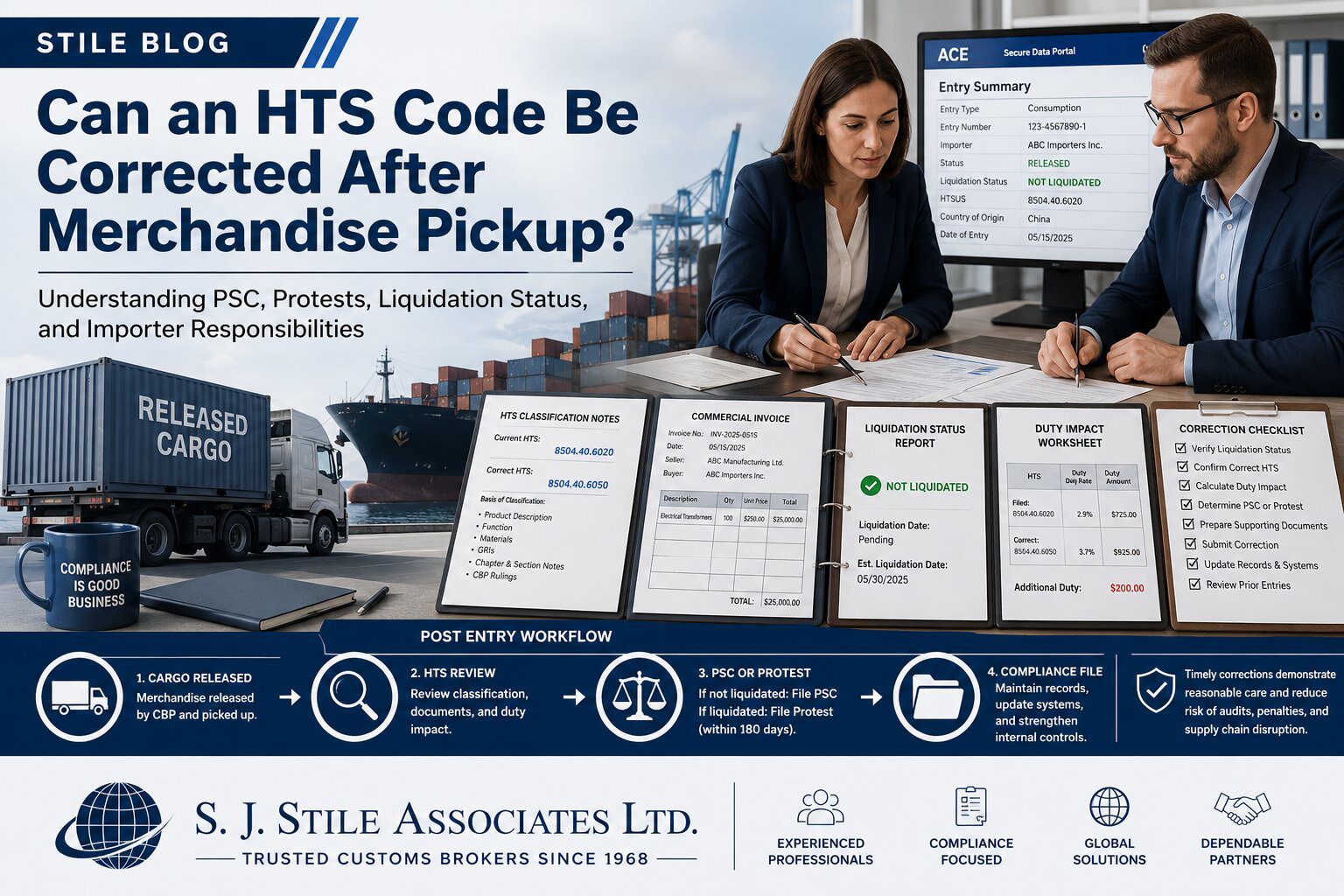
Step 1. Check liquidation status
Before deciding how to correct the entry, confirm whether the entry has liquidated. This can usually be checked through ACE data, broker records, or liquidation reports.
Step 2. Confirm the correct HTS code
Do not change the code based only on a guess. Review:
- Product description
- Material composition
- Principal function
- Intended use
- Technical specifications
- General Rules of Interpretation
- Section and chapter notes
- Relevant CBP rulings, if applicable
Step 3. Determine duty impact
Compare the original HTS code with the corrected HTS code. Identify whether the correction creates:
- Additional duty owed
- Duty refund
- No duty difference
- PGA impact
- Special tariff impact
Step 4. Choose the correct correction method
If the entry is not liquidated, the correction may generally be handled through PSC. If the entry has liquidated, a protest may be required.
CBP’s PSC guidance confirms that PSC is used to electronically correct entry summary data previously accepted by CBP through ACE.
CBP’s protest guidance explains that after liquidation, the relief option is generally protest, depending on the entry status.
Step 5. Maintain a correction file
Each correction should have a record file containing the reason for the correction, the supporting documents, the duty impact, and internal approval.
Step 6. Review prior entries
If the same product was imported before, the importer should evaluate whether prior entries have the same error. This is especially important where the correction results in underpaid duty.
Step 7. Strengthen internal controls
Classification corrections should feed back into the importer’s master database, product catalog, purchasing system, broker instruction sheets, and compliance procedures.
7. Broker Responsibility and Importer Responsibility
A customs broker plays an important operational role in filing entries, transmitting corrections, and advising on process. However, HTS classification depends heavily on product facts that are usually controlled by the importer.
The importer should provide:
- Complete product descriptions
- Technical specifications
- Composition details
- End use information
- Drawings, photos, or catalogs
- Prior rulings or classification history
- Confirmation of whether the item is subject to PGA requirements
The broker should help review the correction path, prepare the transmission when appropriate, and maintain a clear record of the importer’s instructions.
8. When the HTS Correction Increases Duty
If the corrected HTS code results in additional duty owed, the issue should be handled carefully. Prompt correction may reduce future exposure and demonstrate responsible compliance behavior.
The importer should evaluate whether the error was isolated or systemic. If the same incorrect HTS code was used repeatedly, the company may need a broader review of prior entries and potential disclosure obligations.
Importers should consult customs compliance professionals or customs counsel when the facts suggest recurring underpayment, negligence concerns, or potential 19 U.S.C. 1592 exposure.
9. When the HTS Correction Creates a Refund
If the corrected HTS code results in lower duty, the importer may seek correction before liquidation through PSC, or after liquidation through protest if timely and legally supported.
However, refund claims should be documented. CBP may review the classification basis, product facts, and supporting records.
10. How S. J. Stile Associates Can Help
S. J. Stile Associates Ltd. assists importers with practical post entry compliance support, including:
- Reviewing entry status and liquidation timing
- Evaluating whether PSC or protest is the correct path
- Coordinating HTS correction documentation
- Reviewing product descriptions and classification support
- Helping calculate duty impact
- Assisting with broker correction workflows
- Supporting importer recordkeeping and internal controls
- Helping identify recurring classification issues across prior shipments
Our role is to help importers correct issues accurately, timely, and with proper documentation.
11. Key Takeaway
Yes, an HTS code can often be corrected after merchandise has already been picked up.
The real question is:
Has the entry liquidated?
If the entry has not liquidated, a Post Summary Correction may be available. If the entry has liquidated, a protest may be required, generally within the applicable protest period.
Importers should act quickly, document the classification basis, calculate duty impact, and correct internal records to prevent repeat errors.
FAQs
1. Can an HTS code be corrected after cargo release?
Yes. Cargo release or pickup does not automatically prevent correction. The key issue is whether the entry has liquidated.
2. What is the usual method before liquidation?
The usual method is a Post Summary Correction, known as PSC, filed through ACE when available and appropriate.
3. What happens if the entry has already liquidated?
After liquidation, the correction path is generally a protest, if the protest is timely and supported.
4. How long does an importer have to file a protest?
CBP’s ACE Protest FAQ states that a 514 protest may be filed within 180 days after liquidation under 19 U.S.C. 1514(c)(3).
5. Can the broker correct the HTS code without importer support?
The broker may help transmit the correction, but the importer should provide product facts and supporting documentation. Classification depends on accurate product information.
6. What if the correction increases duty?
The importer should act promptly, calculate the duty impact, and review whether the same issue affected prior entries. If the issue is recurring or significant, additional compliance review may be necessary.
7. What if the correction results in a refund?
A refund may be pursued through PSC before liquidation or protest after liquidation, depending on timing and legal support.
8. Does a wrong HTS code affect more than duty?
Yes. HTS classification can affect PGA requirements, special tariffs, AD/CVD exposure, quotas, admissibility, and statistical reporting.
9. Should prior entries be reviewed?
Yes. If the same product was imported under the wrong HTS code, prior entries may need review.
10. What records should be kept?
Importers should keep invoices, packing lists, product specifications, classification analysis, duty calculations, broker instructions, and any CBP rulings or supporting records.
References
- U.S. Customs and Border Protection, Post Summary Corrections
- https://www.cbp.gov/trade/programs-administration/entry-summary/post-summary-correction
- U.S. Customs and Border Protection, Protests
- https://www.cbp.gov/trade/programs-administration/entry-summary/protests
- U.S. Customs and Border Protection, ACE Protest Frequently Asked Questions
- https://www.cbp.gov/trade/programs-administration/entry-summary/protests/ace-protest-frequently-asked-questions
- eCFR, 19 CFR Part 159, Liquidation of Duties
- https://www.ecfr.gov/current/title-19/chapter-I/part-159
- eCFR, 19 CFR Part 174, Protests
- https://www.ecfr.gov/current/title-19/chapter-I/part-174
- eCFR, 19 CFR Part 163, Recordkeeping
- https://www.ecfr.gov/current/title-19/chapter-I/part-163
- eCFR, 19 CFR Part 111, Customs Brokers
- https://www.ecfr.gov/current/title-19/chapter-I/part-111
The Stile Associates Advantage
- More than 55 years of continuous industry experience
- Family leadership with modern trade vision
- Licensed Customs Brokers and compliance professionals
- CTPAT certified supply chain security
- Full service customs and logistics solutions
- Technology driven visibility and control
- Dedicated, personalized client service
- Nationwide U.S. coverage with global support
Choosing S.J. Stile Associates means partnering with a customs broker that understands the realities of today’s trade environment and is fully invested in protecting your business.
Contact S.J. Stile Associates today to learn how we can strengthen your compliance posture and streamline your supply chain.


We’re not just a broker; we’re your strategic compliance partner.
Since 1968, our clients have trusted us to:
- Navigate regulatory shocks
- Deliver personal service from our NYC, Miami, and LA offices
- Build resilient import strategies that drive growth
In this new trade era, trust is everything , and that’s why importers stay with Stile for years.

Call to Action
At Stile Associates, we combine over 55 years of experience with the latest technology to keep your imports compliant and efficient.
Contact us today to explore how AI-driven solutions can optimize your customs operations.


📣 Final Call to Action:
Ready to take control of your shipping costs?
Let’s talk. Contact Stile Associates for a free consultation and let our experts audit your current process, to help you streamline your operations, stay compliant, and save money.

💼 Choose Stile, Your Smartest Move in Global Trade
Whether you’re shipping across the country or across continents, Stile Associates is your strategic partner for building a smarter, more resilient supply chain.
📍 Since 1968, we’ve been delivering peace of mind and performance. Let’s take your logistics to the next level together.
🌐 Visit us at www.stileintl.com
📩 Or contact: stevenheid@stileintl.com
Stile Associates – Trusted. Proven. Personal.
Stile Real Time Cargo Tracking with Global Visibility.

