

1. Introduction
Import entries do not always remain perfect after filing. Importers may later discover that the tariff classification, entered value, country of origin, quantity, duty program claim, manufacturer information, or invoice data was incomplete or incorrect. When that happens before liquidation, the importer and customs broker must determine the correct correction path.
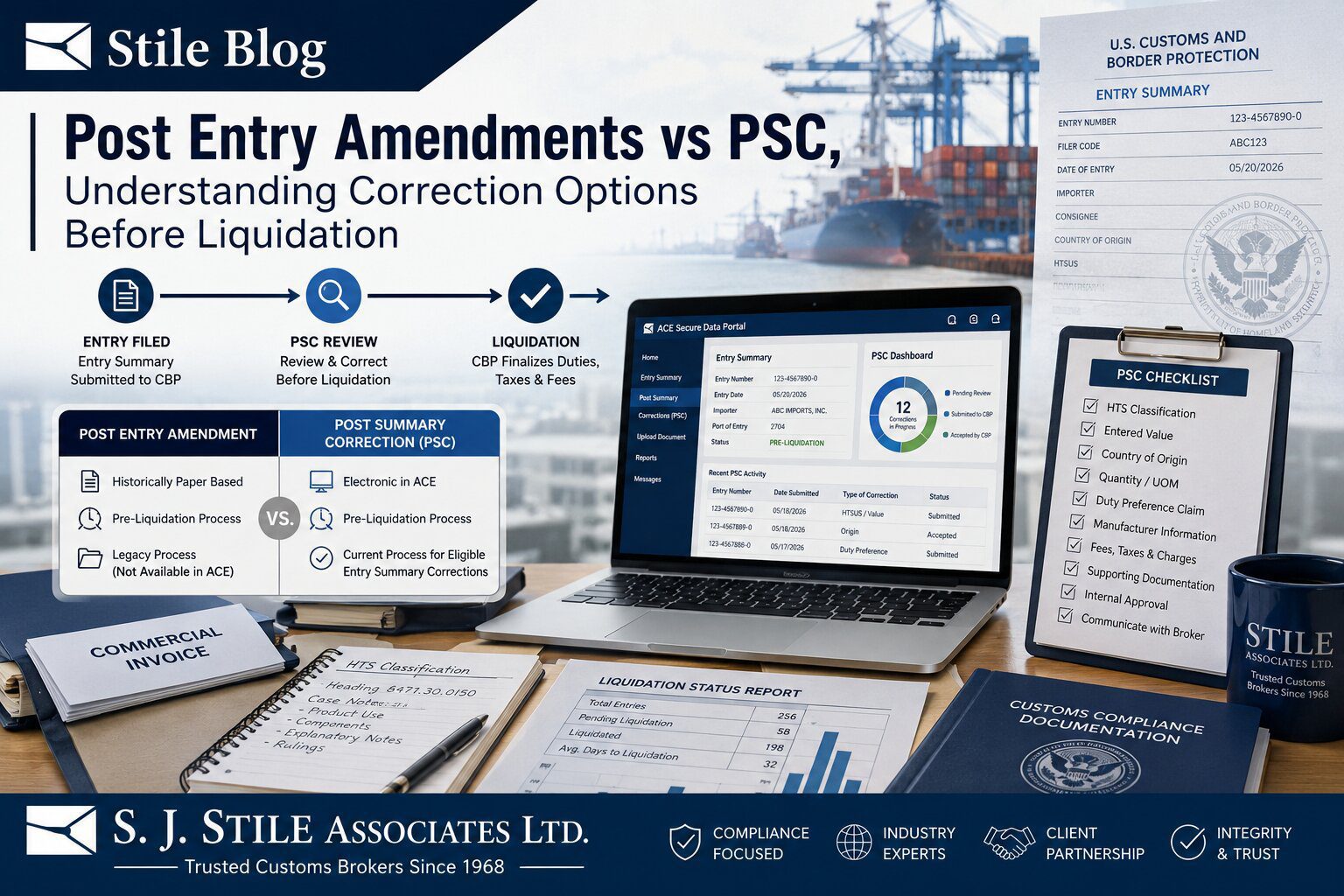
Two terms are often confused, Post Entry Amendment, commonly called PEA, and Post Summary Correction, commonly called PSC. In practical customs operations, the distinction matters because CBP’s modern ACE environment uses PSC as the electronic mechanism for correcting many entry summary issues before liquidation. CBP states that PEAs cannot be filed in ACE and that the electronic PSC process replaces the paper PEA process in ACE.
For importers, the risk is straightforward. If an error is not corrected timely, the entry may liquidate with incorrect duty, taxes, fees, classification, value, or admissibility related data. Once liquidation occurs, the correction options narrow, and the importer may need to use the protest process, which is subject to statutory timing requirements. CBP explains that a protest may be filed within 180 days after liquidation.
2. Regulatory and Policy Context
2.1 What Is Liquidation?
Liquidation is the point at which CBP finalizes the duty, tax, and fee assessment on an entry. Before liquidation, certain entry summary data may still be corrected through CBP accepted mechanisms. After liquidation, the importer generally moves into post liquidation remedies, most commonly protest.
This timing is important because the importer’s correction strategy should be driven by the status of the entry, the type of error, and the available CBP process.
2.2 What Is a Post Summary Correction?
CBP describes a PSC as an electronic correction to entry summary data that has already been presented to and accepted by CBP through ACE.
The PSC process is designed to correct entry summary information before liquidation. This may include corrections related to tariff classification, value, country of origin, quantity, duty preference claims, certain revenue related changes, and other entry summary data, subject to CBP rules, system validations, and entry eligibility.
2.3 What Was a Post Entry Amendment?
A Post Entry Amendment was historically a paper based method used to amend entry summaries before liquidation. CBP’s ACE guidance states that PEAs cannot be filed in ACE, and that PSC replaced the paper PEA process in ACE.
In other words, in modern ACE operations, importers and brokers should generally think in terms of PSC for eligible pre liquidation corrections, not paper PEA.
2.4 Post Liquidation Remedy, Protest
When an entry has already liquidated, the correction question changes. CBP explains that an importer, broker, or attorney may contest CBP decisions relating to imported merchandise by filing a protest within 180 days of liquidation.
This is why monitoring liquidation status is a core internal control. A correction discovered before liquidation may be handled differently than the same correction discovered after liquidation. not be added to the price actually paid or payable, while molds supplied free of charge to a foreign producer may be a required addition to transaction value.
3. Post Entry Amendment vs PSC, Practical Difference
| Issue | Post Entry Amendment | Post Summary Correction |
| Format | Historically paper based | Electronic through ACE |
 Current ACE use Current ACE use | CBP states PEAs cannot be filed in ACE | Used in ACE for eligible entry summary corrections |
| Timing | Pre liquidation historical process | Pre liquidation correction process |
| Operational workflow | Manual paper submission | Broker or filer transmits correction electronically |
| Compliance importance | Legacy terminology still used by some importers | Current practical method for many ACE corrections |
The key compliance point is this: many importers still say “PEA” when they really mean a pre liquidation correction. In the ACE environment, the practical question is usually whether the entry is eligible for a PSC.
4. What CBP Expects Importers to Understand
CBP expects importers to exercise reasonable care over entry information. That includes reviewing the accuracy of data provided to the customs broker and correcting known errors through the appropriate process.
Importers should understand that a PSC is not simply a clerical convenience. It is a compliance control. It creates a corrected entry summary record in ACE and may affect duties, fees, admissibility data, partner government agency data, or audit exposure.
CBP’s entry summary guidance also confirms that entry documents must be filed within 15 calendar days of shipment arrival, and that entry summary filing is a central post release process. This reinforces the need for importers to review entry data quickly, because correction windows are tied to entry processing and liquidation timing.
5. Common Situations That May Require a PSC
A PSC may be considered when the importer or broker identifies an error before liquidation, including:
- Incorrect HTS classification
The product was entered under the wrong tariff provision, resulting in incorrect duty or incorrect trade remedy application. - Incorrect entered value
The invoice value, assist, royalty, tooling cost, freight component, or deduction was omitted or incorrectly reported. - Incorrect country of origin
The entry reflects the wrong origin, affecting marking, duty rate, trade remedies, or special program eligibility. - Incorrect quantity or unit of measure
The reported quantity does not match invoice, packing list, or HTS reporting unit requirements. - Incorrect duty preference claim
A free trade agreement or special tariff program claim was omitted, overstated, or unsupported. - Incorrect manufacturer or supplier data
The entry contains incorrect party information that may affect admissibility, forced labor screening, or audit traceability. - Incorrect fees or taxes
Merchandise Processing Fee, Harbor Maintenance Fee, excise tax, or other entry related charges may require correction.
6. When a PSC May Not Be the Right Tool
A PSC is not always the correct remedy. Importers should evaluate the facts carefully before assuming that an entry can be corrected electronically.
A PSC may not be appropriate when:
- The entry has already liquidated
Once liquidation occurs, the importer generally must evaluate protest or another applicable post liquidation remedy. - The correction is outside PSC eligibility
Certain entry types, timing issues, or system limitations may prevent PSC filing. - The issue involves a separate statutory refund process
Some preference or post importation claims may have their own procedures. CBP has stated in certain contexts that specific post importation preference claims should be processed without requiring a PEA, PSC, or protest. - The issue requires CBP direction or enforcement handling
If the correction involves potential negligence, material false statements, or systemic errors, the importer should evaluate whether a prior disclosure or other compliance action is appropriate.
7. Common Compliance Gaps
7.1 Treating PSC as a Casual Administrative Fix
A PSC changes official entry summary data. Importers should not treat it as a simple clerical note. It should be supported by documentation, internal approval, and a clear explanation of the correction.
7.2 Waiting Too Long to Review Entries
Many companies review customs entries only after monthly accounting close, duty payment, or a CBP inquiry. This delay can reduce correction options. Importers should review high risk entries before liquidation.
7.3 No Written Decision Record
When an importer decides not to file a PSC, that decision should be documented. CBP reviews often focus not only on whether an error occurred, but also on whether the importer had a reasonable process to identify, analyze, and correct errors.
7.4 Weak Broker Communication
The broker files based on data received from the importer. If classification, value, origin, or invoice corrections are discovered internally but not promptly communicated to the broker, the entry may liquidate incorrectly.
7.5 No Liquidation Monitoring
Without liquidation monitoring, importers may miss the window to correct before liquidation. After liquidation, the importer may need to file a protest within the applicable deadline. CBP identifies the protest period as 180 days after liquidation.
8. Practical Steps for Importers
8.1 Build a Pre Liquidation Review Process
Importers should identify high risk entries for review before liquidation. These may include entries involving:
- New products
- New suppliers
- High duty rates
- Section 301, antidumping, countervailing, or other trade remedy exposure
- Related party transactions
- Assists, royalties, or tooling
- Free trade agreement claims
- FDA, USDA, EPA, or other partner government agency issues
8.2 Create a Correction Decision Matrix
A practical matrix should ask:
| Question | Compliance Purpose |
| Has the entry liquidated? | Determines whether PSC or protest may apply |
| Is the correction revenue related? | Identifies duty, tax, fee, and interest exposure |
| Is the correction supported by documents? | Confirms audit defensibility |
| Does the issue affect multiple entries? | Identifies systemic exposure |
| Does the issue indicate a potential violation? | Determines whether escalation is needed |
| Is a prior disclosure analysis required? | Reduces penalty exposure when appropriate |
8.3 Maintain a PSC File
Each PSC file should include:
- Original entry summary
- Corrected entry summary data
- Commercial invoice and packing list
- Classification support
- Valuation support
- Origin support
- Internal approval
- Broker communication
- Explanation of the error and correction
- Evidence of transmission or CBP acceptance
8.4 Escalate Repeated Errors
If the same correction appears across multiple entries, importers should treat it as a compliance signal. Repeated corrections may indicate weaknesses in product master data, vendor onboarding, classification controls, invoice review, or broker instructions.
8.5 Coordinate with Finance
PSC filings can affect duty expense, landed cost, accruals, refunds, and accounts payable reconciliations. CFOs and finance teams should understand that customs corrections may change entry level cost data after importation.
9. Broker Responsibility and Importer Responsibility
The customs broker plays an important role in preparing and transmitting corrections, but the importer remains responsible for the accuracy of information supplied to CBP.
The importer should provide complete, accurate, and timely data. The broker should help evaluate the correct filing mechanism, prepare the correction, transmit it where appropriate, and maintain a professional record of the correction.
A strong importer and broker relationship should include:
- Clear written instructions
- Defined escalation procedures
- Regular entry review reports
- Liquidation monitoring
- Documentation requests before filing corrections
- Periodic compliance reviews
10. How S. J. Stile Associates Can Help
S. J. Stile Associates Ltd. assists importers with customs brokerage, entry review, correction workflows, liquidation monitoring, and compliance documentation. Our team can help identify whether a correction should be addressed before liquidation through PSC, or whether the importer should evaluate post liquidation remedies such as protest.
We also help importers strengthen internal controls by reviewing recurring entry issues, broker instructions, product classification data, valuation support, origin documentation, and entry summary reporting. This practical support helps reduce duty errors, prevent avoidable delays, and improve audit readiness.
11. FAQs
What is the main difference between PEA and PSC?
PEA was historically a paper based post entry amendment process. PSC is the modern electronic ACE process for eligible entry summary corrections before liquidation. CBP states that PEAs cannot be filed in ACE and that PSC replaced the paper PEA process in ACE.
Can a PSC be filed after liquidation?
A PSC is generally a pre liquidation correction mechanism. Once an entry liquidates, the importer should evaluate whether a protest or another post liquidation remedy is available.
How long does an importer have to protest after liquidation?
CBP states that a protest may be filed within 180 days after liquidation of the entry being protested.
Should every entry error be corrected through PSC?
No. The correct remedy depends on the entry status, the type of error, the timing, the legal basis for the correction, and CBP system eligibility. Some issues may require protest, prior disclosure analysis, reconciliation, or another specific process.
Who should decide whether to file a PSC?
The decision should involve the importer, customs broker, and, when needed, customs counsel or a compliance advisor. Finance may also need to be involved when the correction affects duty expense, refunds, accruals, or landed cost.
What documents should support a PSC?
The importer should maintain the original entry summary, corrected data, invoices, classification support, valuation records, origin documents, broker instructions, internal approval, and a written explanation of the correction.
Why is liquidation monitoring important?
Liquidation monitoring helps importers identify entries that must be reviewed before correction options narrow. Missing liquidation deadlines can convert a pre liquidation correction issue into a post liquidation protest issue.
12. References
- U.S. Customs and Border Protection, Post Summary Corrections.
- U.S. Customs and Border Protection, ACE Frequently Asked Questions, including CBP guidance that PEAs cannot be filed in ACE and PSC replaces the paper PEA process in ACE.
- U.S. Customs and Border Protection, Entry Summary and Post Release Processes.
- U.S. Customs and Border Protection, Protests.
- U.S. Customs and Border Protection, ACE Protest Frequently Asked Questions.
- Electronic Code of Federal Regulations, 19 CFR Part 173, Administrative Review in General.
The Stile Associates Advantage
- More than 55 years of continuous industry experience
- Family leadership with modern trade vision
- Licensed Customs Brokers and compliance professionals
- CTPAT certified supply chain security
- Full service customs and logistics solutions
- Technology driven visibility and control
- Dedicated, personalized client service
- Nationwide U.S. coverage with global support
Choosing S.J. Stile Associates means partnering with a customs broker that understands the realities of today’s trade environment and is fully invested in protecting your business.
Contact S.J. Stile Associates today to learn how we can strengthen your compliance posture and streamline your supply chain.


We’re not just a broker; we’re your strategic compliance partner.
Since 1968, our clients have trusted us to:
- Navigate regulatory shocks
- Deliver personal service from our NYC, Miami, and LA offices
- Build resilient import strategies that drive growth
In this new trade era, trust is everything , and that’s why importers stay with Stile for years.

Call to Action
At Stile Associates, we combine over 55 years of experience with the latest technology to keep your imports compliant and efficient.
Contact us today to explore how AI-driven solutions can optimize your customs operations.


📣 Final Call to Action:
Ready to take control of your shipping costs?
Let’s talk. Contact Stile Associates for a free consultation and let our experts audit your current process, to help you streamline your operations, stay compliant, and save money.

💼 Choose Stile, Your Smartest Move in Global Trade
Whether you’re shipping across the country or across continents, Stile Associates is your strategic partner for building a smarter, more resilient supply chain.
📍 Since 1968, we’ve been delivering peace of mind and performance. Let’s take your logistics to the next level together.
🌐 Visit us at www.stileintl.com
📩 Or contact: stevenheid@stileintl.com
Stile Associates – Trusted. Proven. Personal.
Stile Real Time Cargo Tracking with Global Visibility.

