

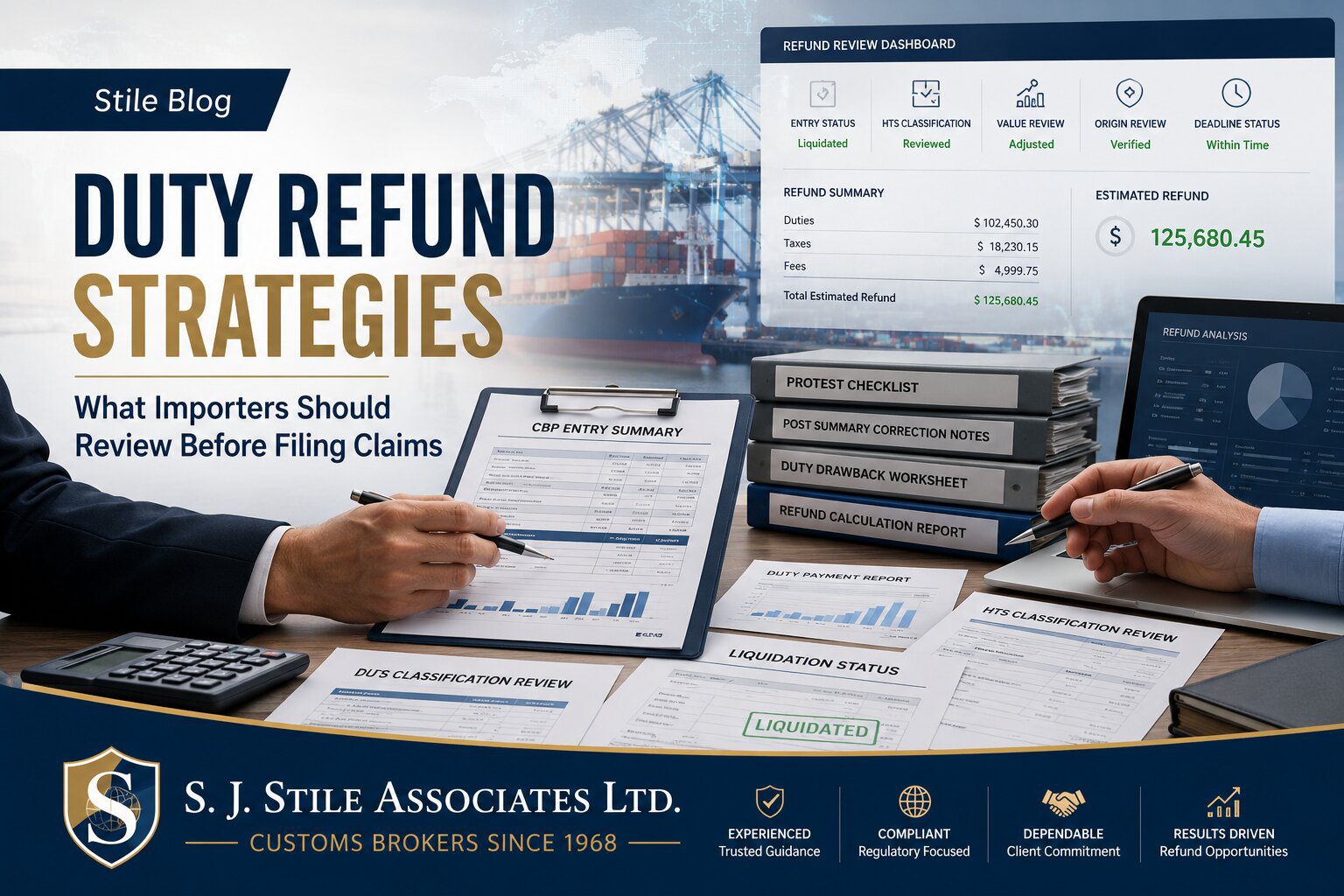
What Importers Should Review Before Filing Claims
For many importers, duty refunds are not just a financial opportunity. They are also a compliance exercise. Before filing a refund claim, an importer should review the entry history, liquidation status, supporting documents, product classification, valuation, origin, special tariff programs, and the correct filing path.
A refund claim filed too quickly, without a proper review, can create delays, denials, or even raise compliance questions. A well-prepared claim, however, can help recover overpaid duties while strengthening the importer’s compliance file.
Why Duty Refunds Matter
Importers may overpay duties for several reasons. A product may have been classified under the wrong HTS code. The declared value may have included non-dutiable charges. The goods may qualify for a free trade agreement or duty preference program. Merchandise may have been exported, rejected, destroyed, or returned. In other cases, special tariffs may have been applied incorrectly or later challenged.
CBP provides different mechanisms for correcting entries and requesting refunds, including Post Summary Corrections before liquidation, protests after liquidation, and duty drawback for certain exported or destroyed merchandise. CBP also describes drawback as the refund of certain duties, taxes, and fees collected on imported merchandise when the legal requirements are met.
The key is knowing which refund path applies before filing.
1. Review the Entry Status First
Before reviewing dollar amounts, importers should first determine the status of the entry.
The most important question is whether the entry has liquidated. Liquidation is CBP’s final calculation of duties, taxes, and fees. If the entry has not yet liquidated, the importer may be able to correct the entry through a Post Summary Correction, commonly called a PSC. CBP states that a PSC requires the entry summary to be in accepted status, not under CBP review, and still within CBP control.
If the entry has already liquidated, the importer generally needs to consider a protest. CBP explains that protests are generally filed on CBP Form 19.
This first step matters because the wrong filing method can cost time and may place the importer at risk of missing a deadline.
2. Confirm the Reason for the Refund
A duty refund claim should never be based only on the idea that “duties seem too high.” The importer should identify the specific legal or transactional reason for the refund.
Common refund reasons include:
| Refund Reason | What to Review |
| Incorrect HTS classification | Product description, material composition, technical specifications, prior rulings, supplier data |
| Incorrect value | Assists, royalties, freight, insurance, discounts, related-party pricing, non-dutiable charges |
| Incorrect country of origin | Manufacturing process, substantial transformation, origin certificates, supplier declarations |
| Free trade agreement eligibility | Rules of origin, certificates, supporting production records |
| Returned, rejected, exported, or destroyed goods | Export records, destruction proof, rejection documents, inventory tracking |
| Special tariff issue | Goods may be routed through third countries to avoid tariffsSection 301, AD/CVD, IEEPA, safeguard duties, exclusions, refunds, or court-related updates |
| Clerical or entry error | Commercial invoice, packing list, entry summary, broker instructions |
The stronger the reason, the stronger the claim.
3. Match the Claim to the Correct Refund Mechanism
Not every refund is filed the same way. Importers should match the issue to the correct customs process.
Post Summary Correction
A PSC is generally used before liquidation to correct certain entry summary data. It can be useful when the importer discovers an error while the entry is still open. CBP’s PSC guidance confirms that the entry must meet certain status conditions, including being accepted, not under CBP review, and within CBP control.
Protest
A protest is generally used after liquidation when the importer disagrees with CBP’s decision or needs to challenge the final duty assessment. CBP identifies protests as a formal process generally filed using CBP Form 19.
Duty Drawback
Duty drawback is different from a correction or protest. It applies when imported merchandise, or substituted merchandise in certain cases, is later exported or destroyed under qualifying conditions. CBP describes drawback as a refund of certain duties, internal revenue taxes, and fees collected upon importation and refunded when merchandise meets the applicable requirements.
Common drawback categories include unused merchandise, manufacturing drawback, and rejected merchandise drawback.
Prior Disclosure Considerations
If the review reveals not only an overpayment but also broader compliance errors, the importer should be careful. A refund review may uncover underpayments, incorrect classifications, valuation issues, or repeated entry problems. CBP’s reasonable care guidance reminds importers that they are responsible for using reasonable care when providing entry information.
In some cases, legal counsel may recommend evaluating whether a prior disclosure is appropriate before or alongside corrective action.
4. Review the HTS Classification
HTS classification is one of the most common areas where refunds may be found. A small classification change can produce a major duty difference, especially when special tariffs apply.
Importers should review:
- Product composition
- Principal use
- Technical specifications
- Catalogs and product literature
- Supplier descriptions
- Prior CBP rulings
- Chapter notes and section notes
- Whether special tariff numbers were properly applied
For example, two products may look similar commercially but classify differently under the HTS because of material, function, construction, or use. A refund claim based on classification should be supported by a clear classification analysis, not only by a preferred lower duty rate.
5. Review Declared Value
Value errors can also create refund opportunities. Importers should confirm whether the entered value included items that should not have been dutiable.
Possible value review areas include:
- International freight
- Insurance
- Post-importation charges
- Discounts
- Buying commissions
- Assists
- Royalties
- Related-party pricing
- Currency conversions
- Invoice revisions or credits
A refund claim based on value must be supported by commercial documents, accounting records, and a clear explanation of why the original value was incorrect.
6. Review Country of Origin
Country of origin affects duty rates, admissibility, marking, trade remedies, and special tariffs. An importer should review origin carefully before filing a refund claim.
This is especially important when goods involve multiple countries, such as fabric from one country, cutting in another, assembly in another, and finishing in another. For textiles, apparel, electronics, machinery, and other multi-stage products, origin analysis can be complex.
Before filing, importers should collect:
- Manufacturer declarations
- Production flow charts
- Bills of material
- Country of origin certificates
- Cutting, sewing, assembly, or transformation records
- Supplier affidavits
- Purchase orders and invoices
A weak origin file can place the refund claim at risk.
7. Review Special Tariffs, Exclusions, and Temporary Measures
Special tariffs can create significant refund opportunities, but they also require careful review. Importers should confirm whether any additional duties were correctly applied and whether exclusions, refunds, court decisions, or administrative programs affect the entries.
In 2026, CBP issued guidance related to IEEPA refund processing and CAPE declarations, including instructions for certain entries and protest-related situations. This shows why importers should monitor current CBP instructions before filing refund claims connected to special tariffs.
Because special tariff programs change over time, importers should avoid assuming that the same strategy applies to every entry.
8. Confirm the Deadline
Deadlines are critical. A valid refund opportunity can be lost if the importer misses the filing window.
Importers should review:
- Entry date
- Summary date
- Scheduled liquidation date
- Actual liquidation date
- Protest deadline
- Drawback filing deadline
- Any extension or suspension status
- Whether the entry is under CBP review
A refund strategy should begin with a deadline report. Entries closest to deadline should be prioritized first.
9. Build the Refund File Before Filing
A refund claim should be supported by a complete file. CBP may ask questions, reject incomplete claims, or request additional documentation.
A strong refund file may include:
- CBP Form 7501 entry summary
- Commercial invoice
- Packing list
- Bill of lading or airway bill
- Arrival notice
- Proof of duty payment
- HTS classification analysis
- Product specifications
- Country of origin support
- Valuation support
- Export records, if drawback applies
- Destruction records, if applicable
- Supplier certifications
- Internal approval notes
- Broker communication
- Calculation worksheet showing the refund amount
The file should tell a complete story. What was entered, what was wrong, why it was wrong, what the correct treatment should be, and how the refund amount was calculated.
10. Review for Risk Before Filing
A refund claim can invite review. That does not mean importers should avoid legitimate refunds, but it does mean they should file carefully.
Before submitting, ask:
- Is the claim legally supportable?
- Are there similar entries with the same issue?
- Could the review uncover underpaid duties on other entries?
- Is the documentation complete?
- Is the importer prepared to explain the position to CBP?
- Should counsel review the claim?
- Does the correction affect PGA requirements, AD/CVD, quota, or marking?
- Does the claim create a need for broader compliance review?
The goal is not only to recover money. The goal is to recover money properly.
Practical Example
An importer brings in apparel and pays additional duties based on the HTS code used at entry. Later, the importer discovers that the garment was classified under a general provision, but the actual fabric composition and construction support a different classification with a lower duty rate.
Before filing a refund claim, the importer should review:
- The entry status
- The liquidation date
- The original HTS code
- The proposed HTS code
- Fabric content
- Manufacturing details
- Supplier specifications
- Commercial invoice descriptions
- Whether any special tariffs were affected
- Whether other similar entries exist
- The refund amount by entry
If the entry is unliquidated, a PSC may be the correct path. If the entry is liquidated, a protest may be required. If the goods were exported or destroyed, drawback may also need to be reviewed.
What Stile Can Do
S. J. Stile Associates Ltd. helps importers review entry data, identify possible refund opportunities, organize supporting documentation, and determine which customs process may apply.
Stile can assist with:
- Entry review
- HTS classification review
- Liquidation status review
- PSC coordination
- Protest support coordination
- Drawback opportunity review
- Duty impact analysis
- Documentation checklists
- Broker file review
- Communication with importers, suppliers, and compliance teams
A refund strategy should not begin with a claim. It should begin with a review.
Final Thought
Duty refunds can represent meaningful savings, but they must be handled with discipline. Importers should not file claims based only on assumptions, verbal supplier statements, or incomplete records.
The best approach is simple: review the entry, confirm the legal basis, verify the deadline, organize the documentation, calculate the refund, and select the correct filing path.
A well-prepared refund claim protects both the importer’s money and the importer’s compliance record.
How S. J. Stile Associates Helps Importers Prepare
S. J. Stile Associates Ltd., Trusted Customs Brokers Since 1968, helps importers navigate the increasingly complex U.S. customs environment.
In an enforcement climate focused on importer identity, documentation, duty accuracy, and supply chain transparency, importers need more than basic entry filing. They need a customs partner that understands how CBP thinks, what documentation matters, and where risk can appear before cargo is delayed.
S. J. Stile Associates supports importers with:
- Customs brokerage.
- Entry preparation.
- Import documentation review.
- HTS classification support.
- Country of origin review.
- Valuation guidance.
- Customs compliance coordination.
- FDA, USDA, FWS, FCC, EPA, DOT, and other agency coordination when applicable.
- Cargo tracking and communication.
- Practical guidance for importers facing increased scrutiny.
With offices in New York, Miami, and Los Angeles, S. J. Stile Associates helps importers manage shipments through key U.S. gateways while maintaining a strong focus on compliance, communication, and customer service.t some low-value shipments were being used to avoid duties or evade trade enforcement measures.
FAQ Section
Duty Refund Strategies, What Importers Should Review Before Filing Claims
1. Can importers get a refund on duties already paid?
Yes. Importers may be able to recover duties if the original entry contained an error or if the merchandise qualifies under a refund mechanism such as a Post Summary Correction, protest, or duty drawback. The correct option depends on the entry status, reason for the refund, and applicable deadlines.
2. What is the first thing an importer should review before filing a refund claim?
The importer should first review the entry status, especially whether the entry has already liquidated. If the entry has not liquidated, a Post Summary Correction may be possible. If the entry has liquidated, a protest may be required.
3. What does liquidation mean?
Liquidation is CBP’s final calculation of duties, taxes, and fees for an entry. Once an entry liquidates, the importer generally has limited time to challenge or correct the final duty decision.
4. What is a Post Summary Correction?
A Post Summary Correction, or PSC, is used to correct certain entry summary information before liquidation. It may be used for issues such as classification, value, origin, or other entry data, as long as the entry is still eligible for correction.
5. What is a customs protest?
A customs protest is a formal request asking CBP to review a decision after liquidation. It is commonly used when an importer believes duties were overpaid because of an incorrect classification, valuation, origin decision, or other customs issue.
6. What is duty drawback?
Duty drawback is a refund of certain duties, taxes, and fees paid on imported merchandise that is later exported, destroyed, rejected, or used in qualifying manufacturing operations. Drawback is different from correcting an entry error.
7. What are the most common reasons for duty refund claims?
Common reasons include:
- Incorrect HTS classification
- Incorrect declared value
- Incorrect country of origin
- Free trade agreement eligibility
- Returned or rejected merchandise
- Exported or destroyed goods
- Incorrect application of special tariffs
- Clerical or entry transmission errors
8. Can an HTS code correction result in a duty refund?
Yes. If the original HTS code had a higher duty rate and a proper review supports a different classification with a lower rate, the importer may be able to request a refund. The claim should be supported by product specifications, composition details, and a clear classification analysis.
9. Can freight or insurance charges cause duty overpayment?
Yes, in some cases. Importers should review whether non-dutiable charges were included in the entered value. This may include certain international freight, insurance, or post-importation charges, depending on how the transaction was structured and documented.
10. Can country of origin affect duty refunds?
Yes. Country of origin can affect regular duty rates, special tariffs, free trade agreement eligibility, marking, admissibility, and trade remedy duties. If the origin was declared incorrectly, it may create either a refund opportunity or a compliance risk.
11. Should importers file a refund claim if they only suspect duties were too high?
No. A refund claim should be based on a clear legal and documentary basis. Importers should first review the entry, supporting records, tariff classification, value, origin, and deadlines before filing.
12. What documents should be reviewed before filing a claim?
Importers should review:
- Entry summary
- Commercial invoice
- Packing list
- Bill of lading or airway bill
- Proof of duty payment
- Product specifications
- HTS classification notes
- Country of origin documents
- Valuation records
- Supplier declarations
- Export or destruction records, if drawback applies
13. Can filing a refund claim create risk?
Yes. A refund claim may lead to additional CBP questions. If the claim reveals broader classification, value, origin, or entry issues, CBP may review similar entries. That is why importers should review the compliance risk before filing.
14. Should all similar entries be reviewed?
Yes. If one entry appears to have been overpaid, other entries for the same product may have the same issue. Reviewing similar entries can help identify additional refund opportunities and also reduce future compliance problems.
15. How can Stile help importers with duty refund strategies?
S. J. Stile Associates Ltd. can help importers review entry data, check liquidation status, analyze HTS classification, organize supporting documents, identify possible refund opportunities, and determine whether a PSC, protest, or drawback review may be appropriate.
The Stile Associates Advantage
- More than 55 years of continuous industry experience
- Family leadership with modern trade vision
- Licensed Customs Brokers and compliance professionals
- CTPAT certified supply chain security
- Full service customs and logistics solutions
- Technology driven visibility and control
- Dedicated, personalized client service
- Nationwide U.S. coverage with global support
Choosing S.J. Stile Associates means partnering with a customs broker that understands the realities of today’s trade environment and is fully invested in protecting your business.
Contact S.J. Stile Associates today to learn how we can strengthen your compliance posture and streamline your supply chain.


We’re not just a broker; we’re your strategic compliance partner.
Since 1968, our clients have trusted us to:
- Navigate regulatory shocks
- Deliver personal service from our NYC, Miami, and LA offices
- Build resilient import strategies that drive growth
In this new trade era, trust is everything , and that’s why importers stay with Stile for years.

Call to Action
At Stile Associates, we combine over 55 years of experience with the latest technology to keep your imports compliant and efficient.
Contact us today to explore how AI-driven solutions can optimize your customs operations.


📣 Final Call to Action:
Ready to take control of your shipping costs?
Let’s talk. Contact Stile Associates for a free consultation and let our experts audit your current process, to help you streamline your operations, stay compliant, and save money.

💼 Choose Stile, Your Smartest Move in Global Trade
Whether you’re shipping across the country or across continents, Stile Associates is your strategic partner for building a smarter, more resilient supply chain.
📍 Since 1968, we’ve been delivering peace of mind and performance. Let’s take your logistics to the next level together.
🌐 Visit us at www.stileintl.com
📩 Or contact: stevenheid@stileintl.com
Stile Associates – Trusted. Proven. Personal.
Stile Real Time Cargo Tracking with Global Visibility.

