

Introduction
Customs compliance does not depend on one document alone. It depends on whether the complete import record tells one consistent story.
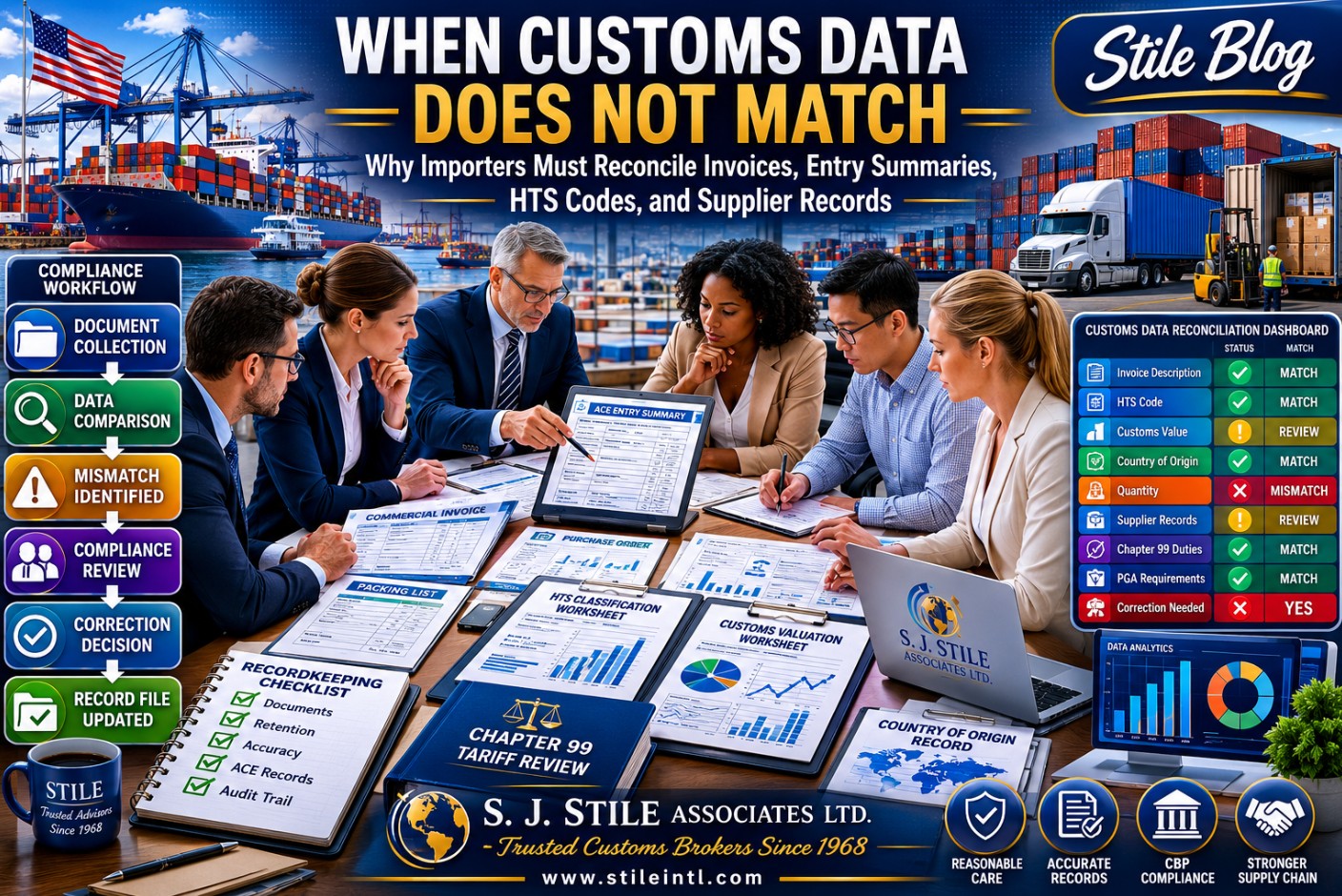
A commercial invoice may describe one product. The packing list may show different quantities. The purchase order may use a different part number. The supplier specification sheet may identify a different material composition. The ACE entry summary may report a different HTS classification, value, country of origin, or duty treatment. When those records do not match, the importer may face questions from U.S. Customs and Border Protection, duty exposure, delayed release, post entry corrections, recordkeeping problems, or audit risk.
For importers, customs data reconciliation is not only an accounting exercise. It is part of reasonable care. Under 19 U.S.C. § 1484, the importer of record is responsible for using reasonable care when making entry and filing information needed by CBP to determine release, classification, value, duty, statistics, and other legal requirements.
This is why importers should periodically compare invoices, entry summaries, HTS codes, values, origin records, supplier documents, and internal receiving data. A mismatch discovered internally can often be evaluated and corrected more effectively than a mismatch discovered later during a CBP inquiry.
Regulatory and Policy Context
The legal foundation begins with the importer of record. Under 19 U.S.C. § 1484, the importer of record, either directly or through an authorized agent, must use reasonable care when making entry and filing information necessary for CBP to determine whether the merchandise may be released. The statute also requires the filing of declared value, classification, duty rate, and other information needed to assess duties, collect accurate statistics, and determine whether other legal requirements are met.
Customs records must also be maintained. CBP’s recordkeeping regulations at 19 CFR Part 163 govern the maintenance, production, inspection, and examination of customs records. The regulation explains that records include information required for entry and information from which entry related data is derived.
CBP’s recordkeeping framework is broad. It covers documents and electronically generated or machine readable data that may be reviewed in audits, inquiries, investigations, duty assessments, penalty matters, and compliance reviews.
CBP also publishes Informed Compliance Publications, including guidance on reasonable care, customs value, tariff classification, and recordkeeping. These publications are designed to help the trade community understand compliance expectations, although CBP notes that some guidance documents may not be binding.
What CBP Expects Importers to Understand
CBP expects importers to provide accurate entry information and to maintain records that support that information. The customs broker may transmit the entry, but the importer of record remains responsible for the accuracy of the information supplied and for exercising reasonable care.
In practical terms, importers should understand the relationship between:
Commercial invoice descriptions and entered descriptions
Purchase orders and invoice line items
Supplier part numbers and internal SKU numbers
HTS classifications and product specifications
Country of origin declarations and manufacturing records
Customs value and payment records
Packing lists and quantities entered
Chapter 99 provisions and special tariff applicability
Partner government agency requirements and product admissibility
When these data points do not align, the risk is not limited to clerical inconvenience. A mismatch may affect duty calculation, admissibility, forced labor review, antidumping or countervailing duty exposure, free trade agreement claims, Section 301 or Section 232 duties, or PGA filings.
CBP Form 7501, the Entry Summary, is a central customs document because CBP relies on it to determine information such as appraisement, classification, origin, and other entry related elements. If the entry summary does not reconcile with the importer’s underlying records, the importer should evaluate whether the discrepancy is harmless, requires documentation, or requires correction.
Why Customs Data Mismatches Matter
A customs entry is a legal declaration. It is not merely a shipping record.
If an invoice says “cotton woven shirts,” but the HTS code entered applies to synthetic knit garments, the classification may be incorrect. If a supplier invoice shows assists, royalties, or tooling charges that were not reviewed for customs value, the declared value may be incomplete. If a packing list shows 1,200 cartons but the entry summary reflects a different quantity, the importer may need to determine whether the issue is a shipping variance, invoice correction, or entry error.
These issues matter because CBP can request information, review records, and examine supporting documentation. CBP Form 28 is used as a Request for Information, and CBP provides guidance for trade users on responding to CBP Forms through the ACE Portal.
When the importer can quickly produce a clear reconciliation file, the company is in a stronger position to explain the entry. When records are incomplete, inconsistent, or unavailable, the importer may face delays, additional questions, or greater compliance exposure.
Common Compliance Gaps
1. Invoice Descriptions Do Not Support the HTS Code
Many importers rely on short commercial invoice descriptions such as “parts,” “samples,” “accessories,” or “machines.” These descriptions may not provide enough detail to support classification. A broker may need material composition, function, technical specifications, gender, age group, end use, dimensions, or component breakdowns.
A weak description can create classification risk because the HTS code must be supported by the actual product facts, not by shorthand used for purchasing or shipping.
2. Supplier Part Numbers Do Not Match Internal Records
Suppliers often use one part number, while the importer uses another SKU, style number, or item master code. If the cross reference is not maintained, the importer may have difficulty proving that the HTS code, value, origin, or PGA data applied to the correct item.
3. Quantity Differences Are Not Investigated
Differences between purchase order quantities, invoice quantities, packing list quantities, bill of lading quantities, and received quantities may occur for legitimate reasons. However, they should be reviewed and documented. Quantity differences can affect value, duty, statistical reporting, quota, antidumping or countervailing duty exposure, and reconciliation with inventory records.
4. Country of Origin Is Accepted Without Support
A country of origin statement on an invoice is not always enough. Importers should maintain records supporting where the goods were manufactured, processed, grown, assembled, or substantially transformed, depending on the applicable rule.
Origin mismatches can affect marking, duty rates, Section 301 duties, free trade agreement eligibility, government procurement restrictions, and forced labor due diligence.
5. Customs Value Does Not Match Accounting Records
Customs value should be reviewed against purchase orders, invoices, payment records, assists, royalties, tooling, commissions, rebates, discounts, and related party pricing where applicable. CBP maintains informed compliance guidance on customs value, and importers should ensure that the value declared to CBP is supported by their commercial and accounting records.
6. Special Tariff Data Is Not Reconciled
Chapter 99 provisions, Section 301 duties, Section 232 duties, antidumping or countervailing duty case numbers, exclusions, and special program claims should be reconciled against product records and origin records. These data elements can materially affect landed cost and compliance exposure.
7. Entry Corrections Are Not Linked to Root Cause
Some companies correct individual entries but do not investigate why the error occurred. If the issue came from an outdated item master, incorrect supplier description, missing origin field, or manual spreadsheet error, the same problem may repeat.
Practical Steps for Importers
1. Create a Customs Data Reconciliation Checklist
Importers should compare the following data points before or shortly after entry:
Importer of record number
Seller, shipper, and manufacturer
Commercial invoice number and date
Purchase order number
SKU, style, model, or part number
Product description
HTS classification
Country of origin
Customs value
Quantity and unit of measure
Currency
Freight, insurance, assists, royalties, and other value elements
Chapter 99 or special tariff provisions
PGA data requirements
Broker reference number and entry number
Liquidation status and duty paid
This checklist should be tailored by product line and risk level. A textile importer, electronics importer, food importer, machinery importer, and chemical importer may each need different data points.
2. Build a Product Master File
A product master file should connect internal SKUs to customs relevant data. At minimum, it should include item description, HTS code, origin, supplier, manufacturer, unit value, material composition, technical specifications, PGA indicators, and last review date.
The file should be controlled. Changes to HTS codes, origin, product description, or value logic should be reviewed before they affect entries.
3. Compare Entry Data Against Source Records
Importers should periodically select samples of entries and compare the ACE entry summary against commercial invoices, packing lists, purchase orders, supplier specifications, and payment records. The goal is to confirm that the entry data matches the records that support it.
This review should not be limited to high value shipments. Low value, repetitive, or fast moving shipments can also create compliance exposure if the same error repeats across many entries.
4. Document the Reason for Differences
Not every difference is an error. Sometimes the invoice quantity differs from the received quantity because of a short shipment. Sometimes the accounting value differs from customs value because certain costs are treated differently. Sometimes the product description differs because the commercial invoice uses a short description and the classification file contains the detailed description.
The key is documentation. The importer should be able to explain the difference and show why the entry was still correct or why a correction was made.
5. Escalate Classification, Valuation, and Origin Questions
When a mismatch affects classification, valuation, origin, admissibility, or duty treatment, the issue should be escalated. Importers should not treat these issues as routine data cleanup. They may require review by compliance personnel, customs counsel, a licensed customs broker, or a subject matter specialist.
6. Use Post Entry Tools When Needed
If an error is discovered after entry, the importer should evaluate available post entry options based on timing and the nature of the issue. Depending on the facts, this may involve a correction before liquidation, a post summary correction, a protest, reconciliation, or other appropriate action. The correct option depends on the entry status, issue type, and applicable regulations.
7. Keep a Reconciliation Audit Trail
A reconciliation file should show:
- What was reviewed
- Who reviewed it
- What mismatch was found
- What documents supported the conclusion
- Whether the entry was correct
- Whether correction was required
- What process change was made to prevent recurrence
This audit trail can help demonstrate reasonable care and support future responses to CBP inquiries.
What Importers Should Monitor Regularly
Importers should monitor recurring mismatch patterns, including:
- Repeated HTS changes for the same item
- Supplier invoices with vague descriptions
- Country of origin changes without explanation
- Value changes that do not match purchase terms
- Unexpected Chapter 99 duty changes
- Quantity differences between packing list and entry
- Entries with missing PGA data
- Supplier documents that conflict with product master data
- Corrections filed repeatedly for the same supplier or product
- High duty products with manual data entry
These patterns may indicate a system weakness rather than a one time error.
Internal Departments That Should Be Involved
Customs data reconciliation should not be handled by logistics alone. Import compliance depends on coordination among several departments.
Purchasing controls supplier data, part numbers, pricing, and purchase terms.
Accounting controls payment records, assists, royalties, credits, and financial adjustments.
Logistics controls shipment documents, packing lists, bills of lading, and delivery records.
Compliance controls classification, origin, valuation, PGA requirements, and broker instructions.
Information technology controls item master systems, data mapping, automation, and document retention.
Executive management controls resources, policies, and accountability.
When these departments work separately, customs data gaps are more likely. When they share a controlled process, the importer is better positioned to identify and correct problems before they become enforcement issues.
Broker Responsibility and Importer Responsibility
A licensed customs broker plays an important role in preparing and transmitting entry information, advising on documentation, identifying inconsistencies, and helping importers manage customs procedures. However, the broker usually relies on the information provided by the importer, supplier, carrier, and other parties.
The importer should provide complete, accurate, and timely information. The broker should review the documentation provided, identify obvious inconsistencies, ask appropriate questions, and transmit the entry based on the available information and instructions.
The strongest compliance process is collaborative. Importers and brokers should maintain clear communication, current product data, documented instructions, and an escalation process for uncertain items.
How S. J. Stile Associates Can Help
S. J. Stile Associates Ltd. helps importers review customs documentation, identify entry data inconsistencies, and strengthen the connection between commercial records and customs declarations.
Our team can assist with:
- Entry document review
- Invoice and entry summary comparison
- HTS classification support
- Country of origin review
- Customs value review
- Special tariff and Chapter 99 review
- Post entry issue identification
- Broker instruction improvement
- Document retention and audit readiness support
- Coordination with import, logistics, accounting, and compliance teams
The objective is practical compliance. Importers need a process that works in daily operations, supports accurate customs entry, and creates a defensible record if CBP asks questions.
FAQs
What is customs data reconciliation?
Customs data reconciliation is the process of comparing customs entry data against the importer’s source records, including invoices, packing lists, purchase orders, supplier specifications, origin documents, payment records, and internal item master data. The goal is to confirm that the entry filed with CBP is accurate and supported.
Why does it matter if the invoice description is different from the HTS description?
A short invoice description may be acceptable for commercial purposes but insufficient for customs classification. If the description does not support the HTS code, the importer should maintain additional product documentation, such as specifications, material composition, use, dimensions, or technical data.
Is the customs broker responsible for correcting mismatched data?
The customs broker can help identify and resolve discrepancies, but the importer of record remains responsible for exercising reasonable care and providing accurate information. The broker and importer should work together, but the importer should not assume that the broker has all underlying product, pricing, origin, and accounting records.
How often should importers review entry data?
The frequency depends on volume, risk, product complexity, duty exposure, and prior error history. A practical approach is to review higher risk entries regularly, test samples from routine entries, and perform targeted reviews when products, suppliers, countries, or tariff measures change.
What should an importer do if it discovers an entry error?
The importer should document the issue, determine whether the error affects classification, value, origin, duty, admissibility, or PGA reporting, and evaluate the appropriate correction method based on entry status and timing. The importer should also determine whether the same issue affected other entries.
Can mismatched records lead to CBP questions?
Yes. CBP may request information or documentation when entry data requires review. CBP Form 28 is one mechanism used to request information from the trade. Importers should be able to respond with organized records that support the entry.
Should importers keep records electronically?
Electronic records can be acceptable if they are complete, accessible, reliable, and maintained in accordance with applicable recordkeeping requirements. Importers should ensure that electronic records can be produced when requested and that they connect clearly to the relevant entry.
What is the biggest risk in customs data mismatch?
The biggest risk is not always the individual mismatch. The larger concern is whether the mismatch shows a systemic weakness in classification, valuation, origin, supplier data, broker instructions, or recordkeeping. Repeated errors can create greater exposure than a single isolated issue.
References
- U.S. Customs and Border Protection, Informed Compliance Publications.
- 19 U.S.C. § 1484, Entry of merchandise.
- 19 CFR Part 163, Recordkeeping.
- U.S. Customs and Border Protection, Reasonable Care.
- U.S. Customs and Border Protection, Customs Value.
- U.S. Customs and Border Protection, Tariff Classification.
- U.S. Customs and Border Protection, CBP Form 28, Request for Information.
- U.S. Customs and Border Protection, ACE Portal, Receive and Respond to CBP Forms.
- U.S. Customs and Border Protection, CBP Form 7501, Entry Summary.
The Stile Associates Advantage
- More than 55 years of continuous industry experience
- Family leadership with modern trade vision
- Licensed Customs Brokers and compliance professionals
- CTPAT certified supply chain security
- Full service customs and logistics solutions
- Technology driven visibility and control
- Dedicated, personalized client service
- Nationwide U.S. coverage with global support
Choosing S.J. Stile Associates means partnering with a customs broker that understands the realities of today’s trade environment and is fully invested in protecting your business.
Contact S.J. Stile Associates today to learn how we can strengthen your compliance posture and streamline your supply chain.


We’re not just a broker; we’re your strategic compliance partner.
Since 1968, our clients have trusted us to:
- Navigate regulatory shocks
- Deliver personal service from our NYC, Miami, and LA offices
- Build resilient import strategies that drive growth
In this new trade era, trust is everything , and that’s why importers stay with Stile for years.

Call to Action
At Stile Associates, we combine over 55 years of experience with the latest technology to keep your imports compliant and efficient.
Contact us today to explore how AI-driven solutions can optimize your customs operations.


📣 Final Call to Action:
Ready to take control of your shipping costs?
Let’s talk. Contact Stile Associates for a free consultation and let our experts audit your current process, to help you streamline your operations, stay compliant, and save money.

💼 Choose Stile, Your Smartest Move in Global Trade
Whether you’re shipping across the country or across continents, Stile Associates is your strategic partner for building a smarter, more resilient supply chain.
📍 Since 1968, we’ve been delivering peace of mind and performance. Let’s take your logistics to the next level together.
🌐 Visit us at www.stileintl.com
📩 Or contact: stevenheid@stileintl.com
Stile Associates – Trusted. Proven. Personal.
Stile Real Time Cargo Tracking with Global Visibility.

