

Introduction
Artificial intelligence is no longer a theoretical development for the customs and international trade community. It is already being used by government agencies for risk analysis, document processing, anomaly detection, operational support, and information retrieval.
The Department of Homeland Security published its updated 2025 Artificial Intelligence Use Case Inventory on January 28, 2026. The Customs and Border Protection portion of that inventory includes systems such as the Trade Entity Risk Model, the Advanced Trade Analytics Program, document summarization tools, and a proposed Forced Labor Virtual Consultant. CBP has also previously described using artificial intelligence to help identify anomalies and assist officers who screen cargo and conveyances. to importers and customs brokers because government enforcement capabilities are becoming more data driven. Customs transactions can be evaluated across importers, manufacturers, suppliers, tariff classifications, countries of origin, values, routes, and historical entry patterns.
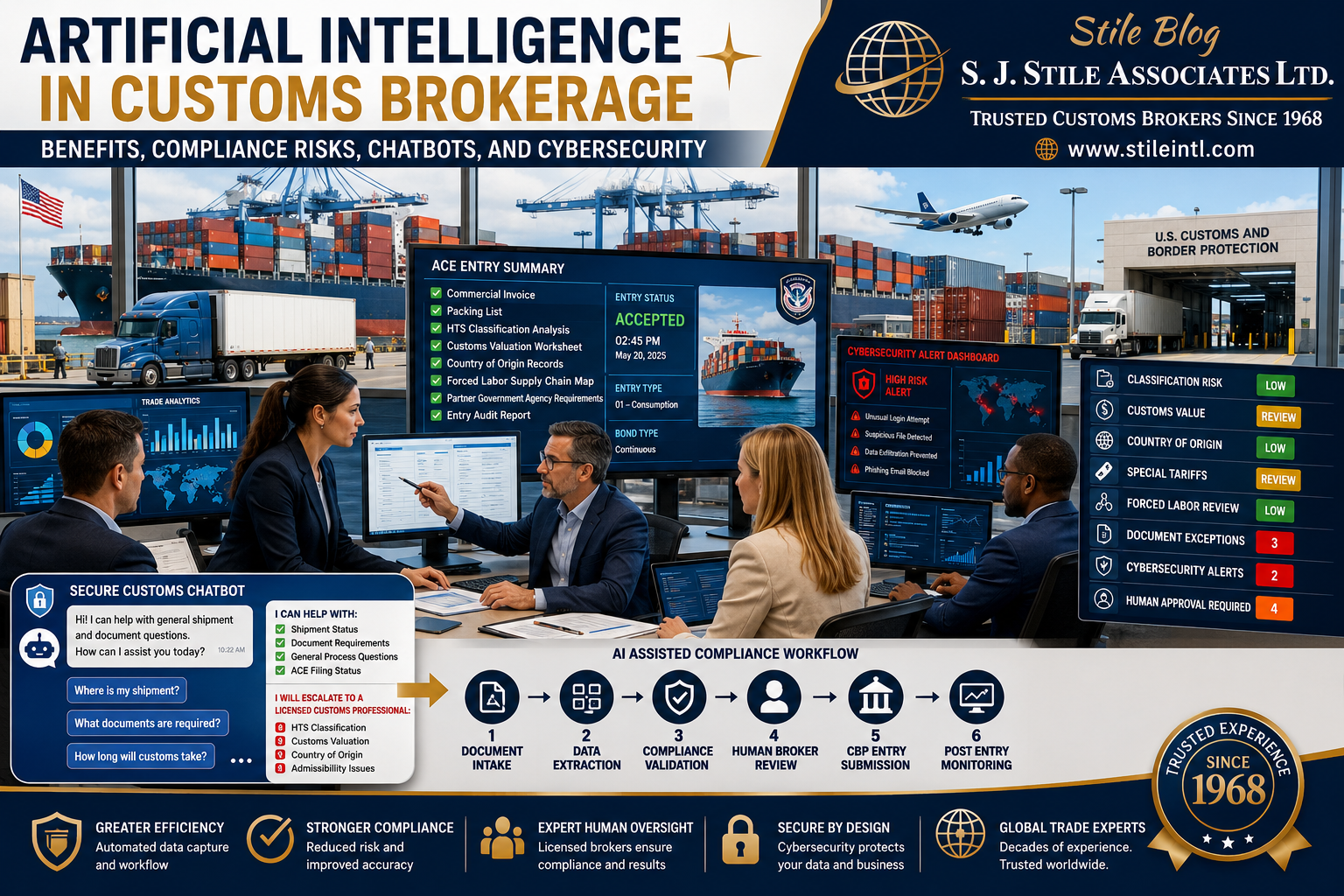
Artificial intelligence can also help customs brokerage companies improve efficiency. It can assist employees with document review, data extraction, client communications, internal research, audit sampling, and cybersecurity monitoring. However, it can also produce incorrect answers, expose sensitive information, or create new attack surfaces when it is implemented without adequate governance.
The appropriate objective is not to replace customs professionals. The objective is to use AI as a controlled support tool while maintaining professional judgment, documented procedures, human review, and regulatory accountability.
Regulatory and Policy Context
Importer Reasonable Care Still Applies
Under 19 U.S.C. 1484, the importer of record must use reasonable care when making entry and providing the information required for CBP to determine admissibility, classification, value, duty liability, and other entry requirements. CBP’s Reasonable Care publication reinforces that the importer remains responsible for the accuracy of customs information. oes not transfer that responsibility to the software provider. An importer cannot assume that an HTS classification, country of origin determination, customs value, or special tariff recommendation is correct merely because it was produced by an advanced model.
Customs Broker Responsibility Also Continues
Customs brokers must exercise responsible supervision and control over customs business conducted under their licenses and permits. Customs business includes activities involving entry, admissibility, classification, valuation, duty payment, refund claims, and preparation or electronic transmission of documents intended for CBP. refore cannot operate as an uncontrolled substitute for licensed broker supervision. A broker must still maintain procedures, qualified personnel, review controls, records, and escalation processes appropriate to the customs work being performed.
Current AI Risk Management Guidance
The National Institute of Standards and Technology Artificial Intelligence Risk Management Framework is voluntary guidance designed to help organizations govern, map, measure, and manage AI risks. NIST’s Generative Artificial Intelligence Profile identifies risks such as confidently incorrect information, data privacy exposure, information security weaknesses, human overreliance, and risks created by third party components. ping a Cybersecurity Framework Profile for Artificial Intelligence. As of July 2, 2026, that profile remained under development following a preliminary draft and public working sessions held during the spring of 2026. Its three principal areas are securing AI systems, using AI for cyber defense, and defending against attacks that are enabled by AI. cting the Customs Environment
Government Risk Analysis
CBP’s published AI inventory includes the Trade Entity Risk Model and the Advanced Trade Analytics Program. The inventory describes the Advanced Trade Analytics Program as producing analyses that can be presented through data visualizations and dashboards. These programs demonstrate how large volumes of trade information can be analyzed for patterns and risk indicators. that inconsistent classifications, unusual values, changing origins, supplier relationships, and abnormal entry patterns may be easier for regulators to identify when data is analyzed across multiple transactions.
AI does not need to identify a complete violation to increase exposure. It may help identify an entry, importer, supplier, or product group that warrants additional review by a CBP employee.
Cargo Screening and Anomaly Detection
CBP has described the use of artificial intelligence to assist with contraband detection and anomaly analysis in passenger vehicles and cargo conveyances. The DHS inventory also identifies CBP projects involving cargo anomaly detection and automated identification of items of interest. very shipment is inspected by an autonomous AI system. It means AI can support targeting and inspection personnel by helping prioritize information, images, or shipments for additional examination.
Document Review and Information Retrieval
The 2025 DHS inventory identifies a deployed CBP use case for generative AI document summarization and content generation. It also identifies a Forced Labor Virtual Consultant in the development stage. cularly relevant to customs brokers because brokerage operations depend on large volumes of commercial invoices, packing lists, bills of lading, entry summaries, product specifications, rulings, supplier statements, and government guidance.
Practical Uses of AI for Customs Brokerage Companies
1. Document Intake and Data Extraction
AI assisted document processing can help identify and extract information such as:
- Importer and consignee names.
- Invoice numbers and dates.
- Product descriptions.
- Quantities and units of measure.
- Currency and entered value.
- Country of origin.
- Manufacturer information.
- Freight and insurance charges.
- Purchase order references.
- Potentially missing documents or fields.
The extracted information should be compared against the original commercial documents before it is transmitted to an ABI system or CBP.
2. Document Comparison
AI can help compare a commercial invoice, packing list, purchase order, bill of lading, and entry worksheet. It can identify differences involving quantities, descriptions, values, currency, weights, origin statements, and parties.
This can reduce the time required for routine comparisons. It can also help direct employees toward exceptions rather than requiring them to manually compare every field.
The compliance control remains essential. An AI identified difference is an alert, not a final customs conclusion.
3. Classification Research Support
AI can assist classification research by organizing product information, identifying missing technical characteristics, retrieving relevant HTS headings, comparing official rulings, and preparing questions for the importer or manufacturer.
It should not be used as the sole authority for assigning an HTS classification. NIST identifies confabulation as the production of confidently stated but incorrect information. In customs classification, a confident but incorrect answer can affect ordinary duties, Section 301 duties, Section 232 duties, antidumping and countervailing duty exposure, partner government agency requirements, and admissibility. sions should be based on complete product information, the legal text of the HTSUS, applicable notes, General Rules of Interpretation, CBP rulings, and qualified human review.
4. Customs Valuation Review
AI can help organize valuation information involving assists, royalties, commissions, related party transactions, indirect payments, packing costs, and freight charges.
The system can flag transactions that appear inconsistent with established importer procedures. It cannot determine the correct customs value without reliable transaction information and appropriate legal analysis.
5. Country of Origin and Supply Chain Review
AI can help organize bills of materials, supplier declarations, manufacturing locations, processing records, and transportation documents.
This may be particularly useful for forced labor due diligence, tariff origin analysis, marking reviews, and supplier risk management. CBP’s development of a Forced Labor Virtual Consultant illustrates the potential value of guided information retrieval in this area.
Aace direct supplier verification, documentary traceability, or evidence demonstrating the actual production process.
6. Entry Auditing and Exception Detection
A brokerage or importer can use controlled analytics to identify:
- Unusual changes in classification.
- Large differences in unit value.
- Missing manufacturer identification information.
- Unexpected country of origin changes.
- Entries without required supporting documents.
- Potentially omitted special tariff provisions.
- Repeated corrections involving the same product.
- Transactions that fall outside established importer profiles.
This type of review can support internal auditing and post entry compliance testing.
7. Landed Cost and Duty Analysis
AI can help organize the inputs used for landed cost calculations, tariff comparisons, and sourcing scenarios.
However, calculations should be connected to controlled tariff data and validated business rules. A chatbot that relies on outdated tariff information may produce an answer that appears reasonable but no longer reflects the applicable Chapter 99 provisions or effective dates.
Can Customs Brokers Use Chatbots?
Yes, but the chatbot must be designed for a clearly defined purpose.
Appropriate Chatbot Uses
A controlled chatbot may assist with:
- Shipment status questions.
- Requests for missing documents.
- General explanations of brokerage procedures.
- Internal searches of approved compliance manuals.
- Locating company procedures and client instructions.
- Preparing preliminary responses for employee review.
- Directing complex questions to a licensed broker or compliance specialist.
- Providing links to approved CBP, FDA, USDA, or other government resources.
High Risk Chatbot Uses
A chatbot should not independently provide final decisions concerning:
- HTS classification.
- Customs valuation.
- Country of origin.
- Antidumping or countervailing duty applicability.
- Forced labor admissibility.
- FDA, USDA, EPA, DOT, FCC, or other agency admissibility.
- Protest, prior disclosure, or penalty strategy.
- Transmission of customs entry data without human review.
Chatbot Controls
A customs related chatbot should use an approved knowledge base and identify the source supporting its answer. It should distinguish general information from transaction specific advice. It should also escalate uncertain or high risk questions to qualified personnel.
The chatbot should not be connected to customer files, powers of attorney, entry records, payment information, or ABI credentials unless strong authentication, access controls, logging, and data protection measures are in place.
Benefits of AI in Customs Brokerage
Greater Processing Efficiency
AI can perform initial document extraction, comparison, and organization more quickly than a completely manual process. This allows brokerage employees to devote more attention to exceptions and higher risk transactions.
More Consistent Preliminary Review
A properly configured system can apply the same initial review criteria to every transaction. This may reduce differences caused by workload, time pressure, or varying employee experience.
Better Identification of Exceptions
AI and analytical tools can review larger transaction populations than traditional manual sampling. This can help identify patterns that might not be visible during the review of an individual entry.
Improved Customer Service
A controlled chatbot can provide basic information outside normal business hours, acknowledge requests, collect missing information, and direct questions to the appropriate department.
Stronger Internal Knowledge Access
Employees can use an internal AI assistant to locate approved procedures, client instructions, CBP guidance, and compliance manuals more efficiently.
Cybersecurity Support
AI can support threat detection, network anomaly analysis, message review, and prioritization of security alerts. NIST’s developing Cyber AI Profile specifically recognizes AI enabled cyber defense as one of its principal focus areas. antages
Incorrect or Invented Answers
Generative AI may produce incorrect facts, nonexistent rulings, inaccurate tariff provisions, or explanations that appear authoritative. NIST formally identifies this risk as confabulation. nformation
Customs duties, Chapter 99 provisions, agency requirements, sanctions, and enforcement instructions can change. A model that is not connected to current official sources may provide obsolete information.
Loss of Context
AI may not understand that two products with similar commercial descriptions have different physical characteristics, functions, compositions, or manufacturing processes. Those distinctions may determine classification, origin, and admissibility.
Confidentiality and Privacy Exposure
Commercial invoices, customs entries, supplier records, product specifications, powers of attorney, and customer communications may contain sensitive business information or personally identifiable information.
Submitting that information to an unapproved public AI service may create unauthorized disclosure, retention, or access risks. NIST identifies data privacy and information security as material generative AI risks. Automation
Employees may accept an AI result because it is presented clearly or confidently. This creates automation bias, particularly when employees are under time pressure.
Integration Risk
An AI application connected to email, document management, customer relationship systems, accounting systems, or ABI related workflows may receive broader access than it actually requires.
Vendor Risk
The customs broker or importer may not know where information is stored, how long prompts are retained, whether data is used for model training, or which subcontractors can access the information.
Does AI Increase Cybersecurity Risk?
AI can improve cybersecurity, but it also creates additional risks.
More Convincing Fraud and Impersonation
The FBI has warned that criminals use generative AI to create believable text, fraudulent identities, cloned voices, and manipulated images or videos. AI generated communications can be used for spear phishing, payment fraud, credential theft, and business email compromise. rime Report states that IC3 received more than 22,000 complaints containing AI related information, with adjusted reported losses exceeding $893 million. The report also states that businesses reported more than $30 million in losses from business email compromise schemes involving AI. These figures reflect complaints reported to IC3 and should not be interpreted as a complete measure of all AI related crime.
Fornvincing fraudulent message could impersonate an importer, executive, overseas agent, carrier, or government representative. The objective might be to change banking instructions, obtain entry documents, steal credentials, redirect cargo information, or gain access to customer records.
Attacks Against AI Systems
NIST’s 2025 adversarial machine learning publication identifies categories of attacks involving evasion, data poisoning, privacy compromise, and misuse.
Formay attempt to manipulate information supplied to a model, obtain sensitive information through carefully designed prompts, or cause the system to produce an unsafe action.
Sensitive Data Exposure
CISA’s 2025 AI Data Security guidance emphasizes that data security is essential to the accuracy, integrity, and trustworthiness of AI results. ny should therefore protect not only the AI model, but also the documents, prompts, reference sources, system connections, user identities, and outputs associated with the model.
Common Compliance and Security Gaps
- Employees use public AI services without company authorization.
- Commercial invoices or customer records are copied into public chatbots.
- AI generated HTS classifications are accepted without supporting analysis.
- The chatbot does not identify the official source behind an answer.
- Tariff and regulatory information is not updated.
- AI output is transmitted to ABI without human review.
- No record is maintained of the prompt, source material, output, reviewer, or final decision.
- AI applications receive unrestricted access to customer folders or email accounts.
- Shared accounts or shared API credentials are used.
- Vendor contracts do not clearly address data retention, model training, security incidents, or subcontractors.
- Employees are not trained to recognize AI generated impersonation attempts.
- The company has no procedure for reporting an incorrect AI result or suspected AI related security event.
Practical Steps for Importers and Customs Brokers
1. Establish an AI Use Policy
Define which AI services are approved, which data may be entered, who may use the systems, and which activities are prohibited.
2. Classify Customs and Customer Data
Separate public information from confidential business information, personally identifiable information, financial information, powers of attorney, entry data, credentials, and legally sensitive records.
3. Begin With Lower Risk Uses
Initial projects may include document sorting, internal procedure searches, customer status questions, and preliminary document comparisons.
Classification, valuation, origin, admissibility, and entry transmission should remain subject to stronger review controls.
4. Use Official and Controlled Sources
Configure the system to retrieve information from approved CBP, eCFR, U.S. Code, HTSUS, FDA, USDA, USTR, and company procedure sources.
The system should identify the source and date of the information used.
5. Require Human Approval
Designate the employees authorized to approve AI assisted work. High risk customs decisions should be reviewed by qualified compliance personnel or licensed brokers.
6. Test the System
Test the application against known transactions, prior rulings, historical errors, and difficult product descriptions. Measure incorrect answers, unsupported answers, and missing information.
7. Maintain an Audit Trail
Document the information submitted, sources reviewed, AI output, changes made by employees, final decision, and person who approved the result.
8. Apply Cybersecurity Controls
Use individual accounts, multifactor authentication, minimum necessary access, encryption, activity logging, system monitoring, and prompt protection.
9. Review AI Vendors
Evaluate where data is stored, whether prompts are retained, whether customer information is used for training, how incidents are reported, and how access is terminated.
10. Train Employees
Employees should understand that a professional sounding answer can still be wrong. Training should also cover phishing, voice cloning, impersonation, confidential information, and escalation procedures.
11. Monitor Performance
AI systems should be reviewed after implementation. Changes in tariff rules, company procedures, customer profiles, software versions, and data sources may affect performance.
How S. J. Stile Associates Can Help
S. J. Stile Associates Ltd. can help importers identify where AI assisted processes intersect with customs compliance responsibilities.
Our role may include reviewing entry documentation, identifying missing product or valuation information, evaluating classification and origin support, coordinating partner government agency requirements, and helping importers maintain appropriate customs records.
AI may improve how information is collected and organized, but professional customs review remains essential. S. J. Stile Associates combines technology enabled processes with experienced customs brokerage oversight to help clients manage entry accuracy, regulatory requirements, and supply chain risk.
Frequently Asked Questions
Can AI legally classify imported merchandise?
AI can assist with research and information organization. The importer of record remains responsible for exercising reasonable care, and the classification must be supported by the HTSUS, product facts, legal notes, applicable rules, and authoritative customs guidance. automatically transmit an AI prepared entry?
Automation may support entry preparation, but the broker must maintain responsible supervision and control. High risk data and exceptions should be reviewed before transmission. nsed customs broker?
AI can perform support functions, but it does not hold a customs broker license, assume importer reasonable care obligations, or exercise professional accountability. Licensed brokerage activity remains governed by 19 CFR Part 111. invoices to a public chatbot?
Not automatically. The company must understand the provider’s privacy, retention, access, and training terms. Sensitive customs and customer information should not be entered into an unapproved service.
What is the safest use of a customs chatbot?
A lower risk design answers general questions from an approved knowledge base, provides source references, avoids transaction specific legal conclusions, and escalates complex questions to qualified personnel.
Can AI improve customs audits?
AI can help select transactions, compare documents, identify unusual values, and detect inconsistent entry patterns. Employees must investigate the underlying documents before concluding that an error exists.
Does AI make cybercrime more dangerous?
AI can increase the speed, volume, personalization, and credibility of phishing, impersonation, and fraud. It also creates risks involving AI system manipulation and data exposure. AI can strengthen cyber defense, but only when the technology itself is securely designed and monitored. intelligence will affect customs brokerage through faster document processing, stronger analytics, improved information retrieval, customer service automation, and enhanced cybersecurity tools.
It will also increase the importance of data quality, human review, access control, documentation, and professional accountability.
The most effective customs organizations will not treat AI as an unrestricted replacement for employees. They will use it as a controlled assistant within a documented compliance framework.
For importers, the essential principle remains unchanged. Technology may support the customs process, but the accuracy of the entry, the quality of the supporting records, and the exercise of reasonable care remain fundamental responsibilities.
References
1. Department of Homeland Security, Artificial Intelligence Use Case Inventory
- DHS inventory of artificial intelligence use cases across the Department and its components.
- View the official DHS source
2. Department of Homeland Security, United States Customs and Border Protection AI Use Cases
- CBP specific inventory covering artificial intelligence applications involving trade, cargo screening, operational support, document analysis, and other functions.
- View the official CBP AI use case inventory
3. Department of Homeland Security, Using AI to Secure the Homeland
- DHS summary of how its components, including CBP, use artificial intelligence to support cargo screening, identity validation, security, and operational activities.
- View the official DHS source
4. U.S. Customs and Border Protection, Artificial Intelligence to Harness Key Insights at CBP
- CBP discussion of artificial intelligence, anomaly detection, inspection support, and the use of advanced analytics in agency operations.
- View the official CBP source
5. U.S. Customs and Border Protection, Reasonable Care
- CBP informed compliance publication explaining importer responsibilities for classification, valuation, entry information, and customs compliance.
- View the official CBP publication
6. United States Code, 19 U.S.C. § 1484, Entry of Merchandise
- Federal statute establishing importer of record entry obligations and the reasonable care standard.
- View the official U.S. Code provision
7. Electronic Code of Federal Regulations, 19 CFR Part 111, Customs Brokers
- Federal regulations governing customs broker licensing, permits, duties, recordkeeping, conduct, and customs business.
- View the official eCFR regulation
8. Electronic Code of Federal Regulations, 19 CFR § 111.28, Responsible Supervision and Control
- Regulation describing the supervision and control customs brokers must exercise over customs business and brokerage personnel.
- View the official eCFR provision
9. National Institute of Standards and Technology, Artificial Intelligence Risk Management Framework 1.0
- NIST framework for identifying, evaluating, documenting, and managing risks associated with artificial intelligence systems.
- View the official NIST publication page
- Download the official NIST AI RMF PDF
10. National Institute of Standards and Technology, Generative Artificial Intelligence Profile, NIST AI 600-1
- NIST guidance addressing risks such as inaccurate output, data privacy, information security, human overreliance, third party components, and generative AI governance.
- View the official NIST publication page
- Download the official NIST publication
11. National Institute of Standards and Technology, Adversarial Machine Learning, NIST AI 100-2 E2025
- NIST taxonomy covering attacks and mitigations involving evasion, data poisoning, privacy compromise, abuse, and other adversarial machine learning risks.
- View the official NIST publication page
- Download the official NIST publication
12. National Institute of Standards and Technology, Cybersecurity Framework Profile for Artificial Intelligence, NIST IR 8596, Preliminary Draft
- NIST guidance organized around securing AI systems, conducting AI enabled cyber defense, and protecting organizations against AI enabled attacks. The document remained a preliminary draft as of July 2, 2026.
- View the official NIST publication page
- Download the official preliminary draft
13. Cybersecurity and Infrastructure Security Agency, New Best Practices Guide for Securing AI Data
- CISA guidance addressing the security, integrity, accuracy, and trustworthiness of data used in artificial intelligence systems.
- View the official CISA source
14. Cybersecurity and Infrastructure Security Agency, AI Cybersecurity Collaboration Playbook
- CISA guidance for artificial intelligence providers, developers, adopters, researchers, and cybersecurity organizations responding to AI related security incidents.
- View the official CISA playbook
15. Federal Bureau of Investigation, 2025 Internet Crime Report
- FBI Internet Crime Complaint Center report addressing cybercrime complaints, financial losses, business email compromise, artificial intelligence related fraud, and other cyber enabled crime trends.
- View the FBI annual reports page
- Download the official 2025 IC3 report
16. Federal Bureau of Investigation, Criminals Use Generative Artificial Intelligence to Facilitate Financial Fraud
- FBI warning explaining how criminals use AI generated text, images, audio, video, fraudulent identities, social engineering, spear phishing, and financial fraud.
- View the official FBI IC3 advisory
17. Federal Bureau of Investigation, Senior U.S. Officials Impersonated in Malicious Messaging Campaign
- FBI warning concerning impersonation, fraudulent text messages, voice messages, social engineering, and possible use of AI generated voices.
- View the official FBI IC3 advisory
18. Federal Bureau of Investigation, Business Email Compromise
- FBI guidance concerning fraudulent communications that impersonate executives, vendors, suppliers, customers, and other trusted parties to obtain funds or sensitive information.
- View the official FBI guidance
The Stile Associates Advantage
- More than 55 years of continuous industry experience
- Family leadership with modern trade vision
- Licensed Customs Brokers and compliance professionals
- CTPAT certified supply chain security
- Full service customs and logistics solutions
- Technology driven visibility and control
- Dedicated, personalized client service
- Nationwide U.S. coverage with global support
Choosing S.J. Stile Associates means partnering with a customs broker that understands the realities of today’s trade environment and is fully invested in protecting your business.
Contact S.J. Stile Associates today to learn how we can strengthen your compliance posture and streamline your supply chain.


We’re not just a broker; we’re your strategic compliance partner.
Since 1968, our clients have trusted us to:
- Navigate regulatory shocks
- Deliver personal service from our NYC, Miami, and LA offices
- Build resilient import strategies that drive growth
In this new trade era, trust is everything , and that’s why importers stay with Stile for years.

Call to Action
At Stile Associates, we combine over 55 years of experience with the latest technology to keep your imports compliant and efficient.
Contact us today to explore how AI-driven solutions can optimize your customs operations.


📣 Final Call to Action:
Ready to take control of your shipping costs?
Let’s talk. Contact Stile Associates for a free consultation and let our experts audit your current process, to help you streamline your operations, stay compliant, and save money.

💼 Choose Stile, Your Smartest Move in Global Trade
Whether you’re shipping across the country or across continents, Stile Associates is your strategic partner for building a smarter, more resilient supply chain.
📍 Since 1968, we’ve been delivering peace of mind and performance. Let’s take your logistics to the next level together.
🌐 Visit us at www.stileintl.com
📩 Or contact: stevenheid@stileintl.com
Stile Associates – Trusted. Proven. Personal.
Stile Real Time Cargo Tracking with Global Visibility.

