

Introduction
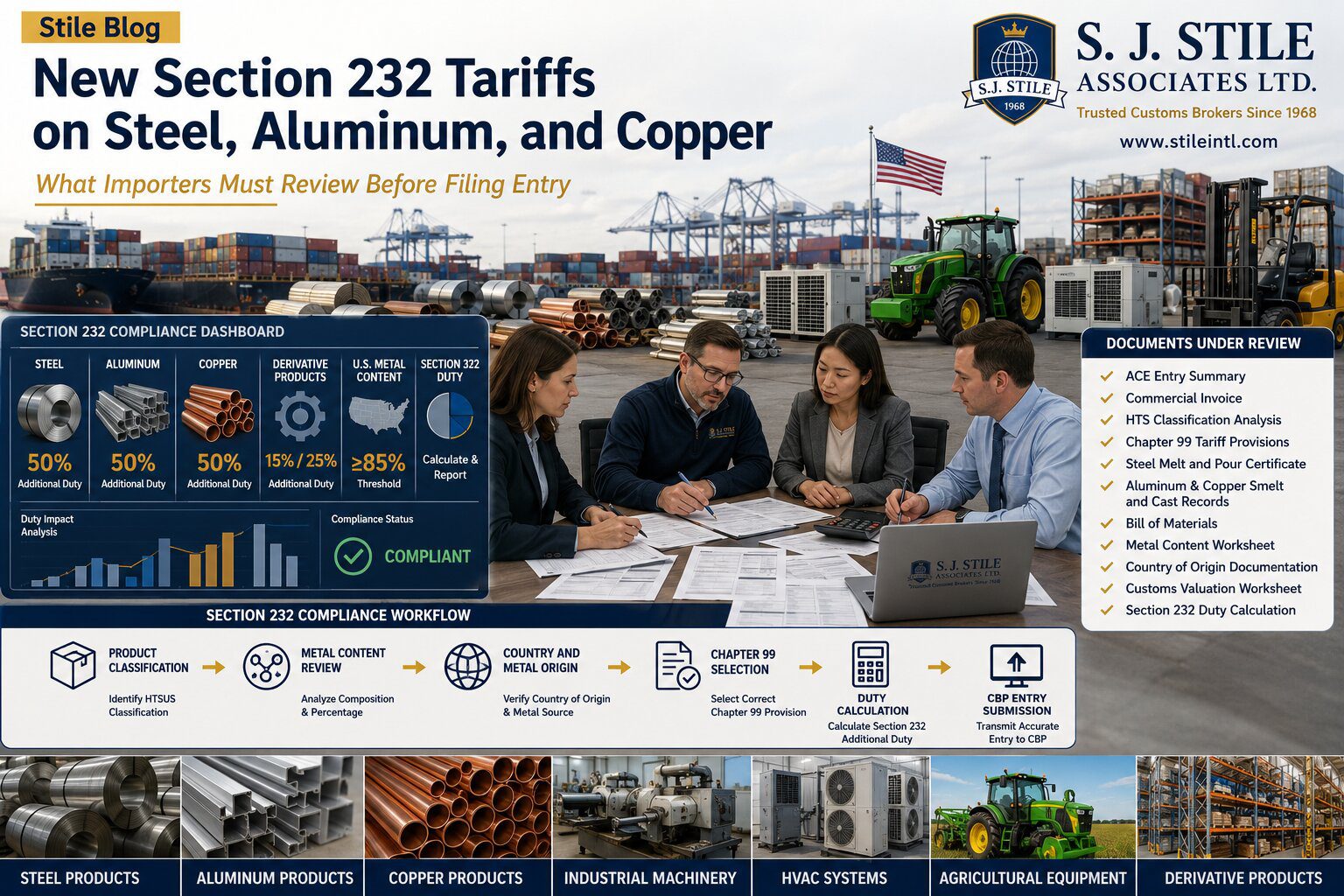
Recent changes to the Section 232 tariff programs for steel, aluminum, copper, and derivative products have created new classification, valuation, origin, and documentation responsibilities for importers.
Presidential Proclamation 11032, issued on June 1, 2026, modified the tariff treatment established under earlier Section 232 actions. The changes became effective for covered merchandise entered for consumption, or withdrawn from warehouse for consumption, on or after 12:01 a.m. Eastern Daylight Time on June 8, 2026.
The revised framework does not affect only traditional raw steel, aluminum, or copper products. It also applies to specified derivative articles, machinery, equipment, components, and other products identified through the Harmonized Tariff Schedule of the United States.
For importers, the principal risk is filing an entry without sufficient information to determine:
- Whether the product is covered
- Which Section 232 rate applies
- Whether a reduced rate is available
- Whether the product qualifies for country specific treatment
- Whether U.S. metal content affects the duty calculation
- Which Chapter 99 tariff provision must be reported
These decisions should be completed before entry transmission whenever possible. Incorrect reporting may result in additional duties, entry corrections, liquidated damages exposure, penalties, or increased CBP scrutiny.
Regulatory and Policy Context
Section 232 of the Trade Expansion Act of 1962 authorizes the President to adjust imports when they are determined to threaten to impair the national security of the United States.
The current metal tariff structure is based on several presidential actions involving aluminum, steel, and copper. Proclamation 11021, issued on April 2, 2026, reorganized the Section 232 tariff regimes and established different tariff categories for metal articles and derivative products.
Under that framework, the administration imposed:
- A 50 percent additional ad valorem duty on specified products made of steel, aluminum, or copper
- A 25 percent additional duty on specified derivative products that are predominantly composed of those metals
- A temporarily reduced 15 percent rate on certain fixed industrial machinery and power equipment
Proclamation 11032 subsequently modified the product coverage and treatment of several categories. It expanded the reduced rate category to include specified agricultural equipment and certain residential HVAC systems and components. It also established temporary treatment for certain mobile industrial equipment and machinery.
The applicable treatment is controlled by the product description, HTSUS classification, applicable annex, Chapter 99 provision, country of origin, metal sourcing, and other entry specific facts.
Important Changes Effective June 8, 2026
Agricultural Equipment and Residential HVAC Products
Specified agricultural equipment and certain heating, ventilation, and air conditioning systems and components predominantly intended for residential use were added to the category of derivative products eligible for the temporarily reduced 15 percent additional duty.
Importers should not assume that every agricultural machine or HVAC product qualifies. Eligibility depends on whether the exact tariff classification is included in the applicable annex and whether the merchandise meets the relevant product description.quotas, or certain agency requirements may require formal entry procedures regardless of their value.
Mobile Industrial Equipment and Machinery
The proclamation temporarily modified the additional duties applicable to specified mobile industrial equipment and machinery.
This category may include certain construction, material handling, manufacturing, and industrial products, but the tariff treatment must be determined by reference to the specific annex and HTSUS provisions. Commercial descriptions such as “industrial equipment” or “construction machine” are not sufficient by themselves.
Aluminum Lithographic Plates and Steel Racks
Aluminum lithographic plates and steel racks were added to the Section 232 product coverage as derivative articles.
Importers of these products should immediately review classifications, purchase orders, product specifications, and entries filed on or after the effective date.
Revised U.S. Metal Content Threshold
The threshold for a product’s metal content to be treated as composed entirely of qualifying U.S. aluminum, steel, or copper was reduced from 95 percent to 85 percent by weight of the applicable metal content.
Under the revised standard, qualifying treatment may be available when at least 85 percent of the relevant aluminum was smelted and cast in the United States, the steel was melted and poured in the United States, or the copper was smelted and cast in the United States.
This does not mean that an importer may simply estimate that the product contains 85 percent U.S. content. The importer should possess supplier documentation that supports the claim.
What CBP Expects Importers to Understand Accurate HTS Classification
The first step is confirming the proper HTSUS classification of the imported merchandise.
Section 232 coverage is often determined by exact tariff provisions listed in presidential proclamation annexes and Chapter 99 notes. A small classification difference may determine whether a product is subject to:
- A 50 percent additional duty
- A 25 percent additional duty
- A temporary 15 percent rate
- Country specific treatment
- A metal content based calculation
- No Section 232 duty
The importer remains responsible for exercising reasonable care when classifying the merchandise, even when a customs broker prepares and transmits the entry.
Correct Chapter 99 Reporting
Covered products generally require the reporting of a Chapter 99 secondary tariff number in addition to the ordinary HTSUS classification.
The Chapter 99 provision identifies the applicable trade remedy, additional duty rate, exemption, or reduced treatment. An incorrect Chapter 99 number can result in an underpayment or overpayment of duties.
Importers should confirm that their product database, broker instructions, and entry audit procedures reflect the current provisions.
Product Composition
Importers may need to determine:
- Total product weight
- Steel weight
- Aluminum weight
- Copper weight
- Percentage of each metal
- Country where the metal was melted, poured, smelted, or cast
- Value attributable to U.S. produced parts
- Whether the merchandise contains multiple covered metals
A commercial invoice stating only “metal machinery” or “aluminum component” may not provide enough information to determine the correct Section 232 treatment.
Country of Origin and Preferential Treatment
Proclamation 11032 establishes specialized treatment for products from certain countries and trading partners.
For products of certain listed jurisdictions, the Section 232 duty may be calculated in relation to the ordinary Column 1 duty rate. Products from Canada or Mexico that qualify for preferential treatment under the United States Mexico Canada Agreement may receive separate treatment involving the non U.S. content of the merchandise, subject to the applicable minimum effective rate and CBP guidance.
Importers should distinguish among:
- Country of origin of the finished product
- Country of origin of individual components
- Country where the metal was melted and poured
- Country where aluminum or copper was smelted and cast
- USMCA qualification
- U.S. content of the finished product
These are related but legally distinct determinations.
Customs Value
The Section 232 framework may apply additional duties to the full customs value of specified covered products.
Importers should therefore confirm that the entered value is accurate and supported by:
- Commercial invoices
- Purchase orders
- Assists
- Packing costs
- Royalties or license fees
- Related party pricing documentation
- Proceeds of subsequent resale
- Other additions required under customs valuation law
A classification error combined with an undervaluation issue can create substantial additional duty exposure.
Supplier Documentation
Claims involving U.S. origin metal, U.S. content, or reduced duty treatment should be supported by reliable records.
Depending on the product, the compliance file may include:
- Mill certificates
- Melt and pour certificates
- Smelt and cast documentation
- Bills of materials
- Product weight calculations
- Manufacturer declarations
- Supplier affidavits
- Production records
- Costed bills of materials
- Country of origin analyses
- USMCA certifications
- Technical drawings and specifications
CBP may request evidence supporting the information declared at entry.
Common Compliance Gaps
Using Outdated Tariff Instructions
Section 232 requirements have changed repeatedly. An instruction sheet created several months ago may no longer reflect current rates, covered products, or Chapter 99 provisions.
Relying Only on Product Descriptions
Descriptions such as “steel rack,” “air conditioner,” “farm equipment,” or “industrial machine” do not establish the correct tariff treatment.
The importer must connect the technical product characteristics to the proper HTSUS classification and applicable annex.
Missing Metal Origin Information
A supplier may identify the country where the finished product was assembled without identifying where the steel was melted and poured or where the aluminum or copper was smelted and cast.
Finished product origin documentation may therefore be insufficient for a metal sourcing claim.
Unsupported U.S. Content Claims
Proclamation 11032 warns that CBP may impose penalties, to the extent permitted by law, where an importer engages in fraud or deliberately misleads the Government regarding U.S. content.
Importers should not claim reduced treatment unless they possess documentation that supports the calculation.
Incorrect Treatment of Mixed Metal Products
A product may contain steel, aluminum, and copper. The importer should determine which tariff provisions apply and how the applicable proclamation and HTSUS notes address products potentially subject to more than one rate.
The analysis should be documented rather than based on the product’s predominant commercial description.
Failure to Review Existing Entries
Importers sometimes update future purchase orders but fail to review entries filed after a new tariff rule became effective.
Entries filed on or after June 8, 2026 should be reviewed when they involve newly listed products, reduced rate categories, mobile industrial equipment, agricultural equipment, residential HVAC merchandise, steel racks, aluminum lithographic plates, or U.S. metal content claims.
Inadequate Broker Instructions
A customs broker cannot independently determine metal percentages, melt and pour origin, smelt and cast origin, or U.S. content without reliable information from the importer and supplier.
Providing only an invoice and packing list may not be sufficient.
Practical Steps for Importers
1. Identify Potentially Covered Products
Create a list of imported products containing steel, aluminum, or copper, including machines, parts, racks, equipment, housings, containers, tools, and components.
Do not limit the review to products classified in the primary metal chapters.
2. Validate HTS Classifications
Review the tariff classification of each potentially covered product against:
- The current HTSUS
- The proclamation annexes
- Chapter 99 notes
- CBP Cargo Systems Messaging Service guidance
- Relevant CBP rulings
Document the reason for each classification decision.
3. Obtain Detailed Product Data
Request from suppliers:
- Complete material composition
- Weight of each covered metal
- Manufacturing location
- Melt and pour country
- Smelt and cast country
- U.S. material content
- U.S. component value
- Technical specifications
- Bills of materials
The request should be product specific and tied to the tariff requirement being evaluated.
4. Review Country Specific Treatment
Determine whether the product may qualify for special treatment based on its country of origin, USMCA status, U.S. content, or qualifying U.S. metal.
Do not apply reduced rates merely because the supplier is located in a qualifying country.
5. Calculate Landed Cost Before Shipment
The importer should estimate:
- Ordinary customs duty
- Section 232 duty
- Other trade remedy duties
- Merchandise Processing Fee
- Harbor Maintenance Fee, when applicable
- Antidumping or countervailing duties, if applicable
- Freight and logistics costs
This review allows purchasing and finance teams to identify unexpected duty exposure before the merchandise reaches the United States.
6. Provide Written Instructions to the Customs Broker
The broker instruction should identify:
- Final HTS classification
- Chapter 99 provision
- Applicable Section 232 category
- Country of origin
- Metal origin information
- Metal percentage
- U.S. content
- Applicable reduced rate or exclusion basis
- Supporting document location
7. Audit Entries After Filing
Importers should compare the filed entry against the approved classification and duty analysis.
The audit should confirm:
- HTSUS classification
- Chapter 99 reporting
- Entered value
- Country of origin
- Duty rate
- Metal content reporting
- Special program claims
- Supporting records
8. Correct Errors Promptly
When an error is identified, the importer should evaluate the appropriate correction mechanism, including a Post Summary Correction, protest, or prior disclosure, depending on the entry status and circumstances.
A prior disclosure should not be filed automatically. It requires a careful legal and factual evaluation of the potential violation, revenue impact, and completeness of the proposed disclosure.
How S. J. Stile Associates Can Help
S. J. Stile Associates Ltd. can assist importers in coordinating the entry information required for Section 232 reporting.
Our customs brokerage and compliance support may include:
- Reviewing HTS classifications
- Identifying potentially applicable Chapter 99 provisions
- Reviewing product and metal content documentation
- Coordinating supplier information requirements
- Evaluating entry data before transmission
- Reviewing filed entries for reporting inconsistencies
- Assisting with Post Summary Corrections
- Supporting recordkeeping and compliance procedures
- Helping importers communicate clear filing instructions to their brokerage team
The importer should provide complete and accurate product information. The customs broker can then apply that information to the entry process and identify issues requiring additional review.
Frequently Asked Questions
Do the new rules apply only to raw steel, aluminum, and copper?
No. The Section 232 actions also cover numerous derivative products, including specified machinery, equipment, parts, and other manufactured articles.
Coverage must be determined by reference to the HTSUS and the applicable proclamation annexes.
When did the June 2026 changes become effective?
The principal changes under Proclamation 11032 became effective for covered goods entered for consumption, or withdrawn from warehouse for consumption, on or after 12:01 a.m. Eastern Daylight Time on June 8, 2026.
Are all agricultural machines subject to the 15 percent rate?
No. Only products included in the relevant tariff provisions and annexes qualify for the temporarily reduced treatment.
The product’s commercial use alone does not establish eligibility.
Are all residential HVAC products eligible for reduced treatment?
No. The proclamation applies to specified HVAC systems and components predominantly intended for residential use.
The importer must verify the exact classification and product coverage.
What is the new U.S. metal threshold?
A product’s applicable metal content may be treated as composed entirely of qualifying U.S. metal when at least 85 percent by weight of that metal satisfies the relevant U.S. production standard.
The documentation must establish whether the steel was melted and poured in the United States, or the aluminum or copper was smelted and cast in the United States.
Can an importer rely on a supplier statement?
A supplier statement may be part of the supporting documentation, but it should be specific, credible, and consistent with the product records.
A general statement such as “made with American metal” may not be sufficient to substantiate the percentage, production process, or origin claim.
Does USMCA qualification automatically eliminate Section 232 duties?
No. USMCA qualification and Section 232 treatment are separate issues.
Proclamation 11032 provides specialized treatment for certain qualifying products from Canada and Mexico, but importers must satisfy the applicable requirements and follow CBP implementation guidance.
Can Section 232 duties be recovered through drawback?
Drawback availability is limited and depends on the product, country, sourcing, and conditions established in the applicable proclamation.
Proclamation 11021 permits manufacturing drawback for certain qualifying derivative products from defined trade agreement partners when specific conditions are met. Other drawback claims may be unavailable.
What should an importer do if the entry was filed incorrectly?
The importer should review the liquidation status, duty impact, reason for the error, and available correction procedure.
Depending on the facts, a Post Summary Correction, protest, or prior disclosure may need to be considered.
Conclusion
The revised Section 232 framework requires more than identifying whether a product contains metal.
Importers must evaluate tariff classification, product coverage, country of origin, metal sourcing, U.S. content, customs value, Chapter 99 reporting, and supporting documentation before the entry is filed.
The strongest compliance approach is a coordinated process involving purchasing, engineering, suppliers, customs compliance personnel, finance, and the customs broker. When the analysis is completed before shipment, the importer is better positioned to calculate landed cost accurately, avoid entry errors, and respond to CBP questions with a complete compliance record.
Official References
- The White House, Proclamation 11032, Further Adjusting the Tariff Regimes for Imports of Aluminum, Steel, and Copper Into the United States, June 1, 2026.
- Federal Register, Proclamation 11032, 91 FR 34085, published June 4, 2026.
- Federal Register, Proclamation 11021, Strengthening Actions Taken To Adjust Imports of Aluminum, Steel, and Copper Into the United States, published April 9, 2026.
- U.S. Customs and Border Protection, Trade Remedies, Section 232 Metals guidance and related Cargo Systems Messaging Service notices.
- 19 U.S.C. § 1862, Safeguarding National Security, Section 232 of the Trade Expansion Act of 1962.
The Stile Associates Advantage
- More than 55 years of continuous industry experience
- Family leadership with modern trade vision
- Licensed Customs Brokers and compliance professionals
- CTPAT certified supply chain security
- Full service customs and logistics solutions
- Technology driven visibility and control
- Dedicated, personalized client service
- Nationwide U.S. coverage with global support
Choosing S.J. Stile Associates means partnering with a customs broker that understands the realities of today’s trade environment and is fully invested in protecting your business.
Contact S.J. Stile Associates today to learn how we can strengthen your compliance posture and streamline your supply chain.


We’re not just a broker; we’re your strategic compliance partner.
Since 1968, our clients have trusted us to:
- Navigate regulatory shocks
- Deliver personal service from our NYC, Miami, and LA offices
- Build resilient import strategies that drive growth
In this new trade era, trust is everything , and that’s why importers stay with Stile for years.

Call to Action
At Stile Associates, we combine over 55 years of experience with the latest technology to keep your imports compliant and efficient.
Contact us today to explore how AI-driven solutions can optimize your customs operations.


📣 Final Call to Action:
Ready to take control of your shipping costs?
Let’s talk. Contact Stile Associates for a free consultation and let our experts audit your current process, to help you streamline your operations, stay compliant, and save money.

💼 Choose Stile, Your Smartest Move in Global Trade
Whether you’re shipping across the country or across continents, Stile Associates is your strategic partner for building a smarter, more resilient supply chain.
📍 Since 1968, we’ve been delivering peace of mind and performance. Let’s take your logistics to the next level together.
🌐 Visit us at www.stileintl.com
📩 Or contact: stevenheid@stileintl.com
Stile Associates – Trusted. Proven. Personal.
Stile Real Time Cargo Tracking with Global Visibility.

