

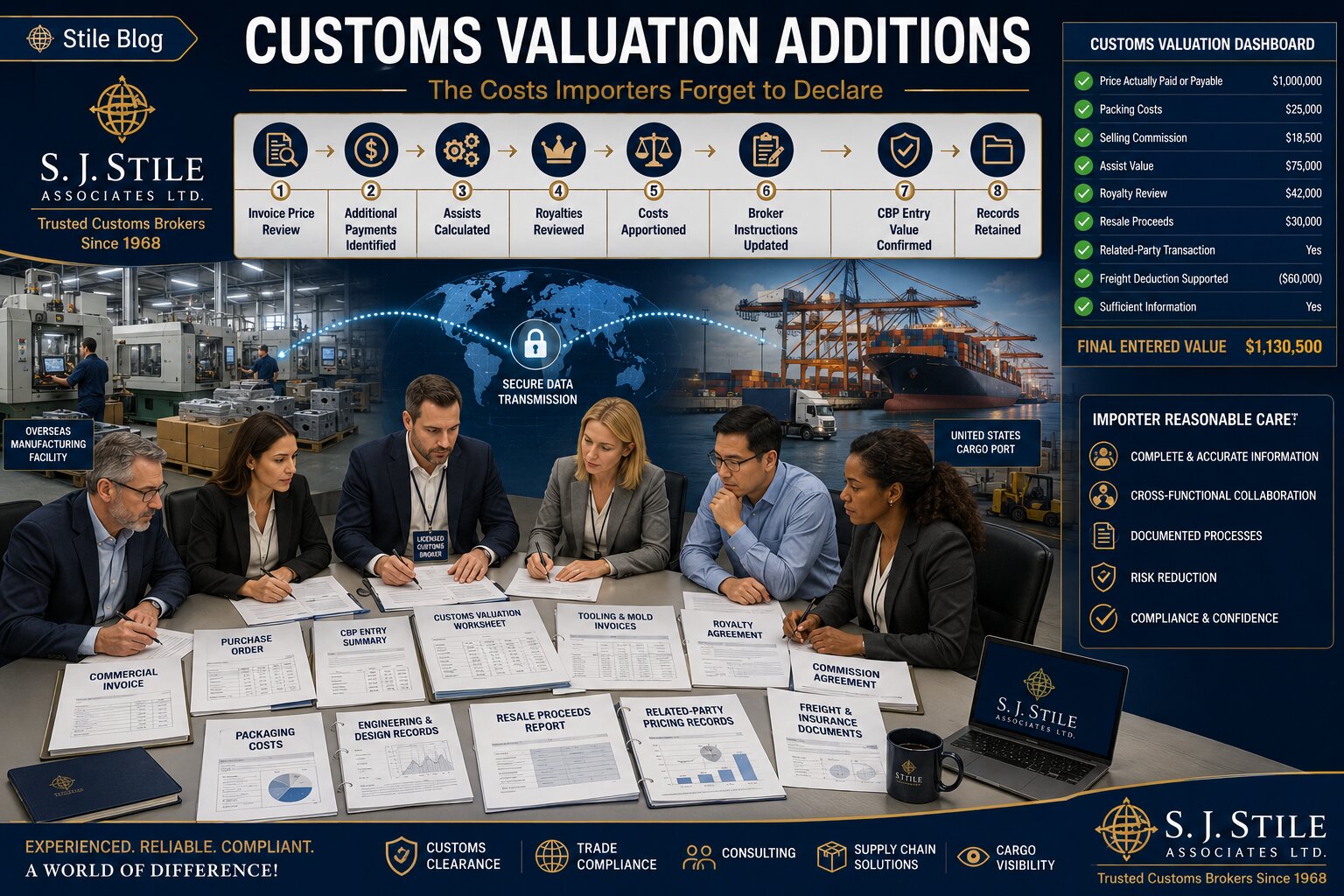
How Assists, Royalties, Packing, Commissions, and Resale Proceeds Can Increase Dutiable Value
Introduction
Many importers assume that the value declared to U.S. Customs and Border Protection is simply the amount printed on the foreign supplier’s commercial invoice.
That assumption can create significant compliance exposure.
Under U.S. customs valuation rules, the transaction value generally begins with the price actually paid or payable for merchandise sold for exportation to the United States. However, certain costs must be added when they are not already included in the invoice price.
These additions may include:
- Packing costs incurred by the buyer
- Selling commissions
- Assists provided to the manufacturer
- Certain royalties and license fees
- Proceeds from a subsequent resale that return to the seller
These expenses may be maintained by purchasing, engineering, licensing, accounting, product development, or marketing departments. As a result, the customs broker may never see them unless the importer establishes an internal process for identifying and reporting them.
The result can be an entered value that appears correct based on the invoice, but is incomplete under U.S. customs law.
Customs Value Is Not Always the Invoice Total
The preferred method of appraisement for most imported merchandise is transaction value.
Transaction value is generally the price actually paid or payable for the merchandise when sold for exportation to the United States, plus five specifically identified categories of additions:
- Packing costs incurred by the buyer
- Selling commissions incurred by the buyer
- The apportioned value of assists
- Certain royalties or license fees
- Proceeds from subsequent resale, disposal, or use that accrue to the seller
These additions apply only to the extent that they are not already included in the price actually paid or payable and can be supported by sufficient information. importer must look beyond the commercial invoice and examine the entire commercial arrangement surrounding the imported merchandise.
1. Packing Costs Incurred by the Buyer
Packing costs include the cost of containers, coverings, packing materials, and packing labor used to place merchandise in condition for shipment to the United States.
Examples may include:
- Export cartons
- Custom wooden crates
- Protective foam
- Pallets purchased for the shipment
- Specialized packaging
- Packing labor
- Product-specific coverings
- Buyer-supplied retail packaging
Under the customs regulations, packing costs generally include both labor and materials used to prepare the merchandise for shipment. ecomes a Valuation Problem
A valuation issue may arise when the importer:
- Purchases packaging separately
- Supplies packaging to the foreign manufacturer without charge
- Pays a third-party packaging company
- Provides labels, cartons, or retail boxes at a reduced price
- Pays a separate packing fee that does not appear on the commercial invoice
For example, an importer may pay a foreign manufacturer $100,000 for merchandise and separately purchase $4,000 in customized retail boxes that are sent to the factory.
If those boxes are used to pack the imported merchandise and the value is not already included in the supplier’s invoice price, the importer should determine whether the $4,000 must be included in the customs value.
2. Selling Commissions
A selling commission is generally a commission paid to an agent who works for, represents, or acts on behalf of the foreign seller or manufacturer.
Selling commissions incurred by the buyer are among the statutory additions to transaction value. Versus Buying Agent
Importers should distinguish between:
- A selling agent representing the foreign seller
- A bona fide buying agent representing the U.S. buyer
A selling commission is generally added to the customs value when it is not already included in the price.
A legitimate buying commission may receive different treatment, but merely describing a payment as a “buying commission” does not establish that it is nondutiable. CBP may examine the actual relationship, services performed, degree of control, payment structure, and contractual arrangements.
Importers using overseas agents should maintain:
- Agency agreements
- Commission invoices
- Payment records
- Correspondence describing the agent’s responsibilities
- Evidence showing which party controls the agent
- Documentation explaining how the commission was calculated
The importer should provide this information to its customs broker or customs counsel when the treatment of the commission is uncertain.
3. Assists Provided to the Foreign Manufacturer
Assists are among the most frequently overlooked customs valuation additions.
An assist generally exists when the buyer supplies certain goods or services directly or indirectly, free of charge or at a reduced cost, for use in producing merchandise for exportation to the United States.
Under 19 CFR § 152.102, assists may include:
- Materials, components, parts, and similar items incorporated into the imported merchandise
- Tools, dies, molds, and similar items used in production
- Merchandise consumed during production
- Engineering, development, artwork, design work, plans, and sketches undertaken outside the United States and necessary for production s of Assists
An importer may create an assist when it provides:
- Fabric or leather to an overseas apparel manufacturer
- Electronic components to an assembly facility
- Molds used to produce plastic products
- Dies used to stamp metal components
- Cutting tools or production equipment
- Chemicals consumed during manufacturing
- Product drawings prepared outside the United States
- Technical designs developed by a foreign engineering company
- Artwork necessary to manufacture branded packaging
- Prototypes used in the production process
The importer may not recognize these items as part of the purchase price because they were purchased from a different vendor or recorded as engineering, tooling, development, or capital expenses.
For customs purposes, however, their value may need to be added to the imported merchandise.
Valuing an Assist
The value of an assist may depend on how the buyer obtained it.
For example:
- If purchased from an unrelated supplier, the value may generally be based on acquisition cost.
- If produced by the buyer or a related party, the value may generally be based on production cost.
- Transportation expenses to the foreign place of production may also be included.
- Prior use, repairs, modifications, or leasing arrangements may affect the calculation.
The value must then be apportioned to the imported merchandise using a reasonable method supported by documentation and generally accepted accounting principles. pportionment Example
Assume a U.S. importer purchases a mold for $60,000 and sends it to a foreign manufacturer. The mold is expected to produce 120,000 imported units.
A simplified calculation could be:
Mold value: $60,000
Expected production: 120,000 units
Assist value per unit: $0.50
If 20,000 units are included in a shipment, the apportioned assist value for that shipment could be:
20,000 units × $0.50 = $10,000
The actual method must reflect the facts, anticipated production, supporting records, and applicable customs requirements.
2. Selling Commissions
A selling commission is generally a commission paid to an agent who works for, represents, or acts on behalf of the foreign seller or manufacturer.
Selling commissions incurred by the buyer are among the statutory additions to transaction value. Versus Buying Agent
Importers should distinguish between:
- A selling agent representing the foreign seller
- A bona fide buying agent representing the U.S. buyer
A selling commission is generally added to the customs value when it is not already included in the price.
A legitimate buying commission may receive different treatment, but merely describing a payment as a “buying commission” does not establish that it is nondutiable. CBP may examine the actual relationship, services performed, degree of control, payment structure, and contractual arrangements.
Importers using overseas agents should maintain:
- Agency agreements
- Commission invoices
- Payment records
- Correspondence describing the agent’s responsibilities
- Evidence showing which party controls the agent
- Documentation explaining how the commission was calculated
The importer should provide this information to its customs broker or customs counsel when the treatment of the commission is uncertain.
3. Assists Provided to the Foreign Manufacturer
Assists are among the most frequently overlooked customs valuation additions.
An assist generally exists when the buyer supplies certain goods or services directly or indirectly, free of charge or at a reduced cost, for use in producing merchandise for exportation to the United States.
Under 19 CFR § 152.102, assists may include:
- Materials, components, parts, and similar items incorporated into the imported merchandise
- Tools, dies, molds, and similar items used in production
- Merchandise consumed during production
- Engineering, development, artwork, design work, plans, and sketches undertaken outside the United States and necessary for production s of Assists
An importer may create an assist when it provides:
- Fabric or leather to an overseas apparel manufacturer
- Electronic components to an assembly facility
- Molds used to produce plastic products
- Dies used to stamp metal components
- Cutting tools or production equipment
- Chemicals consumed during manufacturing
- Product drawings prepared outside the United States
- Technical designs developed by a foreign engineering company
- Artwork necessary to manufacture branded packaging
- Prototypes used in the production process
The importer may not recognize these items as part of the purchase price because they were purchased from a different vendor or recorded as engineering, tooling, development, or capital expenses.
For customs purposes, however, their value may need to be added to the imported merchandise.
Valuing an Assist
The value of an assist may depend on how the buyer obtained it.
For example:
- If purchased from an unrelated supplier, the value may generally be based on acquisition cost.
- If produced by the buyer or a related party, the value may generally be based on production cost.
- Transportation expenses to the foreign place of production may also be included.
- Prior use, repairs, modifications, or leasing arrangements may affect the calculation.
The value must then be apportioned to the imported merchandise using a reasonable method supported by documentation and generally accepted accounting principles. pportionment Example
Assume a U.S. importer purchases a mold for $60,000 and sends it to a foreign manufacturer. The mold is expected to produce 120,000 imported units.
A simplified calculation could be:
Mold value: $60,000
Expected production: 120,000 units
Assist value per unit: $0.50
If 20,000 units are included in a shipment, the apportioned assist value for that shipment could be:
20,000 units × $0.50 = $10,000
The actual method must reflect the facts, anticipated production, supporting records, and applicable customs requirements.
4. Royalties and License Fees
Not every royalty is dutiable, and not every royalty is excluded.
The treatment depends on the facts of the commercial arrangement.
A royalty or license fee is generally added to transaction value when it:
- Relates to the imported merchandise
- Is paid directly or indirectly by the buyer
- Is required as a condition of the sale for exportation to the United States
- Is not already included in the price actually paid or payable
CBP evaluates royalty arrangements individually, including the purpose of the payment, the recipient, the relationship among the parties, and whether the merchandise could be purchased without paying the royalty. Require Careful Review
Importers should review payments involving:
- Trademarks
- Patents
- Manufacturing processes
- Brand licensing
- Product technology
- Franchise arrangements
- Copyrights
- Distribution rights
- Design licenses
- Payments calculated as a percentage of U.S. sales
Royalties associated with manufacturing processes may be treated differently from payments made for certain rights to distribute, reproduce, or market products after importation.
Because royalty determinations are highly fact-specific, importers should not rely only on the wording of an agreement or the name assigned to the payment.
Documents That Should Be Reviewed
A complete review may require:
- Purchase contracts
- License agreements
- Royalty agreements
- Manufacturing agreements
- Distribution agreements
- Trademark agreements
- Intercompany agreements
- Payment records
- Sales reports
- Correspondence among the manufacturer, licensor, and importer
The importer should determine whether the royalty is connected to the imported merchandise and whether payment is effectively required for the merchandise to be sold for exportation to the United States.
5. Proceeds of Subsequent Resale
Transaction value may also require an addition when part of the proceeds from the subsequent resale, disposal, or use of the merchandise accrues directly or indirectly to the foreign seller.
For example, an importer may initially pay the foreign seller $20 per unit and later pay an additional amount based on U.S. sales.
If the importer agrees to return a percentage of resale revenue or profit to the seller, that payment may be part of the customs value.
CBP regulations provide an example in which a buyer pays $1 per unit at importation and another $1 after the unit is sold in the United States. When the subsequent payment can be determined, the transaction value is $2 per unit. hat Should Be Examined
Importers should review:
- Revenue-sharing agreements
- Profit-sharing arrangements
- Earn-out payments
- Supplemental payments based on resale
- Payments based on sales volume
- End-of-year price adjustments
- Rebates flowing back to the seller
- Intercompany transfer-pricing adjustments
- Payments to parties related to the seller
Not every payment to a foreign seller is necessarily dutiable. Dividends and payments unrelated to the imported merchandise may receive different treatment. The facts and relationship to the imported merchandise must be evaluated.
Not every royalty is dutiable, and not every royalty is excluded.
The treatment depends on the facts of the commercial arrangement.
A royalty or license fee is generally added to transaction value when it:
- Relates to the imported merchandise
- Is paid directly or indirectly by the buyer
- Is required as a condition of the sale for exportation to the United States
- Is not already included in the price actually paid or payable
CBP evaluates royalty arrangements individually, including the purpose of the payment, the recipient, the relationship among the parties, and whether the merchandise could be purchased without paying the royalty. Require Careful Review
Importers should review payments involving:
- Trademarks
- Patents
- Manufacturing processes
- Brand licensing
- Product technology
- Franchise arrangements
- Copyrights
- Distribution rights
- Design licenses
- Payments calculated as a percentage of U.S. sales
Royalties associated with manufacturing processes may be treated differently from payments made for certain rights to distribute, reproduce, or market products after importation.
Because royalty determinations are highly fact-specific, importers should not rely only on the wording of an agreement or the name assigned to the payment.
Documents That Should Be Reviewed
A complete review may require:
- Purchase contracts
- License agreements
- Royalty agreements
- Manufacturing agreements
- Distribution agreements
- Trademark agreements
- Intercompany agreements
- Payment records
- Sales reports
- Correspondence among the manufacturer, licensor, and importer
The importer should determine whether the royalty is connected to the imported merchandise and whether payment is effectively required for the merchandise to be sold for exportation to the United States.
5. Proceeds of Subsequent Resale
Transaction value may also require an addition when part of the proceeds from the subsequent resale, disposal, or use of the merchandise accrues directly or indirectly to the foreign seller.
For example, an importer may initially pay the foreign seller $20 per unit and later pay an additional amount based on U.S. sales.
If the importer agrees to return a percentage of resale revenue or profit to the seller, that payment may be part of the customs value.
CBP regulations provide an example in which a buyer pays $1 per unit at importation and another $1 after the unit is sold in the United States. When the subsequent payment can be determined, the transaction value is $2 per unit. hat Should Be Examined
Importers should review:
- Revenue-sharing agreements
- Profit-sharing arrangements
- Earn-out payments
- Supplemental payments based on resale
- Payments based on sales volume
- End-of-year price adjustments
- Rebates flowing back to the seller
- Intercompany transfer-pricing adjustments
- Payments to parties related to the seller
Not every payment to a foreign seller is necessarily dutiable. Dividends and payments unrelated to the imported merchandise may receive different treatment. The facts and relationship to the imported merchandise must be evaluated.
Indirect Payments Can Also Affect Customs Value
The price actually paid or payable is not limited to money transferred directly to the foreign seller.
It can include payments made by the buyer for the benefit of the seller.
Examples may include:
- Paying a debt owed by the seller
- Paying one of the seller’s suppliers
- Providing a price reduction to settle an unrelated obligation
- Making a required payment to another party designated by the seller
- Providing goods or services that reduce the seller’s production costs
CBP regulations recognize that direct and indirect payments may be part of the price actually paid or payable. herefore review the complete payment flow, not only the invoice and wire transfer sent directly to the manufacturer.ted merchandise and the value is not already included in the supplier’s invoice price, the importer should determine whether the $4,000 must be included in the customs value.
Costs That May Be Excluded When Properly Identified
Certain costs may be excluded from transaction value when they are reasonable and separately identified.
These can include:
- International transportation, insurance, and related services
- Construction, erection, assembly, or maintenance performed after importation
- Technical assistance provided after importation
- Transportation occurring after importation
- Customs duties and certain federal taxes payable because of importation
The commercial documents should separately identify these charges. When costs are combined into a single price without sufficient supporting information, the importer may have difficulty establishing an exclusion. ot automatically deduct freight, insurance, technical services, or post-importation work without reliable documentation.
Why Valuation Errors Often Go Undetected
Customs valuation information is frequently divided among several departments.
| Department | Information It May Control |
| Purchasing | Supplier prices, commissions, purchase contracts |
| Engineering | Molds, tools, dies, drawings, and prototypes |
| Product development | Artwork, design work, samples, and specifications |
| Accounting | Supplemental payments, rebates, and adjustments |
| Legal | Royalty, trademark, distribution, and license agreements |
| Marketing | Brand fees, packaging, and promotional arrangements |
| Logistics | Freight, insurance, packing, and delivery costs |
| Customs compliance | Entry value and broker instructions |
The customs department or broker may receive only the commercial invoice. Unless the other departments report relevant payments and materials, the entered value may remain incomplete.
Why Incomplete Valuation Creates Compliance Risk
An incomplete customs value may lead to:
- Underpayment of duties
- Incorrect merchandise processing fees
- Inaccurate Section 301 or Section 232 duty calculations
- CBP Requests for Information
- Notices of Action
- Entry corrections
- Post Summary Corrections
- Additional duty bills
- Interest assessments
- Penalty exposure
- Prior disclosure reviews
- Expanded CBP audits
- Questions regarding the importer’s exercise of reasonable care
If sufficient information is unavailable to determine required additions, transaction value may not be acceptable as the method of appraisement. herefore be treated as an ongoing compliance process, not simply an invoice review performed at the time of entry.
A Practical Customs Valuation Review Process
Step 1: Map the Complete Transaction
Identify:
- The buyer
- The seller
- The manufacturer
- The licensor
- All agents
- Related parties
- Parties receiving payments connected to the merchandise
Step 2: Review Payments Outside the Commercial Invoice
Examine:
- General ledger accounts
- Tooling expenses
- Engineering expenses
- Royalty accounts
- Commission payments
- Year-end adjustments
- Intercompany charges
- Supplier credits
- Product development costs
Step 3: Identify Buyer-Supplied Property
Determine whether the buyer provided:
- Components
- Raw materials
- Packaging
- Labels
- Tools
- Molds
- Dies
- Drawings
- Artwork
- Designs
- Production equipment
Step 4: Review Contracts
Review purchase agreements, manufacturing contracts, agency agreements, license agreements, royalty agreements, and distribution contracts.
Step 5: Calculate and Apportion Additions
Document:
- The original cost
- Production or acquisition records
- Transportation to the factory
- Anticipated production
- Units already produced
- Units imported into the United States
- The selected apportionment method
- Management approval
Step 6: Communicate With the Customs Broker
Provide written instructions explaining:
- The invoice value
- Each required addition
- The method used to calculate it
- Whether the addition is shipment-specific or recurring
- Supporting documentation
- Procedures for future updates
Step 7: Test Previously Filed Entries
Review a sample of past entries to determine whether additions were reported consistently.
If an error is found, evaluate the appropriate corrective mechanism based on entry status, liquidation, scope, materiality, and legal advice.
Customs Valuation Checklist for Importers
Before filing an entry, ask:
- Does the commercial invoice include all payments made to or for the benefit of the seller?
- Did the buyer provide components, packaging, tools, dies, or molds?
- Did the buyer provide foreign engineering, artwork, plans, or designs?
- Are selling commissions paid separately?
- Are royalties or license fees connected to the imported merchandise?
- Is payment of a royalty required under the commercial arrangement?
- Does any portion of U.S. resale revenue return to the seller?
- Are there year-end price or transfer-pricing adjustments?
- Are freight and insurance deductions separately supported?
- Are post-importation services separately identified?
- Is the buyer related to the seller?
- Is sufficient information available to support every addition or exclusion?
- Has the customs broker received complete written instructions?
- Are the valuation records connected to the applicable entry numbers?
Frequently Asked Questions
1. Is the commercial invoice always the customs value?
No. The commercial invoice is an essential starting document, but the customs value may require additions for packing, selling commissions, assists, certain royalties, and resale proceeds.
2. What is the most commonly overlooked valuation addition?
Assists are frequently overlooked because tooling, molds, components, artwork, and engineering expenses may be recorded outside the purchasing or customs departments.
3. Is a mold supplied to a foreign manufacturer dutiable?
A mold supplied free of charge or at a reduced cost for use in producing imported merchandise may qualify as an assist. Its value may need to be apportioned and added to the customs value.
4. Is engineering work performed in the United States an assist?
Engineering, development, artwork, design work, plans, and sketches generally fall within the assist definition when undertaken outside the United States and necessary for production. The treatment of work performed in the United States depends on the applicable statutory and regulatory requirements. alties dutiable?
No. Royalty treatment depends on the relationship to the imported merchandise, whether the payment is required as a condition of sale, the recipient, and the complete commercial arrangement.
6. Can an importer spread the cost of an assist across multiple shipments?
The value of an assist may be apportioned using a reasonable method appropriate to the circumstances and supported by documentation and generally accepted accounting principles.
7. Are buying commissions dutiable?
A bona fide buying commission may be treated differently from a selling commission. The importer must be able to demonstrate the true agency relationship through contracts, payment records, control, and the services performed.
8. What happens if the importer cannot calculate an addition?
If sufficient information is not available to determine a required addition, transaction value may not be acceptable. Another legally authorized appraisement method may need to be considered.
9. Should related-party importers review customs value separately from transfer pricing?
Yes. Tax transfer-pricing policies do not automatically establish an acceptable customs value. Related-party importers should review whether the relationship influenced the price and maintain supporting customs valuation documentation. should customs valuation be reviewed?
Importers should review valuation whenever there is a new supplier, product, manufacturing arrangement, license, assist, agent, related-party relationship, or pricing adjustment. Periodic entry testing should also be incorporated into the importer’s compliance program.
How S. J. Stile Associates Helps Importers
S. J. Stile Associates assists importers in identifying and managing customs valuation risks before they become entry problems.
Our customs compliance support can include:
- Reviewing commercial invoices and broker instructions
- Identifying potential assists
- Coordinating tooling and mold calculations
- Reviewing recurring valuation additions
- Supporting royalty and commission reviews
- Examining related-party transactions
- Developing valuation questionnaires
- Creating documented valuation procedures
- Reviewing entry data for inconsistencies
- Supporting Post Summary Corrections and other corrective actions
- Organizing records for CBP inquiries and audits
- Coordinating with the importer’s legal, accounting, purchasing, and logistics teams
The importer remains legally responsible for the accuracy of its entries. A knowledgeable customs broker can help ensure that the information reaching CBP reflects the complete commercial transaction.
Final Takeaway
The price printed on a commercial invoice does not always represent the complete customs value.
Importer-provided molds, tools, packaging, components, foreign design work, selling commissions, royalties, and resale payments can materially affect the value declared to CBP.
The strongest compliance approach is to establish a cross-functional valuation process that connects purchasing, engineering, legal, accounting, logistics, and customs operations.
Valuation accuracy begins before the shipment arrives. It begins when the importer understands every payment, service, material, and commercial agreement connected to the imported merchandise.
Choose Stile, Your Smartest Move in Global Trade
Since 1968, S. J. Stile Associates Ltd. has helped importers navigate the complexities of U.S. customs clearance, valuation, classification, documentation, and regulatory compliance.
Our experienced professionals combine personalized service, advanced technology, and real-time cargo visibility to help importers manage risk and keep shipments moving.
S. J. Stile Associates Ltd.
Trusted Customs Brokers Since 1968
A World of Difference!
The Stile Associates Advantage
- More than 55 years of continuous industry experience
- Family leadership with modern trade vision
- Licensed Customs Brokers and compliance professionals
- CTPAT certified supply chain security
- Full service customs and logistics solutions
- Technology driven visibility and control
- Dedicated, personalized client service
- Nationwide U.S. coverage with global support
Choosing S.J. Stile Associates means partnering with a customs broker that understands the realities of today’s trade environment and is fully invested in protecting your business.
Contact S.J. Stile Associates today to learn how we can strengthen your compliance posture and streamline your supply chain.


We’re not just a broker; we’re your strategic compliance partner.
Since 1968, our clients have trusted us to:
- Navigate regulatory shocks
- Deliver personal service from our NYC, Miami, and LA offices
- Build resilient import strategies that drive growth
In this new trade era, trust is everything , and that’s why importers stay with Stile for years.

Call to Action
At Stile Associates, we combine over 55 years of experience with the latest technology to keep your imports compliant and efficient.
Contact us today to explore how AI-driven solutions can optimize your customs operations.


📣 Final Call to Action:
Ready to take control of your shipping costs?
Let’s talk. Contact Stile Associates for a free consultation and let our experts audit your current process, to help you streamline your operations, stay compliant, and save money.

💼 Choose Stile, Your Smartest Move in Global Trade
Whether you’re shipping across the country or across continents, Stile Associates is your strategic partner for building a smarter, more resilient supply chain.
📍 Since 1968, we’ve been delivering peace of mind and performance. Let’s take your logistics to the next level together.
🌐 Visit us at www.stileintl.com
📩 Or contact: stevenheid@stileintl.com
Stile Associates – Trusted. Proven. Personal.
Stile Real Time Cargo Tracking with Global Visibility.

