

Introduction
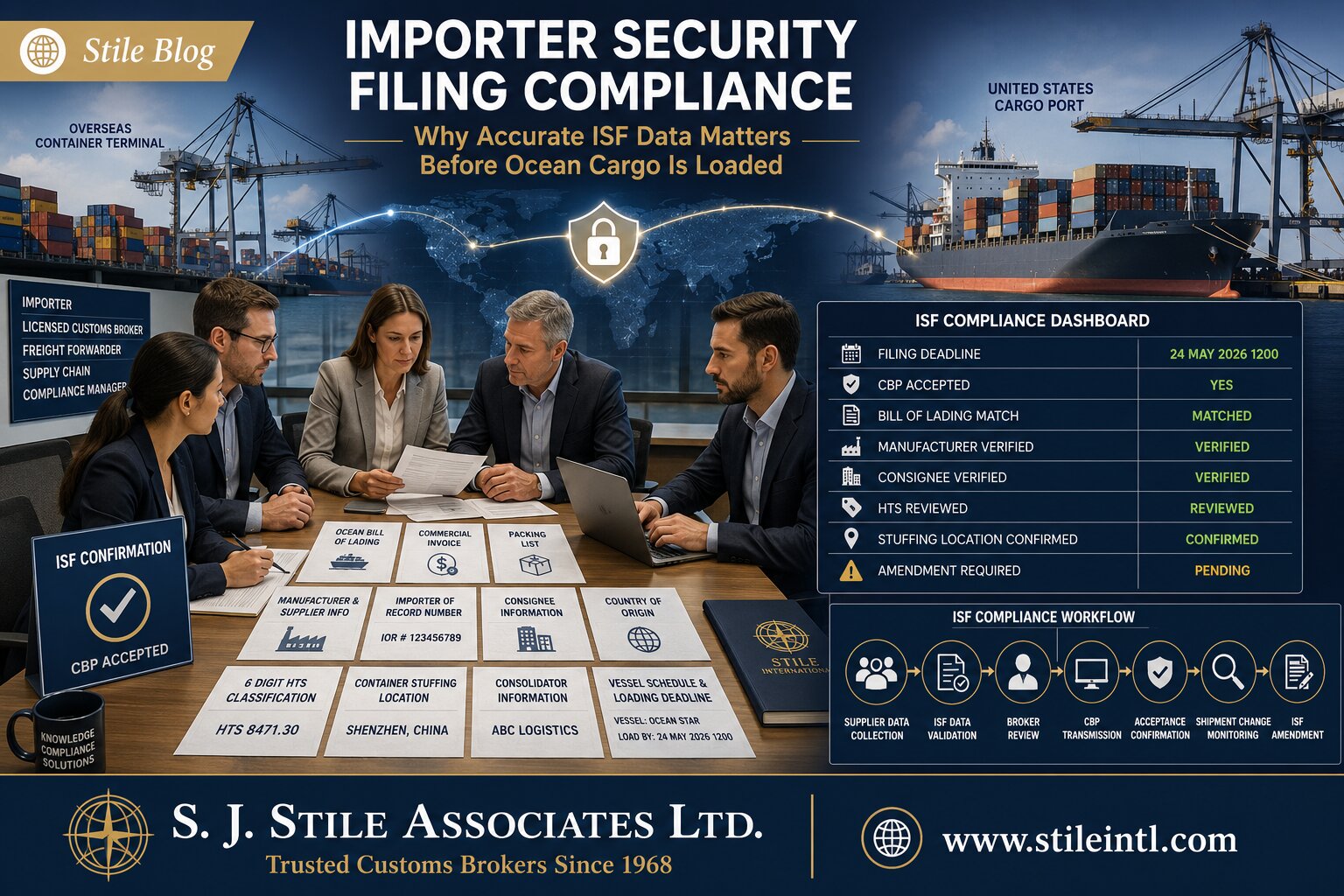
Importer Security Filing, commonly called ISF or “10+2,” is sometimes treated as a routine shipping formality. In practice, it is a federal cargo security requirement that begins before ocean cargo is loaded at the foreign port.
For most covered vessel shipments, the required ISF information must be transmitted to U.S. Customs and Border Protection before loading. The filing must also be updated when information changes or more accurate information becomes available before the goods arrive within the limits of a United States port.
This makes ISF compliance more than a timing issue. Importers must also consider data accuracy, supplier communication, filing responsibility, shipment changes, record retention, and coordination among the importer, customs broker, freight forwarder, carrier, and overseas vendor.
An ISF may be transmitted on time and still create compliance exposure if it identifies the wrong parties, uses incomplete routing information, contains an inaccurate manufacturer, or is not updated after the shipment changes.
Regulatory and Policy Context
Importer Security Filing requirements are established under 19 CFR Part 149. The regulation defines the ISF Importer as the party causing the goods to arrive within the limits of a United States port by vessel.
For most commercial shipments, the ISF Importer may be the owner, purchaser, consignee, or an authorized agent, including a licensed customs broker. The use of an agent does not eliminate the need for the importer to provide complete and accurate information or to maintain effective oversight of the filing process.
CBP’s ISF requirements generally apply to cargo arriving in the United States by ocean vessel. They do not apply in the same manner to cargo arriving solely by air, truck, or rail.
The rule became effective on January 26, 2009, and remains part of CBP’s advance cargo security framework.
The Principal ISF Data Elements
CBP expeFor shipments subject to the standard ISF requirement, the filing generally includes information concerning:
- Seller
- Buyer
- Importer of record number or Foreign Trade Zone applicant identification number
- Consignee number
- Manufacturer or supplier
- Ship to party
- Country of origin
- Commodity classification number
- Container stuffing location
- Consolidator
The carrier separately provides vessel stow plan and container status information, which account for the additional two elements associated with the term “10+2.”
The precise filing requirements can vary for certain cargo movements, including foreign cargo remaining on board, immediate exportation shipments, transportation and exportation shipments, and cargo intended for a Foreign Trade Zone. Importers should determine the correct filing structure before relying on a standard commercial shipment workflow.
What CBP Expects
Timely Transmission
For most covered shipments, specified ISF data must be submitted no later than 24 hours before the cargo is laden aboard the vessel at the foreign port.
Certain data elements may be transmitted under regulatory flexibility when the filer does not yet have the final information, but the information provided must be based on the best information reasonably available at the time of filing. The filing must later be updated when more accurate information becomes available.
Accurate Party Identification
CBP expects the filing to correctly identify the commercial parties involved in the transaction.
Importers should not assume that the foreign exporter, trading company, buying agent, manufacturer, and seller are always the same entity. The documents should be reviewed to determine the actual role of each party.
A filing that simply copies the name appearing at the top of a commercial invoice may be inaccurate when the invoice is issued by an intermediary rather than the actual manufacturer or supplier.
Meaningful Commodity Information
The ISF requires commodity classification information at the six digit Harmonized Tariff Schedule level.
Although the ISF classification may be less detailed than the classification reported at entry, the importer should use a classification that accurately represents the merchandise. Generic or unsupported commodity descriptions can create inconsistencies between the ISF, commercial invoice, entry documentation, and other supply chain records.
Updates When Information Changes
The party that submitted the ISF must update the filing when submitted information changes or when more accurate information becomes available before the goods enter the limits of a United States port.
Common changes may include:
• A different vessel or voyage
• A revised bill of lading
• A different container stuffing location
• A substituted manufacturer or supplier
• A change in consignee
• A revised country of origin
• A corrected commodity classification
• A change in the party receiving the goods in the United States
The importer should have a defined process for communicating these changes to the ISF filer.
Consistency Across Customs Records
CBP may compare ISF information with:
• The vessel manifest
• Entry and entry summary data
• Commercial invoices
• Bills of lading
• Packing lists
• Country of origin records
• Manufacturer information
• Broker records
• Carrier information
• Supply chain security records
Differences are not automatically violations, because legitimate commercial changes can occur. However, unexplained inconsistencies may indicate weak controls or unreliable data.
Common ISF Compliance Gaps
Filing Too Close to Vessel Loading
Importers often receive documentation shortly before the carrier’s cutoff. This leaves little time to identify missing information, confirm the bill of lading, validate the manufacturer, or resolve classification questions.
The result may be a late filing, an incomplete filing, or a filing based on assumptions.
Using Estimated Sailing Dates Instead of Actual Loading Information
A shipment schedule may change without the importer being notified. Importers should distinguish between booking dates, estimated departure dates, carrier cutoff dates, and the actual vessel loading deadline.
Incorrect Manufacturer or Supplier
A seller, exporter, distributor, buying agent, and manufacturer may be different entities. Importers should obtain the identity and address of the party that last manufactured, assembled, produced, or grew the merchandise, when applicable.
Incorrect Ship To Party
The ship to party should reflect the first scheduled delivery location in the United States after release from CBP custody.
Using the importer’s corporate headquarters when the cargo is actually scheduled for a warehouse, fulfillment center, distribution facility, or customer location may result in inaccurate information.
Incomplete Container Stuffing Information
The container stuffing location is frequently unknown when purchase orders are issued. Importers may rely on suppliers, consolidators, or freight forwarders to provide it.
A vague city name or the forwarder’s corporate office may not accurately identify the physical location where the cargo was loaded into the container.
Unsupported HTS Classification
Some importers use broad classifications simply to complete the ISF. That approach can create inconsistencies with the entry filing and may conceal unresolved classification issues.
The six digit classification used for the ISF should be supported by available product information.
Failure to Update the Filing
An importer may file the ISF and assume that the process is complete. However, the regulation requires updates when information changes or more accurate information becomes available before arrival.
Unclear Responsibility Between Service Providers
The freight forwarder may control the booking, the customs broker may transmit the ISF, the supplier may provide the data, and the importer may assume another party is monitoring the deadline.
Without clearly assigned responsibilities, each participant may believe someone else is managing the filing.
Filing Under the Wrong Importer Number
The importer of record number and consignee number should be verified before transmission. Problems can occur when affiliated companies, divisions, foreign entities, previous importers, or customer numbers are used incorrectly.
Practical Steps for Importers
1. Establish a Written ISF Procedure
The procedure should identify:
• Which shipments require an ISF
• Who collects the information
• Who validates the data
• Who authorizes the filing
• Who transmits the filing
• Who monitors acceptance messages
• Who communicates shipment changes
• Who maintains the records
• Who reviews late or inaccurate filings
2. Create a Standard Supplier Data Form
The form should request the required information in a consistent format, including full legal names and complete addresses.
Suppliers should be instructed not to substitute a forwarder, booking agent, or trading company for the actual manufacturer or stuffing location unless that party correctly satisfies the regulatory definition.
3. Set an Internal Deadline Earlier Than the CBP Deadline
The importer should not use the regulatory deadline as its internal operating deadline.
An earlier internal cutoff provides time to:
• Review missing information
• Resolve party identification questions
• Confirm classification
• Verify the bill of lading
• Correct rejected transmissions
• Respond to vessel schedule changes
4. Require Confirmation of Successful Transmission
Submitting information to a service provider is not the same as receiving confirmation that CBP accepted the filing.
Importers should obtain evidence showing:
• Filing date and time
• Bill of lading information
• ISF transaction number
• CBP acceptance status
• Filing party
• Amendments or updates
• Final filing status
5. Compare the ISF With Entry Documentation
Before filing the customs entry, compare the ISF with:
• Commercial invoice
• Packing list
• Bill of lading
• Manufacturer information
• Country of origin
• Importer number
• Consignee number
• HTS classification
• Final delivery location
Differences should be investigated and documented.
6. Monitor Amendments and Shipment Changes
The importer should require suppliers, forwarders, and carriers to report changes immediately.
A written escalation process should be used when changes affect:
• Vessel or voyage
• Bill of lading
• Manufacturer
• Seller
• Buyer
• Consignee
• Ship to party
• Country of origin
• HTS classification
• Stuffing location
• Consolidator
7. Review Filing Performance
Importers should periodically evaluate:
• Percentage of filings submitted on time
• Number of rejected filings
• Number of filings requiring amendments
• Most common missing data elements
• Suppliers creating repeated delays
• Forwarders with recurring documentation problems
• Differences between ISF and entry data
• Shipments loaded before confirmation
• Filings associated with CBP holds or inquiries
8. Maintain Supporting Records
The compliance file should include the information used to prepare the ISF, evidence of transmission, CBP response messages, amendments, communications with the supplier, and documentation explaining material changes.
9. Include ISF Controls in Supplier and Forwarder Agreements
Service expectations should address:
• Data delivery deadlines
• Required document format
• Accuracy responsibilities
• Change notifications
• Escalation contacts
• Record availability
• Performance reporting
• Responsibility for preventable errors
Contract language should be reviewed by qualified legal counsel where appropriate.
Importer Risk and Broker Responsibility
A licensed customs broker may transmit the ISF as the importer’s authorized agent. However, the broker depends on the importer and its supply chain partners for accurate commercial and logistical information.
The broker generally does not control:
• The overseas manufacturing location
• The identity of undisclosed suppliers
• The physical container stuffing location
• Last minute booking changes
• Changes in the final consignee
• Product composition
• Country of origin facts
• Internal purchasing arrangements
Importers should therefore treat the broker as part of the compliance control environment, not as a replacement for importer oversight.
The strongest process combines importer knowledge, supplier documentation, forwarder shipment information, carrier data, and broker filing expertise.
How S. J. Stile Associates Can Help
S. J. Stile Associates Ltd. can assist importers with the operational and customs related aspects of the ISF process, including:
• Reviewing required ISF information
• Identifying missing or inconsistent data
• Transmitting ISF information through approved customs systems
• Monitoring CBP acceptance and rejection messages
• Coordinating corrections and amendments
• Comparing ISF information with entry documentation
• Supporting written compliance procedures
• Helping importers establish practical supplier documentation controls
• Identifying recurring filing weaknesses
The importer remains responsible for providing accurate and timely information. Effective cooperation among the importer, supplier, freight forwarder, carrier, and customs broker helps reduce preventable errors and supply chain disruption.
Frequently Asked Questions
Does every import shipment require an ISF?
No. ISF requirements generally apply to cargo arriving in the United States by vessel. The specific requirements depend on the shipment type and cargo movement.
Is the ISF required for air shipments?
The standard vessel ISF requirement under 19 CFR Part 149 does not apply to cargo arriving solely by air.
Who is responsible for the ISF?
The ISF Importer is the party causing the goods to arrive within the limits of a United States port by vessel. For most commercial shipments, this may be the owner, purchaser, consignee, or an authorized agent.
Can a customs broker file the ISF?
Yes. An eligible authorized agent, including a licensed customs broker, may transmit the filing through an approved electronic data interchange system.
When must the ISF be filed?
For most covered cargo, specified information must be transmitted no later than 24 hours before the cargo is laden aboard the vessel at the foreign port. Special rules may apply to certain shipment types.
Can an ISF be filed before all information is final?
Certain information may be transmitted using the best information reasonably available under the regulatory flexibility provisions. The filing must be updated when more accurate information becomes available before arrival.
Must the ISF be updated after it is filed?
Yes. The filer must update the ISF when submitted information changes or when more accurate information becomes available before the goods enter the limits of a United States port.
Is an ISF the same as a customs entry?
No. The ISF is an advance cargo security filing. The customs entry and entry summary serve separate admissibility, classification, valuation, duty, statistical, and regulatory purposes.
Can the ISF and customs entry be transmitted together?
CBP regulations permit ISF and entry or entry summary information to be submitted through a single electronic transmission when the applicable requirements are satisfied.
What should an importer do when the supplier does not provide the information on time?
The importer should escalate the issue before cargo loading, notify the customs broker or ISF filer, document the communications, and determine whether reliable information can be obtained from another supply chain party. Repeated delays should be addressed through supplier performance controls.
Should importers audit previous ISF filings?
Periodic reviews can help identify late filings, inaccurate parties, missing amendments, classification inconsistencies, and suppliers or forwarders creating repeated compliance problems.
Conclusion
Importer Security Filing compliance begins well before cargo reaches a United States port.
A timely filing is important, but timing alone is not sufficient. The importer must also establish controls for collecting, validating, transmitting, updating, and retaining accurate shipment information.
Importers that depend entirely on suppliers or freight forwarders without reviewing the information may be unable to demonstrate effective oversight when errors occur.
A documented ISF process, supported by reliable supplier data, early internal deadlines, confirmation of CBP acceptance, amendment controls, and coordination with a licensed customs broker, can reduce avoidable customs and supply chain exposure.
References
- U.S. Customs and Border Protection, Importer Security Filing “10+2.”
- Electronic Code of Federal Regulations, 19 CFR Part 149, Importer Security Filing.
- Electronic Code of Federal Regulations, 19 CFR 149.2, Filing Requirements and Time of Transmission.
- Electronic Code of Federal Regulations, 19 CFR 149.3, Data Elements.
- Electronic Code of Federal Regulations, 19 CFR 149.5, Eligibility and Authorized Agents.
- U.S. Customs and Border Protection, ISF Program Frequently Asked Questions.
- Federal Register, Cargo Manifest, Vessel Stow Plan, Container Status Messages, and Importer Security Filing Information Collection Notice, July 1, 2026.
The Stile Associates Advantage
- More than 55 years of continuous industry experience
- Family leadership with modern trade vision
- Licensed Customs Brokers and compliance professionals
- CTPAT certified supply chain security
- Full service customs and logistics solutions
- Technology driven visibility and control
- Dedicated, personalized client service
- Nationwide U.S. coverage with global support
Choosing S.J. Stile Associates means partnering with a customs broker that understands the realities of today’s trade environment and is fully invested in protecting your business.
Contact S.J. Stile Associates today to learn how we can strengthen your compliance posture and streamline your supply chain.


We’re not just a broker; we’re your strategic compliance partner.
Since 1968, our clients have trusted us to:
- Navigate regulatory shocks
- Deliver personal service from our NYC, Miami, and LA offices
- Build resilient import strategies that drive growth
In this new trade era, trust is everything , and that’s why importers stay with Stile for years.

Call to Action
At Stile Associates, we combine over 55 years of experience with the latest technology to keep your imports compliant and efficient.
Contact us today to explore how AI-driven solutions can optimize your customs operations.


📣 Final Call to Action:
Ready to take control of your shipping costs?
Let’s talk. Contact Stile Associates for a free consultation and let our experts audit your current process, to help you streamline your operations, stay compliant, and save money.

💼 Choose Stile, Your Smartest Move in Global Trade
Whether you’re shipping across the country or across continents, Stile Associates is your strategic partner for building a smarter, more resilient supply chain.
📍 Since 1968, we’ve been delivering peace of mind and performance. Let’s take your logistics to the next level together.
🌐 Visit us at www.stileintl.com
📩 Or contact: stevenheid@stileintl.com
Stile Associates – Trusted. Proven. Personal.
Stile Real Time Cargo Tracking with Global Visibility.

