

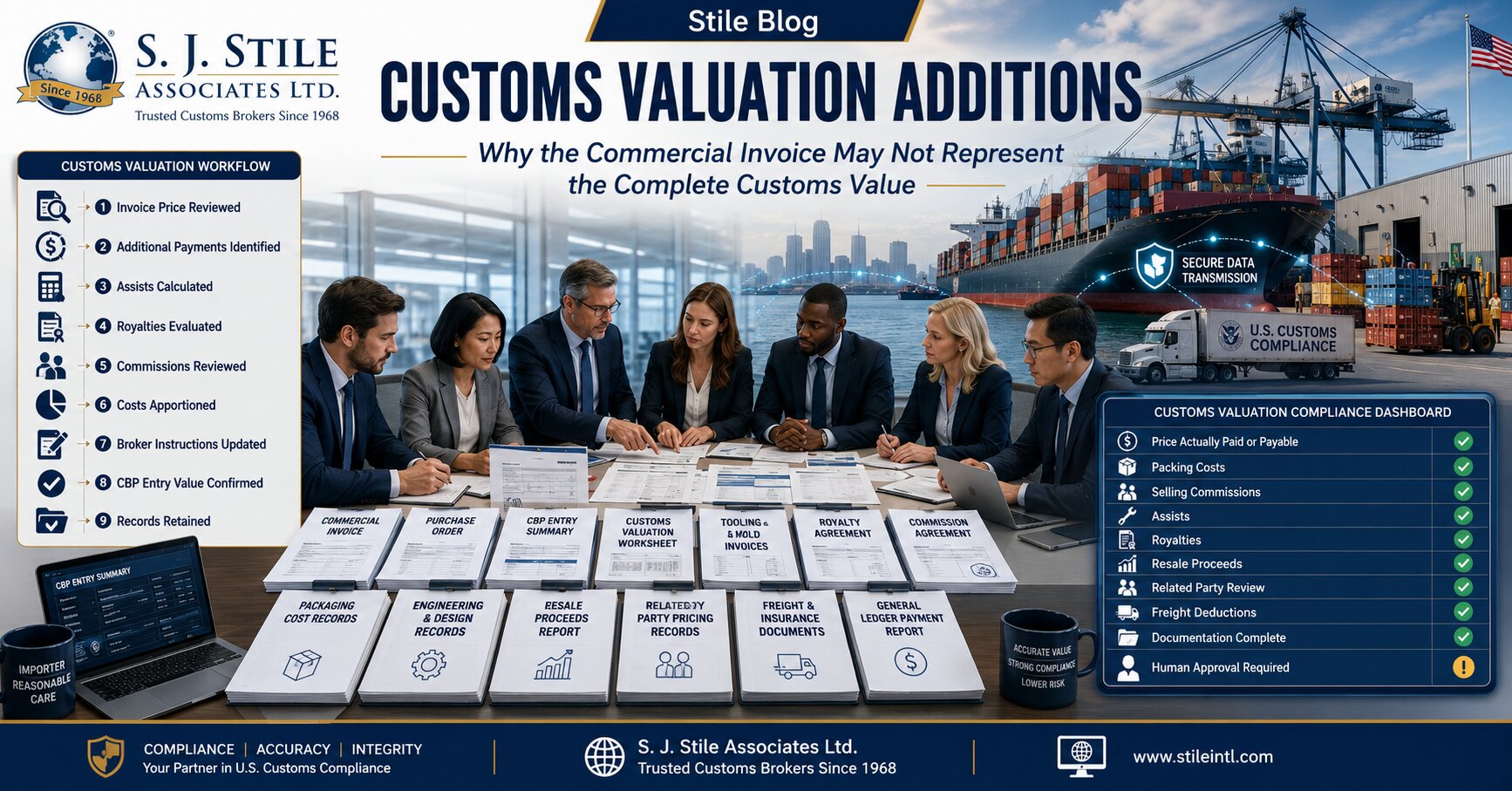
Why the Commercial Invoice May Not Represent the Complete Customs Value
Introduction
The amount shown on a commercial invoice is often the starting point for determining the customs value of imported merchandise. It is not always the final amount that must be declared to U.S. Customs and Border Protection.
Importers may make additional payments or provide materials, tooling, engineering services, packaging, intellectual property rights, or other benefits that are not included in the supplier’s invoice. Depending on the facts of the transaction, some of those items must be added to the price actually paid or payable when the merchandise is entered.
Customs valuation therefore cannot be treated solely as an invoice processing function. It requires coordination among purchasing, accounting, engineering, legal, licensing, supply chain, and customs compliance personnel.
CBP states that declared value should include applicable selling commissions, assists, royalties, production costs, packing costs, and proceeds. CBP also warns that failure to include required additions may result in undervaluation of the merchandise.
For importers, the compliance risk is significant. An incorrect value can affect customs duties, merchandise processing fees, special tariffs, statistical reporting, and the accuracy of the entry declaration.
Regulatory and Policy Context
Transaction Value
The primary method of appraising imported merchandise is generally transaction value.
Under 19 U.S.C. § 1401a, transaction value is the price actually paid or payable for merchandise when sold for exportation to the United States, plus certain statutory additions. Those additions include:
- Packing costs incurred by the buyer
- Selling commissions incurred by the buyer
- The value of assists, apportioned as appropriate
- Certain royalties or license fees
- Proceeds from a subsequent resale, disposal, or use that accrue directly or indirectly to the seller
The implementing regulations are found in 19 CFR Part 152, including 19 CFR § 152.103. The regulation explains how transaction value is determined and how the price actually paid or payable and applicable additions are treated.
Price Actually Paid or Payable
The price actually paid or payable generally includes the total payment made, or to be made, by the buyer to the seller, or for the seller’s benefit, for the imported merchandise.
Payments do not need to appear on the commercial invoice to be relevant. A separate payment, reimbursement, credit arrangement, settlement, or payment to another party may be part of the customs value when it is made for the benefit of the seller or is connected to the imported merchandise.
International transportation, insurance, and related services may generally be excluded when they are properly identified and supported. Post importation transportation and certain post importation construction, assembly, maintenance, or technical assistance costs may also be excluded when statutory requirements are satisfied and the amounts are separately identified.
Importer Reasonable Care
The importer of record is responsible for using reasonable care when providing CBP with the information necessary to assess duties, collect accurate trade statistics, and determine whether the merchandise satisfies applicable legal requirements.
A customs broker may assist with entry preparation and transmission. However, the broker normally does not have independent access to the importer’s royalty agreements, tooling purchases, accounting records, engineering contracts, resale arrangements, or internal cost allocations.
The importer must therefore identify potentially dutiable payments and communicate them to its customs broker in a timely and complete manner.
What CBP Expects Importers to Understand
Packing Costs
Packing costs incurred by the buyer with respect to imported merchandise are a statutory addition to transaction value when they are not already included in the price.
These costs may include:
- Containers and coverings used to prepare the merchandise for shipment
- Packing materials
- Packing labor
- Special export packaging
- Repacking performed before importation
- Product presentation materials supplied by the buyer
An importer should not assume that packing costs are nondutiable simply because the buyer paid a separate vendor.
The determining question is whether the expense represents packing associated with the imported merchandise and whether it is already included in the supplier’s price.
Selling Commissions
A selling commission incurred by the buyer must generally be added to transaction value.
A selling agent normally represents the seller by locating customers, negotiating sales, promoting merchandise, or otherwise acting on the seller’s behalf.
This must be distinguished from a bona fide buying commission. A buying commission paid to a genuine buying agent may not be dutiable, but the importer must be able to substantiate the agency relationship and demonstrate that the agent acted on behalf of the buyer.
The name used on an invoice is not controlling. CBP may evaluate the actual functions performed, the degree of control exercised by the buyer, the financial relationship among the parties, and whether the agent acted independently from the seller.
Assists
An assist may arise when the importer provides certain goods or services to the foreign producer free of charge or at a reduced cost for use in producing merchandise for export to the United States.
Under 19 CFR § 152.102, assists can include qualifying materials, components, parts, tools, dies, molds, consumable items, and certain engineering, development, artwork, design work, plans, or sketches undertaken outside the United States.
Common examples include:
- Molds supplied to an overseas factory
- Tooling purchased by the importer and sent to the manufacturer
- Fabric, labels, fasteners, or components furnished without charge
- Materials sold to the producer below cost
- Engineering or design work performed outside the United States
- Production equipment provided for use in manufacturing imported merchandise
The value of an assist must be determined and apportioned appropriately to the imported merchandise.
An assist may be overlooked when the tooling or service is purchased by an engineering department rather than the purchasing or customs department. The supplier’s invoice may contain only the unit price for the finished merchandise and may not identify the buyer supplied contribution.
Royalties and License Fees
A royalty or license fee may be included in transaction value when it relates to the imported merchandise and the buyer is required to pay it, directly or indirectly, as a condition of the sale for exportation to the United States.
The analysis is fact specific.
Relevant documentation may include:
- Trademark agreements
- Patent licenses
- Technology agreements
- Franchise agreements
- Manufacturing licenses
- Distribution agreements
- Purchase contracts
- Royalty calculation schedules
- Communications among the buyer, seller, and rights holder
The fact that a royalty is paid to a third party does not automatically make it nondutiable. CBP examines the relationship among the parties and the connection between the payment, the imported merchandise, and the sale.
CBP rulings consistently analyze whether the payment relates to the imported merchandise and whether the buyer is required to make the payment as a condition of the sale.
Importers should not make royalty determinations based only on the title of an agreement or the identity of the payment recipient.
Proceeds of Subsequent Resale
Transaction value includes the value of any part of the proceeds from a subsequent resale, disposal, or use of imported merchandise that accrues directly or indirectly to the seller.
Examples may include:
- A percentage of United States resale revenue returned to the foreign seller
- A contractual participation in future sales
- Profit sharing connected to imported merchandise
- Payments triggered by downstream distribution
- Adjustments based on the importer’s resale performance
These arrangements require close review because the final amount may not be known at the time of entry.
The importer may need a valuation procedure that addresses estimated amounts, later adjustments, reconciliation, or another CBP approved reporting method, depending on the facts.
Related Party Transactions
A relationship between the buyer and seller does not automatically prevent the use of transaction value.
However, transaction value is acceptable in a related party transaction only when the relationship did not influence the price, or when the declared value satisfies an applicable test value standard.
Importers should maintain evidence supporting the acceptability of the transfer price for customs purposes. A transfer pricing study prepared for income tax purposes may be useful, but it does not automatically establish that the customs value is acceptable.
CBP provides specific guidance concerning the acceptability of transaction value in related party transactions.
Common Customs Valuation Compliance Gaps
Customs Reviews Only the Commercial Invoice
The entry team may declare the invoice amount without reviewing payments recorded elsewhere in the company.
This process can miss tooling, royalties, commissions, packaging, engineering charges, and payments made through another corporate entity.
Accounting Codes Do Not Identify Dutiable Payments
General ledger accounts may classify payments as product development, consulting, marketing, licensing, machinery, samples, or professional services.
Those accounting classifications do not determine customs treatment. A payment recorded as an operating expense may still affect the customs value.
Engineering Purchases Tooling Without Customs Review
Engineering teams may purchase molds, dies, fixtures, patterns, or production equipment for use by a foreign manufacturer.
When customs compliance personnel are not informed, the assist may never be added to entered value.
Royalty Agreements Are Not Shared
Legal or finance departments may negotiate intellectual property agreements without evaluating customs consequences.
The customs team may receive only the supplier’s commercial invoice and may have no knowledge of the separate royalty arrangement.
Costs Are Not Apportioned Consistently
An importer may identify an assist but lack a written method for allocating its value across the merchandise produced with it.
Inconsistent or unsupported allocation methods can create valuation errors across multiple entries.
Buying and Selling Commissions Are Confused
Invoices may describe a payment merely as a commission.
Without reviewing the agent’s actual role, the importer may incorrectly exclude a selling commission or incorrectly include a legitimate buying commission.
Related Party Prices Are Accepted Without Analysis
An importer may rely on an intercompany price because it appears on the commercial invoice and is used for tax or accounting purposes.
Customs valuation requires a separate analysis of whether the relationship influenced the price.
Freight Deductions Are Unsupported
Importers may deduct estimated freight or insurance amounts from an invoice without retaining invoices, contracts, payment records, or other evidence supporting the deduction.
CBP guidance emphasizes the need for proper documentation when freight and related costs are deducted from customs value.
Broker Instructions Are Incomplete
The customs broker may receive an invoice but no instructions concerning assists, royalties, commission arrangements, related party status, or later value adjustments.
A broker cannot accurately report information that has not been disclosed by the importer.
Practical Steps for Importers
1. Create a Customs Valuation Questionnaire
Develop a questionnaire covering:
- Payments made outside the commercial invoice
- Tooling, molds, dies, and production equipment
- Buyer supplied materials or components
- Engineering and design services
- Royalties and license fees
- Buying and selling commissions
- Packaging and repacking expenses
- Related party transactions
- Resale proceeds
- Rebates and price adjustments
- International freight and insurance deductions
The questionnaire should be completed during supplier onboarding and updated when commercial arrangements change.
2. Establish Cross Functional Review
Customs valuation should involve representatives from:
- Customs compliance
- Purchasing
- Accounts payable
- Finance
- Engineering
- Product development
- Legal
- Tax
- Logistics
- Internal audit
A periodic cross functional review can identify payments that are invisible to the customs entry process.
3. Map General Ledger Accounts
Review general ledger accounts for payments that may affect customs value.
The customs team should receive reports identifying payments to:
- Foreign suppliers
- Related companies
- Foreign manufacturers
- Licensing entities
- Selling agents
- Engineering firms
- Tooling vendors
- Packaging companies
Accounting personnel should be trained to flag transactions that may require customs review.
4. Maintain an Assist Register
The register should identify:
- Assist description
- Foreign producer
- Related imported products
- Purchase cost
- Transportation cost to the production location
- Repair or modification costs
- Expected production quantity
- Apportionment method
- Amount already declared
- Remaining unallocated value
- Supporting documentation
The register should be reconciled periodically against purchase orders, fixed asset records, engineering records, and entry data.
5. Review Royalty Agreements Before Importation
Customs compliance personnel should review royalty and license agreements before entries are filed.
When the treatment is uncertain, the importer may consider requesting a prospective binding ruling from CBP. CBP’s ruling program can address appraised value questions when sufficient facts and supporting agreements are provided.
6. Document Commission Relationships
Maintain:
- Agency agreements
- Correspondence showing who controls the agent
- Service descriptions
- Payment records
- Evidence showing whether the agent represents the buyer or seller
- Information concerning relationships among the parties
The analysis should reflect the actual commercial arrangement, not merely the terminology used in the contract.
7. Create Written Broker Instructions
Provide the customs broker with written, customer specific valuation instructions.
Instructions should explain:
- Which additions apply
- How each addition is calculated
- How additions are allocated by product or shipment
- Whether the parties are related
- Which freight or other deductions are permitted
- What supporting records are available
- Who should be contacted when information is missing
Instructions should be updated whenever contracts, suppliers, products, or payment structures change.
8. Reconcile Entries to Accounting Records
Periodically compare:
- Purchase orders
- Commercial invoices
- Accounts payable records
- Royalty reports
- Tooling invoices
- Engineering expenditures
- Commission payments
- Resale proceeds
- CBP entry summaries
CBP’s Importer Self Assessment materials describe valuation controls that include reviewing payments made in addition to the price paid or payable and comparing purchasing, payment, and entry information.
9. Correct Identified Errors Promptly
When an importer discovers that value additions were omitted, the company should evaluate the affected entries, liquidation status, duty impact, and available correction procedures.
Depending on timing and circumstances, options may include an entry correction, post summary correction, reconciliation, protest, or prior disclosure.
The appropriate method must be determined from the specific facts. Importers should not delay review after discovering a potentially material valuation error.
10. Retain the Complete Valuation File
The file should contain:
- Commercial invoices
- Purchase orders
- Payment records
- Contracts
- Royalty agreements
- Commission agreements
- Assist calculations
- Tooling invoices
- Production quantity reports
- Apportionment worksheets
- Freight and insurance support
- Related party pricing analyses
- Broker instructions
- Internal approvals
- Entry summaries
A calculation without supporting records may be difficult to defend during a CBP review.
Importer and Broker Responsibilities
The importer is responsible for exercising reasonable care and providing complete and accurate entry information.
The customs broker is responsible for exercising responsible supervision and control over its customs business and for preparing entries based on the information and documentation supplied by the importer.
The broker should ask appropriate questions when invoices, payment structures, related party relationships, or customer instructions indicate possible valuation issues. However, the importer remains the primary source of commercial and financial information that may not appear in shipping documents.
Effective compliance requires a documented exchange of information between the importer and broker.
The importer should disclose the complete transaction structure. The broker should communicate apparent discrepancies and request clarification before relying on incomplete or inconsistent information.
Potential Consequences of Incorrect Valuation
A material false statement or omission in entry information may create exposure under 19 U.S.C. § 1592 when merchandise is entered through fraud, gross negligence, or negligence.
Possible consequences can include:
- Additional customs duties
- Interest
- Civil penalties
- Increased CBP scrutiny
- Requests for information
- Notices of action
- Entry reviews
- Audits or focused assessments
- Delayed liquidation
- Additional compliance costs
The appropriate consequence depends on the facts, the nature of the error, the level of culpability, the loss of revenue, and the importer’s response after discovering the issue.
Importers should avoid assuming that a valuation omission is insignificant merely because the amount per unit is small. A recurring omission across many entries can create substantial aggregate exposure.
How S. J. Stile Associates Can Help
S. J. Stile Associates Ltd. can assist importers with the customs entry and broker coordination aspects of a valuation compliance program.
Our team can help:
- Review commercial invoices and broker instructions
- Identify transactions requiring additional valuation information
- Coordinate the reporting of assists and other additions
- Review supporting valuation worksheets
- Identify documentation gaps before entry filing
- Communicate questions to importer compliance personnel
- Assist with entry data reviews
- Support the preparation of information needed for corrections
- Coordinate with importers and their legal, accounting, or customs advisers
The importer should involve qualified customs counsel or other appropriate advisers when a transaction presents complex legal questions, disputed royalty treatment, related party concerns, or significant prior entry exposure.
S. J. Stile Associates Ltd. has served the international trade community since 1968. Our role is to help importers maintain clear communication, complete entry instructions, and reliable customs documentation.
Frequently Asked Questions
Is the commercial invoice always the customs value?
No. The commercial invoice is commonly the starting point, but applicable statutory additions may need to be included. These can include packing costs, selling commissions, assists, certain royalties, and resale proceeds.
What is an assist?
An assist is generally a qualifying item or service supplied directly or indirectly by the buyer, free of charge or at a reduced cost, for use in producing imported merchandise. Examples can include molds, dies, components, materials, and certain foreign engineering or design work.
Are all royalties dutiable?
No. Royalty treatment depends on the agreement and the complete transaction. The analysis considers whether the royalty relates to the imported merchandise and whether payment is required as a condition of the sale for exportation to the United States.
Is a buying commission dutiable?
A bona fide buying commission may be excluded from transaction value. The importer must be able to prove that the agent genuinely represented the buyer. A selling commission incurred by the buyer is generally a required addition.
Are tooling costs always assists?
Not necessarily. The treatment depends on who provided the tooling, how it was supplied, where it is used, who owns it, what merchandise it produces, and whether its value is already included in the price.
How should an assist be allocated?
The value should be apportioned appropriately to the imported merchandise. The method should be reasonable, consistently applied, supported by production information, and documented.
Does a transfer pricing study prove that a related party customs value is acceptable?
Not automatically. Tax transfer pricing and customs valuation are related but distinct analyses. The importer must establish that the related party relationship did not influence the price or satisfy an appropriate customs test value standard.
Can international freight be deducted from customs value?
International freight, insurance, and related transportation costs may generally be excluded when the legal requirements are met and the amounts are properly identified and supported. Unsupported estimates may be challenged.
What should an importer do after discovering omitted assists or royalties?
The importer should promptly identify affected entries, calculate the value and duty impact, determine liquidation status, preserve supporting records, notify its customs broker, and evaluate the appropriate correction procedure with qualified advisers.
Can a customs broker determine all valuation additions from the invoice?
Usually not. Many valuation additions arise from records maintained by accounting, legal, engineering, licensing, purchasing, or other departments. The importer must establish an internal process for identifying and communicating those amounts.
Conclusion
Customs valuation is broader than the amount printed on a supplier’s invoice.
An accurate transaction value analysis must consider the complete commercial relationship, including payments, materials, services, commissions, intellectual property rights, production support, related party pricing, and downstream proceeds.
Importers that establish cross functional controls, maintain assist and royalty records, reconcile customs entries to accounting information, and provide clear instructions to their customs broker are better positioned to demonstrate reasonable care.
The most effective time to address customs valuation is before the merchandise is entered. Early review reduces the likelihood that omitted payments will become recurring entry errors across multiple products, suppliers, and import periods.
References
- 19 U.S.C. § 1401a, Value
- 19 U.S.C. § 1484, Entry of Merchandise
- 19 U.S.C. § 1592, Penalties for Fraud, Gross Negligence, and Negligence
- 19 CFR Part 152, Classification and Appraisement of Merchandise
- 19 CFR § 152.102, Definitions
- 19 CFR § 152.103, Transaction Value
- CBP, Customs Value
- CBP, What Value Should Be on the Commercial Invoice
- CBP, Determining the Acceptability of Transaction Value for Related Party Transactions
- CBP, Proper Deductions for Freight and Other Costs
- CBP, Informed Compliance Publications
- CBP, Binding Ruling Program
The Stile Associates Advantage
- More than 55 years of continuous industry experience
- Family leadership with modern trade vision
- Licensed Customs Brokers and compliance professionals
- CTPAT certified supply chain security
- Full service customs and logistics solutions
- Technology driven visibility and control
- Dedicated, personalized client service
- Nationwide U.S. coverage with global support
Choosing S.J. Stile Associates means partnering with a customs broker that understands the realities of today’s trade environment and is fully invested in protecting your business.
Contact S.J. Stile Associates today to learn how we can strengthen your compliance posture and streamline your supply chain.


We’re not just a broker; we’re your strategic compliance partner.
Since 1968, our clients have trusted us to:
- Navigate regulatory shocks
- Deliver personal service from our NYC, Miami, and LA offices
- Build resilient import strategies that drive growth
In this new trade era, trust is everything , and that’s why importers stay with Stile for years.

Call to Action
At Stile Associates, we combine over 55 years of experience with the latest technology to keep your imports compliant and efficient.
Contact us today to explore how AI-driven solutions can optimize your customs operations.


📣 Final Call to Action:
Ready to take control of your shipping costs?
Let’s talk. Contact Stile Associates for a free consultation and let our experts audit your current process, to help you streamline your operations, stay compliant, and save money.

💼 Choose Stile, Your Smartest Move in Global Trade
Whether you’re shipping across the country or across continents, Stile Associates is your strategic partner for building a smarter, more resilient supply chain.
📍 Since 1968, we’ve been delivering peace of mind and performance. Let’s take your logistics to the next level together.
🌐 Visit us at www.stileintl.com
📩 Or contact: stevenheid@stileintl.com
Stile Associates – Trusted. Proven. Personal.
Stile Real Time Cargo Tracking with Global Visibility.

