

Introduction
A customs broker can prepare and transmit an entry, but the broker does not manufacture the merchandise, negotiate the purchase, determine how the product was produced, approve royalty agreements, select overseas suppliers, or control the importer’s accounting records.
Much of the information required for a correct customs entry originates inside the importer’s organization. Product descriptions may come from engineering. Transaction values may depend on accounting records. Country of origin may require information from production personnel and overseas suppliers. Trade preference eligibility may depend on bills of materials and supplier certifications. Partner government agency requirements may depend on the product’s composition, intended use, labeling, or regulatory status.
When this information is supplied through informal emails, telephone conversations, outdated spreadsheets, or assumptions based on prior entries, the risk of inconsistency increases.
Written customs broker instructions provide a controlled method for communicating the importer’s decisions to its broker. They identify how products should be classified, valued, declared, documented, and reviewed before information is transmitted to U.S. Customs and Border Protection, commonly referred to as CBP.
Written procedures are not merely an administrative preference. They are an important component of importer governance, reasonable care, recordkeeping, internal control, and broker oversight.
Regulatory and Policy Context
The Importer Remains Responsible for the Entry
Under 19 U.S.C. § 1484, the importer of record must use reasonable care when making entry. The importer must provide the documentation and information necessary for CBP to determine whether merchandise may be released and to assess the applicable duties.
The statute places responsibility on the importer of record, even when a licensed customs broker prepares and transmits the entry on the importer’s behalf.
CBP also advises new importers that using a customs broker does not transfer ultimate responsibility for the correctness of entry documentation to the broker. The importer remains responsible for the information declared to CBP.
This distinction is fundamental.
A customs broker acts as the importer’s authorized agent. The broker applies professional knowledge, reviews available documentation, identifies apparent inconsistencies, communicates with the importer, and transmits entry information. However, the importer must provide complete and accurate facts and must make business and compliance decisions that depend on information under the importer’s control.
Reasonable Care Requires an Active Compliance Process
CBP’s Reasonable Care publication explains that importers should establish reliable procedures for determining classification, value, country of origin, admissibility, and other entry requirements. It also encourages importers to obtain assistance from qualified experts when appropriate.
Reasonable care is therefore not satisfied merely by hiring a broker and forwarding a commercial invoice.
An importer should be able to demonstrate that it has:
• Identified the information necessary for its imports
• Assigned responsibility for gathering and validating that information
• Communicated decisions accurately to the customs broker
• Reviewed entry data for errors and inconsistencies
• Corrected identified problems
• Retained supporting records
Written broker instructions help document each of these activities.
Customs Broker Responsibilities
Customs brokers are regulated under 19 CFR Part 111. The regulations establish professional, recordkeeping, supervisory, communication, and conduct requirements for brokers conducting customs business.
A broker must obtain a valid customs power of attorney directly from the importer of record or drawback claimant. The power of attorney authorizes the broker to conduct customs business, but it does not contain all of the operational information needed to prepare individual entries.
The power of attorney establishes authority. Written broker instructions establish how that authority should be exercised for the importer’s transactions.
Customs Recordkeeping
Under 19 CFR Part 163, importers and other parties involved in import transactions must maintain records required by customs laws and regulations. These records may include entry documents, invoices, purchase records, correspondence, certifications, calculations, and other information supporting declarations made to CBP.
CBP’s Recordkeeping informed compliance publication also emphasizes the importer’s responsibility to use reasonable care when entering, classifying, and determining the value of imported merchandise.
Written broker instructions can become an important part of the importer’s entry file because they document what the importer authorized, the information relied upon, and the treatment expected for the shipment.
What CBP and Customs Brokers Expect Importers to Understand
A Broker Can Only Work With the Information Available
A commercial invoice may show a product description, quantity, unit price, and country of shipment. That information may not be sufficient to determine the correct customs treatment.
The broker may also need to know:
• The product’s material composition
• Its principal function
• Its technical specifications
• Whether it is a finished product, component, set, or part
• The actual manufacturer
• The country where substantial transformation occurred
• Whether the buyer supplied tooling, molds, engineering, components, or other assists
• Whether royalties or license fees apply
• Whether commissions were paid
• Whether proceeds from later resale accrue to the seller
• Whether the buyer and seller are related
• Whether antidumping or countervailing duty orders may apply
• Whether Section 232, Section 301, or other special tariff measures apply
• Whether a free trade agreement or special tariff program is being claimed
• Whether the merchandise is regulated by FDA, USDA, EPA, CPSC, FCC, or another agency
• Whether forced labor concerns or supply chain restrictions require additional review
The importer should not expect the broker to infer these facts from a vague invoice description.
Product Knowledge Must Come From the Importer
The importer normally has access to product engineers, buyers, manufacturers, suppliers, catalogs, specifications, bills of materials, laboratory reports, and commercial agreements.
The customs broker may identify that additional information is needed, but the importer must obtain reliable answers from the appropriate source.
Written procedures should identify which department is responsible for each category of information.
For example, purchasing may confirm the seller and payment terms. Engineering may confirm product composition and function. Accounting may identify supplemental payments. Legal may review royalties and licensing agreements. Compliance may approve classification, origin, valuation, and special tariff treatment.
Entry Instructions Must Be Specific Enough to Use
A statement such as “clear the shipment as usual” is not an adequate customs instruction.
Effective instructions should identify the shipment, describe the applicable customs treatment, reference supporting records, and explain any exceptions requiring special attention.
Instructions should also distinguish between standing product instructions and shipment specific instructions.
Standing instructions may apply to products that are repeatedly imported under stable facts. Shipment specific instructions are necessary when a transaction includes a new supplier, changed product, different country of production, special payment, temporary importation, returned merchandise, free trade agreement claim, government agency requirement, or other unusual circumstance.
Why Verbal Instructions Are Not Enough
Verbal communications may be necessary when a shipment is moving quickly, but they should not be the importer’s principal control system.
Telephone conversations create several risks:
• The instruction may be misunderstood
• Important qualifications may be omitted
• The person receiving the instruction may not be the person preparing the entry
• The conversation may not be retained in the entry file
• The importer may later be unable to prove what information was provided
• Different employees may give conflicting instructions
• A temporary decision may be repeated on future entries without approval
When an urgent instruction is given verbally, it should be confirmed promptly in writing.
The written confirmation should identify the entry or shipment, summarize the instruction, identify the person who approved it, and include any supporting documentation.
What Written Customs Broker Instructions Should Cover
Importer and Shipment Identification
Each instruction should identify the importer of record and the shipment to which the instruction applies.
Relevant identifiers may include:
• Importer name
• Importer number
• Customs broker file number
• Purchase order number
• Commercial invoice number
• Bill of lading or air waybill number
• Container number
• Supplier name
• Manufacturer name
• Expected port of entry
• Estimated arrival date
Clear identification reduces the risk that instructions will be applied to the wrong shipment or importer account.
Merchandise Description
Descriptions should be specific enough to support classification and admissibility review.
The instruction should avoid general terms such as “parts,” “samples,” “accessories,” “equipment,” or “miscellaneous goods” when more precise information is available.
A useful description may include:
• Commercial product name
• Generic product name
• Material composition
• Principal function
• Model or part number
• Technical characteristics
• Intended use
• Packaging or presentation
• Whether the item is complete, unfinished, assembled, or unassembled
Tariff Classification
The importer should provide the approved Harmonized Tariff Schedule classification when one has been established.
The instruction should identify the basis for the classification, such as:
• Internal classification analysis
• Binding CBP ruling
• Prior disclosure determination
• Protest decision
• Legal opinion
• Technical specification review
• Broker classification review approved by the importer
A classification should not be copied automatically from a supplier invoice, another importer, or a prior shipment without verifying that the merchandise and relevant facts are the same.
When classification remains uncertain, the entry should be escalated for additional review. Depending on the circumstances, the importer may consider requesting a binding ruling under 19 CFR Part 177 before future transactions occur. CBP’s ruling procedures generally apply prospectively and require a complete description of the proposed transaction.
Country of Origin
Written instructions should identify the country of origin and explain the supporting basis when origin is not apparent.
The country of export, country of shipment, seller’s location, and country of origin are not necessarily the same.
Origin review may require:
• Manufacturing process descriptions
• Component origin information
• Production records
• Supplier certifications
• Bills of materials
• Processing performed in each country
• Applicable tariff shift or regional value content calculations
• Marking analysis
The instruction should also identify whether the declared origin is being used for marking, normal duty treatment, trade remedies, government procurement, a free trade agreement, or another purpose. Different legal standards may apply in different contexts.
Customs Valuation
The broker should receive the complete customs value, not merely the amount printed on the commercial invoice.
The importer’s instructions should address whether the transaction includes:
• Packing costs
• Selling commissions
• Assists
• Royalties or license fees
• Proceeds of subsequent resale
• Supplemental payments
• Price adjustments
• Rebates or credits
• Related party transactions
• Noncash consideration
• Currency conversion issues
• Freight and insurance amounts that may be separately identified
Accounting and purchasing records should be reviewed because dutiable payments may not appear on the shipment invoice.
When an assist or other addition must be apportioned across multiple entries, the importer should provide the broker with a written calculation method, the total amount, the entries affected, and the remaining balance.
Special Tariffs and Trade Remedies
Written instructions should identify any applicable Chapter 99 provision or trade remedy.
This may include:
• Section 301 duties
• Section 232 duties
• Antidumping duties
• Countervailing duties
• Safeguard measures
• Emergency tariff measures
• Product exclusions
• Quota requirements
• Country specific tariff treatment
The importer should not rely solely on the ordinary tariff classification. Special tariff provisions may depend on origin, material content, producer information, value allocation, or the scope language of a particular measure.
Partner Government Agency Requirements
Many products are regulated by agencies in addition to CBP.
Written broker instructions should identify the applicable agency and provide the data elements, registrations, permits, certificates, disclaimers, or product codes needed for filing.
Depending on the merchandise, the relevant agencies may include:
• Food and Drug Administration
• United States Department of Agriculture
• Environmental Protection Agency
• Consumer Product Safety Commission
• Federal Communications Commission
• National Highway Traffic Safety Administration
• Fish and Wildlife Service
• Alcohol and Tobacco Tax and Trade Bureau
The importer should confirm agency jurisdiction before arrival. The broker should not be expected to determine product safety, intended use, chemical composition, or regulatory eligibility from an invoice alone.
Free Trade Agreements and Special Programs
A preferential duty claim should be supported before the entry is filed.
Written instructions should identify:
• The program being claimed
• The applicable special program indicator
• The qualifying rule
• The producer or exporter certification
• The origin analysis
• Any regional value content calculation
• The period covered by a blanket certification
• The individual responsible for approving the claim
A supplier’s unsupported statement that a product “qualifies” is not a substitute for importer verification.
Antidumping and Countervailing Duty Review
Antidumping and countervailing duty exposure can create significant financial risk.
Written instructions should document the importer’s review of:
• Product scope
• Country of origin
• Manufacturer
• Exporter
• Applicable case number
• Deposit rate
• Scope ruling or exclusion
• Whether the imported merchandise matches the written scope description
The broker should be notified whenever a product may fall within the scope of an order. A tariff number alone may not resolve the issue because scope descriptions and agency determinations can control applicability.
Forced Labor and Supply Chain Documentation
Importers should consider whether products, raw materials, producers, or geographic regions present forced labor concerns.
Written instructions should identify any required supply chain documentation and escalation procedures.
Relevant records may include:
• Supplier identity
• Manufacturer identity
• Production locations
• Raw material sources
• Transaction records
• Transportation records
• Bills of materials
• Purchase orders
• Labor and production documentation
The customs broker can transmit entry information and help coordinate responses, but the importer must maintain visibility into its supply chain and obtain the evidence needed to support admissibility.
Standing Instructions and Shipment Specific Instructions
Standing Product Instructions
Standing instructions may be appropriate for recurring imports when the relevant facts remain consistent.
A standing instruction file may include:
• Approved product description
• Part number
• Tariff classification
• Country of origin
• Customs value methodology
• Government agency requirements
• Trade remedy treatment
• Required supporting documents
• Approval date
• Approving employee
• Review date
Standing instructions should be reviewed periodically and whenever a material fact changes.
Shipment Specific Instructions
Shipment specific instructions should be used when an entry differs from the normal import pattern.
Examples include:
• A new product
• A new manufacturer
• A new country of production
• A new seller
• A related party transaction
• A free of charge shipment
• Samples or prototypes
• Warranty replacements
• Returned merchandise
• Temporary imports
• Repairs or alterations
• Assists or tooling charges
• Royalty payments
• New government agency requirements
• A free trade agreement claim
• A product potentially subject to antidumping or countervailing duties
• A shipment requiring a permit, license, certificate, or quota
These entries should not be processed automatically under prior instructions.
Common Compliance Gaps
Instructions Are Spread Across Multiple Emails
When classification instructions, valuation adjustments, origin information, and government agency data are distributed across separate email chains, the entry preparer may not see all relevant information.
Importers should consolidate final instructions into one controlled communication or one approved entry instruction form.
The Importer Uses Prior Entries as the Only Reference
Prior entries may contain outdated classifications, values, origins, duty programs, agency codes, or tariff provisions.
Past treatment does not prove current treatment is correct.
Before instructing the broker to repeat a prior entry, the importer should confirm that the product, supplier, manufacturer, production process, price structure, origin, and regulatory requirements have not changed.
Supplier Descriptions Are Accepted Without Review
Suppliers may use commercial descriptions that are appropriate for sales but insufficient for customs purposes.
The importer should verify descriptions against technical records and actual product characteristics.
Classification Decisions Are Not Approved Internally
In some organizations, purchasing staff send tariff numbers directly to the broker without compliance review.
Written procedures should define who may approve classifications and who may authorize changes.
Accounting Information Is Not Shared With the Customs Team
Customs value errors often arise because the trade compliance department does not receive information about tooling payments, royalties, commissions, price adjustments, or other payments recorded outside the invoice process.
Written procedures should require coordination between compliance, purchasing, accounting, finance, and legal departments.
Instructions Do Not Identify Exceptions
A general instruction may be accurate for most shipments but wrong for a specific transaction.
Instructions should identify products or circumstances that require separate review.
Changes Are Communicated After Entry Filing
When important information reaches the broker after the entry has been transmitted, the importer may need to determine whether an amendment, post summary correction, protest, prior disclosure, or other corrective action is appropriate.
The better control is to identify the information before filing whenever possible.
There Is No Evidence of Importer Approval
An entry may be prepared correctly, but the importer may have no documented record showing who reviewed the classification, origin, value, or special tariff treatment.
Approval records support accountability and help demonstrate the importer’s compliance process.
Broker Questions Are Not Answered Promptly
A broker may identify conflicting documents or missing information shortly before arrival.
Delayed responses may result in entry delays, storage, demurrage, examination costs, or filing based on incomplete information.
The importer should designate primary and backup contacts who are authorized to answer customs questions.
Practical Steps for Importers
Establish a Formal Broker Instruction Policy
The policy should state that customs instructions must be provided in writing and retained with the entry records.
It should identify which employees are authorized to issue instructions and approve exceptions.
Create a Standard Entry Instruction Form
A standard form should capture the information needed for each shipment.
The form may include:
• Importer and shipment identifiers
• Product description
• Tariff classification
• Country of origin
• Customs value
• Additions to value
• Special tariff provisions
• Government agency requirements
• Free trade agreement claims
• Antidumping and countervailing duty review
• Forced labor review
• Supporting document references
• Internal approval
• Special comments
The form should be designed around the importer’s actual products and compliance risks.
Develop a Product Classification Database
The importer should maintain a controlled product database containing approved customs information.
The database should include effective dates, source documents, rulings, approval history, and review status.
Access should be controlled so that unauthorized changes cannot be made without review.
Assign Departmental Responsibilities
Written procedures should identify which department is responsible for providing each category of data.
A practical division of responsibility may include:
• Purchasing, supplier and transaction information
• Engineering, product composition and function
• Accounting, payments and valuation additions
• Legal, royalties, licensing, and contract terms
• Logistics, transportation and shipment information
• Compliance, classification, origin, trade remedies, and agency requirements
• Executive management, oversight and resource allocation
Require Review Before the First Importation
New products and new suppliers should be reviewed before shipment whenever possible.
Preimportation review provides time to obtain specifications, analyze classification, confirm origin, identify permits, and resolve valuation issues.
Waiting until the cargo arrives can force decisions under severe time pressure.
Establish Change Management Controls
Suppliers, materials, production locations, prices, contracts, and regulations change.
The importer should require notification when any fact that could affect customs treatment changes.
Changes should trigger review of standing broker instructions.
Confirm Verbal Decisions in Writing
Urgent decisions made by telephone should be documented immediately.
The written confirmation should state:
• What was decided
• Who made the decision
• Which shipment was affected
• What supporting information was considered
• Whether the instruction applies only once or to future shipments
Review Entry Summaries
Importers should review CBP entry summaries and related reports for consistency with their instructions.
The review should compare:
• Importer of record
• Seller and manufacturer
• Classification
• Country of origin
• Entered value
• Duty rate
• Chapter 99 provisions
• Government agency data
• Free trade agreement claims
• Antidumping or countervailing duty information
• Quantities and units of measure
Discrepancies should be investigated promptly.
Conduct Periodic Broker Instruction Audits
An importer should periodically select entry files and confirm that:
• Written instructions were provided
• Instructions matched supporting documents
• Broker questions were resolved
• Entry data matched approved instructions
• Changes were documented
• Records were retained
• Errors were corrected
Audit results should be documented and used to improve procedures.
Maintain an Escalation Process
Not every customs question can be resolved through routine entry processing.
Written procedures should identify when an issue must be escalated to:
• A licensed customs broker
• The importer’s compliance manager
• Customs counsel
• A technical specialist
• A government agency
• CBP through a binding ruling request or other authorized process
Employees should understand that delaying a shipment is sometimes preferable to filing information that has not been adequately verified.
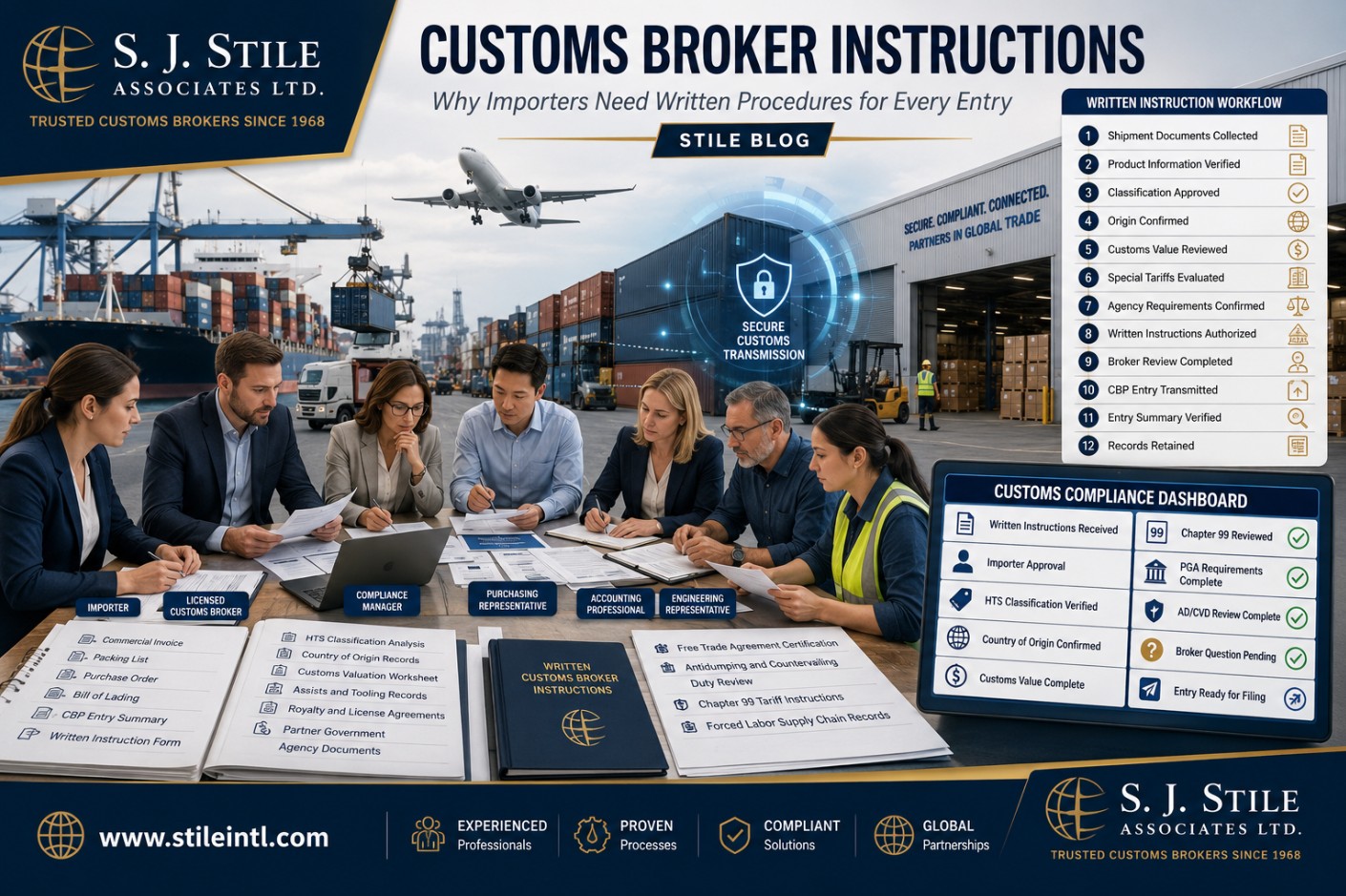
A Practical Written Instruction Workflow
A controlled customs instruction process should begin before shipment and continue through entry review.
Step 1. Document Collection
The importer collects the commercial invoice, packing list, purchase order, transportation document, product specifications, supplier information, and any required certificates.
Step 2. Product and Transaction Review
The importer verifies classification, origin, value, trade remedies, government agency requirements, and special program eligibility.
Step 3. Exception Identification
The importer determines whether the shipment contains new products, new suppliers, unusual payments, free of charge goods, returns, samples, or other nonstandard conditions.
Step 4. Written Instruction Preparation
An authorized employee prepares a consolidated instruction using approved product data and shipment documents.
Step 5. Internal Approval
The appropriate compliance, accounting, legal, engineering, or management personnel approve higher risk decisions.
Step 6. Broker Review
The customs broker reviews the instruction and identifies missing or conflicting information.
Step 7. Importer Clarification
The importer responds to questions in writing and provides additional supporting documentation.
Step 8. Entry Transmission
The broker prepares and transmits the entry using the final authorized information.
Step 9. Entry Verification
The importer reviews the entry summary and confirms that the filing reflects its instructions.
Step 10. Record Retention and Correction
The importer retains the instruction, supporting documents, approvals, broker communications, and entry records. Any identified error is evaluated and corrected through the appropriate procedure.
Broker Responsibility and Importer Responsibility Must Work Together
A reliable customs process is not based on shifting responsibility from one party to another.
The importer and customs broker have different but complementary roles.
The importer controls the business facts. The broker applies customs knowledge to those facts and conducts customs business under the importer’s authorization.
A strong relationship requires:
• Complete information from the importer
• Professional review by the broker
• Timely communication
• Documented decisions
• Clear escalation procedures
• Prompt correction of errors
Written instructions create a common record that both parties can follow.
How S. J. Stile Associates Can Help
S. J. Stile Associates Ltd. works with importers to establish clear and consistent entry communication procedures.
Our customs brokerage professionals can assist importers by:
• Reviewing entry documentation for apparent inconsistencies
• Identifying information needed for classification, valuation, origin, and admissibility
• Helping organize standing and shipment specific broker instructions
• Reviewing product databases and classification records
• Identifying entries requiring additional compliance review
• Coordinating partner government agency filing requirements
• Reviewing Chapter 99 and special tariff treatment
• Supporting entry summary verification
• Helping importers evaluate correction options when errors are identified
The importer remains responsible for its declarations and business records. Our role is to provide experienced customs brokerage support, communicate compliance concerns, and help the importer establish a more controlled entry process.
Written instructions allow the importer and broker to work from the same approved information. That improves consistency, strengthens documentation, and reduces reliance on assumptions.
Frequently Asked Questions
Is an importer legally required to use a customs broker?
There is no general legal requirement that every importer hire a customs broker. Many importers use licensed brokers because customs entries involve technical classification, valuation, admissibility, documentation, and electronic filing requirements. CBP confirms that brokers are licensed to conduct customs business on behalf of importers.
Does hiring a customs broker transfer responsibility for the entry?
No. The importer of record remains ultimately responsible for the correctness of entry documentation and the exercise of reasonable care.
Is a customs power of attorney the same as written entry instructions?
No. A power of attorney authorizes the broker to conduct customs business for the importer. Written entry instructions tell the broker how the importer has determined that a particular product or shipment should be declared.
Can an importer give permanent instructions for recurring products?
Yes, standing instructions may be appropriate when the relevant facts remain consistent. They should be documented, approved, periodically reviewed, and updated whenever the product, supplier, manufacturer, origin, value, or regulatory treatment changes.
Should the broker rely on tariff numbers supplied by the foreign vendor?
Not without appropriate review. The foreign vendor’s tariff number may reflect another country’s tariff schedule, an incomplete analysis, or a commercial assumption. The importer should establish the appropriate United States classification.
Who should approve customs classifications?
The importer should designate qualified personnel with sufficient product and customs knowledge. Complex or uncertain classifications may require review by a licensed customs broker, customs counsel, technical specialist, or CBP through a binding ruling request.
What should happen when the broker identifies conflicting information?
The broker should request clarification. The importer should investigate the conflict, obtain reliable supporting information, and provide a written response before filing whenever possible.
Are emails acceptable as written instructions?
Emails can serve as written instructions when they clearly identify the shipment, provide complete information, show appropriate authorization, and are retained with the entry records. A controlled instruction form may provide greater consistency.
How long should customs instructions be retained?
Customs records are generally subject to the retention requirements of 19 CFR Part 163. The applicable retention period and required records depend on the transaction and the specific regulatory provision. Importers should maintain a documented recordkeeping schedule and consider whether other agency or business requirements require longer retention.
What should an importer do after discovering incorrect instructions?
The importer should promptly determine which entries were affected, stop the incorrect instruction from being used, preserve relevant records, consult its customs broker or customs counsel, and evaluate the appropriate corrective procedure.
Depending on the facts and procedural status, correction may involve an entry amendment, post summary correction, protest, prior disclosure, or another authorized action.
Can the broker make a decision when the importer does not respond?
A broker may be able to proceed when reliable documentation and established instructions support the filing. However, material uncertainty involving classification, value, origin, admissibility, trade remedies, or government agency requirements should be resolved before transmission whenever possible.
The broker should not be expected to invent missing facts.
Conclusion
Written customs broker instructions are one of the most practical controls an importer can establish.
They help ensure that the broker receives accurate product, transaction, origin, valuation, and regulatory information. They also create a record of the importer’s decision making and internal approval process.
A customs broker is an essential compliance partner, but the broker cannot replace the importer’s knowledge of its products, suppliers, contracts, accounting records, and supply chain.
Importers that rely on informal communications and historical assumptions may find it difficult to explain why an entry was filed in a particular manner. Importers that maintain written instructions can more readily demonstrate what information was reviewed, who approved the treatment, what the broker was told, and how errors were addressed.
The objective is not paperwork for its own sake. The objective is a repeatable entry process that supports reasonable care, consistent filings, accurate duties, regulatory compliance, and effective broker oversight.
References
- 19 U.S.C. § 1484, Entry of Merchandise, United States House of Representatives, Office of the Law Revision Counsel.
- 19 CFR Part 111, Customs Brokers, Electronic Code of Federal Regulations.
- 19 CFR Part 111, Subpart C, Duties and Responsibilities of Customs Brokers, Electronic Code of Federal Regulations.
- 19 CFR Part 141, Entry of Merchandise, Electronic Code of Federal Regulations.
- 19 CFR Part 141, Subpart C, Powers of Attorney, Electronic Code of Federal Regulations.
- 19 CFR Part 163, Recordkeeping, Electronic Code of Federal Regulations.
- Reasonable Care, U.S. Customs and Border Protection.
- Recordkeeping, Informed Compliance Publication, U.S. Customs and Border Protection.
- Tips for New Importers and Exporters, U.S. Customs and Border Protection.
- Importing into the United States, A Guide for Commercial Importers, U.S. Customs and Border Protection.
- Informed Compliance Publications, U.S. Customs and Border Protection.
- 19 CFR Part 177, Administrative Rulings, Electronic Code of Federal Regulations.
The Stile Associates Advantage
- More than 55 years of continuous industry experience
- Family leadership with modern trade vision
- Licensed Customs Brokers and compliance professionals
- CTPAT certified supply chain security
- Full service customs and logistics solutions
- Technology driven visibility and control
- Dedicated, personalized client service
- Nationwide U.S. coverage with global support
Choosing S.J. Stile Associates means partnering with a customs broker that understands the realities of today’s trade environment and is fully invested in protecting your business.
Contact S.J. Stile Associates today to learn how we can strengthen your compliance posture and streamline your supply chain.


We’re not just a broker; we’re your strategic compliance partner.
Since 1968, our clients have trusted us to:
- Navigate regulatory shocks
- Deliver personal service from our NYC, Miami, and LA offices
- Build resilient import strategies that drive growth
In this new trade era, trust is everything , and that’s why importers stay with Stile for years.

Call to Action
At Stile Associates, we combine over 55 years of experience with the latest technology to keep your imports compliant and efficient.
Contact us today to explore how AI-driven solutions can optimize your customs operations.


📣 Final Call to Action:
Ready to take control of your shipping costs?
Let’s talk. Contact Stile Associates for a free consultation and let our experts audit your current process, to help you streamline your operations, stay compliant, and save money.

💼 Choose Stile, Your Smartest Move in Global Trade
Whether you’re shipping across the country or across continents, Stile Associates is your strategic partner for building a smarter, more resilient supply chain.
📍 Since 1968, we’ve been delivering peace of mind and performance. Let’s take your logistics to the next level together.
🌐 Visit us at www.stileintl.com
📩 Or contact: stevenheid@stileintl.com
Stile Associates – Trusted. Proven. Personal.
Stile Real Time Cargo Tracking with Global Visibility.

