

Introduction
An import entry may clear U.S. Customs and Border Protection without examination and still contain significant compliance weaknesses.
Cargo release does not necessarily mean that CBP has accepted the classification, valuation, country of origin, tariff treatment, or admissibility information declared on the entry. CBP may review the transaction later through a Request for Information, a Notice of Action, a trade audit, a recordkeeping request, or another enforcement mechanism.
For this reason, importers should not wait for CBP to identify documentation problems. A structured internal entry documentation review can reveal missing records, inconsistent product descriptions, unsupported tariff classifications, valuation errors, and other weaknesses while correction options may still be available.
The objective is not simply to confirm that documents exist. The importer should determine whether the records support every material declaration transmitted to CBP.
Regulatory and Policy Context
Under 19 U.S.C. 1484, the importer of record must use reasonable care when entering merchandise. This responsibility includes providing the information necessary for CBP to determine admissibility, classification, value, duty treatment, and compliance with other applicable laws.
Although a licensed customs broker may prepare and transmit the entry, the importer of record remains responsible for the accuracy and completeness of the information provided to CBP.
Entry information transmitted electronically is certified as true and correct to the best of the knowledge and belief of the importer or its authorized agent. The transmission is legally binding in substantially the same manner as a signed entry document.
CBP also requires importers and other covered parties to maintain and produce entry records. Part 163 of Title 19 of the Code of Federal Regulations governs the maintenance, production, inspection, and examination of customs records.
CBP generally requires entry records to be maintained for five years from the date of entry, or from the date of the activity that created the record. Records must be produced or transmitted when requested by CBP.
What CBP Expects Importers to Understand
CBP expects an importer to understand the factual basis supporting its entry declarations. This includes more than sending an invoice and packing list to the customs broker.
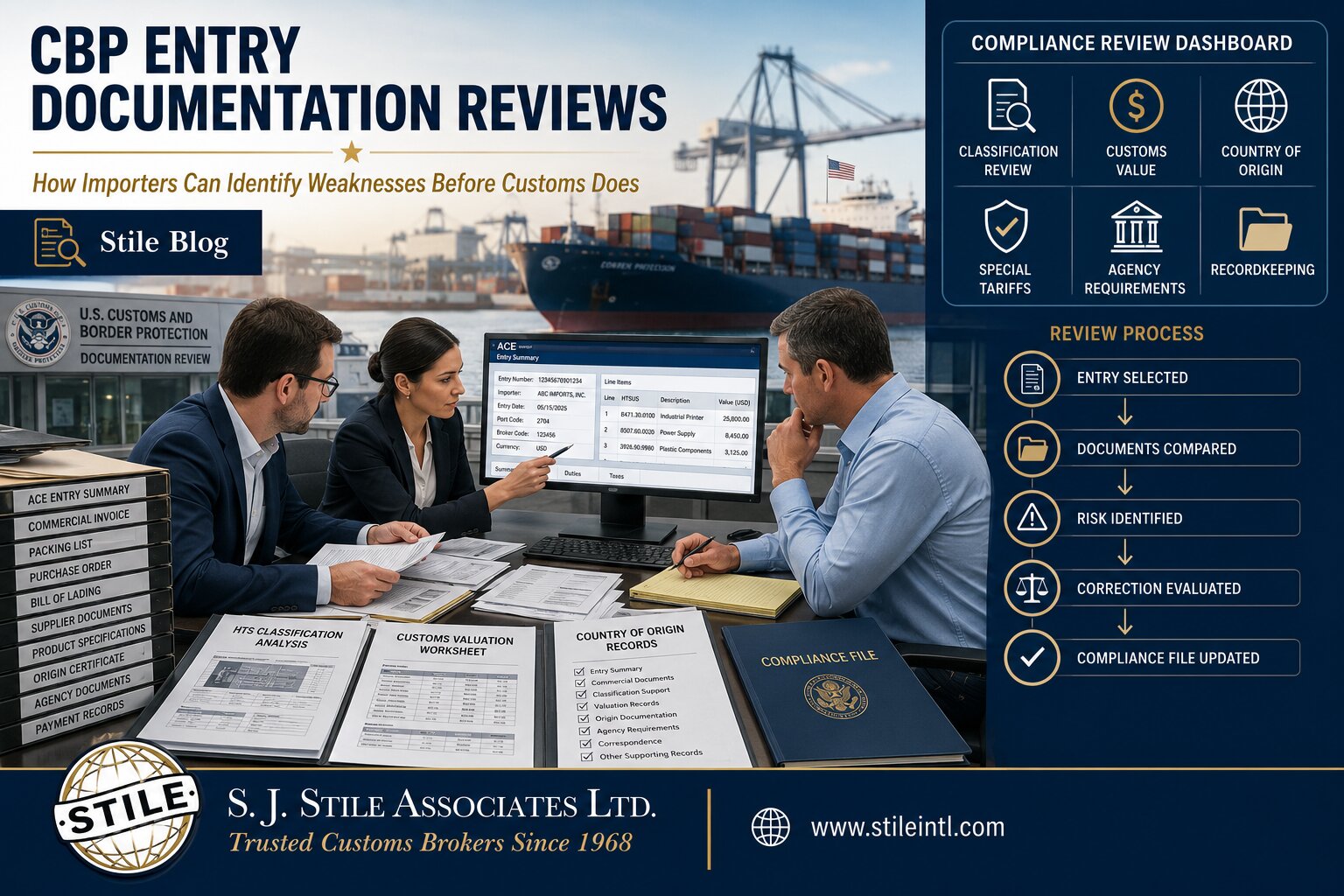
A defensible entry file should support the following areas.
Product Description and Tariff Classification
The commercial description should be specific enough to identify the product and support its classification under the Harmonized Tariff Schedule of the United States.
Descriptions such as “parts,” “accessories,” “samples,” “equipment,” or “general merchandise” may be insufficient when they do not explain what the article is, what it is made from, how it functions, and how it will be used.
The importer should be able to produce technical specifications, product literature, composition details, diagrams, photographs, or engineering information when those records are necessary to support the tariff classification.
CBP identifies tariff classification and reasonable care among the principal informed compliance responsibilities of importers. Classification can also determine whether merchandise is subject to quotas, restrictions, special tariffs, or other agency requirements.
Customs Value
The declared value should be supported by the commercial invoice, purchase order, payment records, and the commercial arrangement between the buyer and seller.
The importer should determine whether the declared value includes all legally required additions. Potential valuation issues may involve assists, packing costs, selling commissions, royalties, license fees, proceeds paid to the seller, related party pricing, or indirect payments.
A documentation review should also determine whether deductions for international freight, insurance, or other charges are separately identified and legally supportable.
Country of Origin and Marking
The country shown on the entry should reflect the applicable rules of origin, not simply the country from which the merchandise was shipped.
Where production occurs in more than one country, the importer may need manufacturing records, bills of materials, processing descriptions, supplier certifications, or other evidence showing where the relevant production occurred.
The entry file should also support the country of origin marking appearing on the merchandise or its container.
Special Tariffs and Trade Programs
An entry review should confirm whether additional tariffs, exclusions, preferential duty claims, antidumping duties, countervailing duties, or other special measures apply.
The importer should retain the factual and legal analysis supporting any claim for reduced or duty free treatment. A certificate of origin alone may not be sufficient when the applicable program requires additional production or sourcing evidence.
Partner Government Agency Requirements
Products regulated by agencies such as the Food and Drug Administration, the Department of Agriculture, the Environmental Protection Agency, the Federal Communications Commission, or the Department of Transportation may require additional data, permits, declarations, or admissibility records.
The importer should confirm that the product description and agency data transmitted to CBP are consistent with the supporting commercial and technical documents.
Common Compliance Gaps
Inconsistent Product Descriptions
The invoice, purchase order, catalog, and entry summary may describe the same product differently. These inconsistencies can make the classification appear unsupported or inaccurate.
Classification Based Only on Supplier Codes
A foreign supplier may provide an HS code, but the supplier’s code may use another country’s tariff schedule or may not include the correct United States statistical suffix.
The importer should independently validate the classification under the HTSUS.
Missing Classification Support
The entry file may contain an HTS number without any explanation of how the classification was selected. This becomes especially problematic when products are complex, multifunctional, or composed of several materials.
Undeclared Assists
Importers sometimes provide tooling, molds, designs, components, or engineering services to a foreign manufacturer without evaluating whether the value must be added to the customs value.
Unverified Origin Statements
The country of origin may be accepted from the supplier without reviewing the actual manufacturing process.
Unsupported Tariff Exclusions
An importer may claim an exclusion because the product description appears similar to the exclusion language, without confirming that the article meets every applicable requirement.
Missing Records
Required records may be scattered among purchasing, accounting, logistics, engineering, and email systems. A document may technically exist but still be difficult to retrieve promptly when CBP requests it.
Failure to Compare the Entry With the Final Transaction
Price adjustments, debit notes, credit notes, royalties, or additional payments may occur after entry. Importers should determine whether these changes affect the value or other information reported to CBP.
Practical Steps for Importers
1. Establish a Risk Based Review Schedule
Importers do not necessarily need to review every entry manually. Reviews can be prioritized using factors such as:
- High duty rates
- High entered values
- New suppliers
- New products
- New HTS classifications
- Related party transactions
- Preferential trade claims
- Antidumping or countervailing duty exposure
- Products regulated by other government agencies
- Entries subject to additional tariffs
2. Compare the Entry With Source Documents
The review should compare the entry summary with the commercial invoice, packing list, purchase order, transportation documents, payment information, technical specifications, and origin records.
The reviewer should not assume that the entry is correct merely because the information matches the invoice. The invoice itself may be incomplete.
3. Document Classification Decisions
Maintain a classification file for recurring products. The file should include the product description, composition, function, intended use, relevant HTS provisions, applicable legal notes, CBP rulings, and the reason the final classification was selected.
4. Review Valuation Controls
Purchasing, finance, and customs compliance personnel should communicate about payments or benefits provided to foreign suppliers.
The review should identify assists, royalties, commissions, tooling, year end adjustments, and related party pricing issues before they create repeated entry errors.
5. Verify Country of Origin
Request sufficient information from suppliers to understand where the merchandise and its principal components are produced.
Supplier declarations should be tested against manufacturing records, production flow information, and other available evidence.
6. Confirm Record Accessibility
Importers should be able to retrieve a complete entry file promptly. CBP requires covered parties to produce or transmit entry records upon demand.
A centralized electronic filing structure should identify the entry number, importer number, supplier, product, shipment, classification support, valuation records, origin documents, and agency documentation.
7. Track Findings and Corrective Actions
Every review finding should be documented. The record should identify:
- The entry reviewed
- The issue discovered
- The cause of the issue
- The potential duty or admissibility impact
- The corrective action taken
- The person responsible
- The date the correction was completed
- Whether other entries may contain the same error
8. Evaluate Available Correction Procedures
When an error is identified, the importer should determine whether it can be corrected through a Post Summary Correction, reconciliation, protest, prior disclosure, or another appropriate mechanism.
The correct procedure depends on the type of error, the entry status, liquidation, and the surrounding facts. Importers should review significant issues with their customs broker and customs counsel when necessary.
Broker Responsibility and Importer Oversight
A customs broker can help identify inconsistencies, request missing information, review entry instructions, and communicate concerns to the importer.
However, brokers generally rely on the commercial and technical information supplied by their clients. A broker may not know that the importer provided tooling to the manufacturer, made a separate royalty payment, received a year end credit, or changed the product’s composition.
Effective compliance requires cooperation among the importer, customs broker, purchasing department, accounting team, logistics personnel, and product specialists.
The broker should receive complete information before transmission. The importer should then review entry data and address discrepancies promptly.
How S. J. Stile Associates Can Help
S. J. Stile Associates Ltd. can assist importers in organizing a practical entry review process focused on customs documentation and entry accuracy.
Our customs brokerage team can help clients:
- Review entry summaries against commercial documents
- Identify unclear or incomplete product descriptions
- Evaluate HTS classification documentation
- Review country of origin information
- Identify potential valuation questions
- Monitor special tariff treatment
- Review liquidation and entry status
- Coordinate appropriate post entry correction procedures
- Improve communication between internal departments and the customs broker
- Develop more consistent entry documentation practices
A structured review process can help importers identify errors earlier, improve the quality of information provided to the broker, and strengthen the company’s overall reasonable care position.
Frequently Asked Questions
Does cargo release mean that CBP approved the entry?
No. Cargo release permits the merchandise to leave CBP custody, but CBP may later review classification, value, origin, admissibility, duty treatment, and supporting records.
How often should an importer review its entries?
The frequency should reflect the importer’s size, products, transaction volume, compliance history, and risk profile. Many importers use periodic sampling combined with targeted reviews of higher risk transactions.
Is the customs broker responsible for every entry error?
The broker is responsible for performing its customs business professionally and in accordance with applicable requirements. However, the importer of record remains responsible for exercising reasonable care and providing accurate and complete information.
What records should be included in an entry file?
The file may include the entry summary, commercial invoice, packing list, purchase order, bill of lading, payment records, classification support, origin documentation, valuation analysis, tariff program records, agency documents, and relevant correspondence.
The precise records required depend on the merchandise and transaction.
How long should customs records be maintained?
Customs records are generally required to be maintained for five years from the date of entry, or from the date of the activity that required the record to be created. Specific transactions or regulatory programs may have additional requirements.
What should an importer do after discovering an error?
The importer should determine the scope of the problem, identify affected entries, calculate the potential duty impact, preserve relevant records, stop the error from continuing, and evaluate the appropriate correction or disclosure procedure.
Can an importer rely entirely on information supplied by a foreign vendor?
Supplier information can be an important part of the entry file, but the importer should evaluate whether it is complete, consistent, and sufficiently reliable to support the declaration made to CBP.
References
- 19 U.S.C. 1484, Entry of Merchandise
- 19 CFR Part 163, Recordkeeping
- 19 CFR 163.2, Persons Required to Maintain Records
- 19 CFR 163.3, Entry Records
- CBP Informed Compliance Publications
- CBP Focused Assessment Program
- CBP Entry Summary Recordkeeping Guidance
The Stile Associates Advantage
- More than 55 years of continuous industry experience
- Family leadership with modern trade vision
- Licensed Customs Brokers and compliance professionals
- CTPAT certified supply chain security
- Full service customs and logistics solutions
- Technology driven visibility and control
- Dedicated, personalized client service
- Nationwide U.S. coverage with global support
Choosing S.J. Stile Associates means partnering with a customs broker that understands the realities of today’s trade environment and is fully invested in protecting your business.
Contact S.J. Stile Associates today to learn how we can strengthen your compliance posture and streamline your supply chain.


We’re not just a broker; we’re your strategic compliance partner.
Since 1968, our clients have trusted us to:
- Navigate regulatory shocks
- Deliver personal service from our NYC, Miami, and LA offices
- Build resilient import strategies that drive growth
In this new trade era, trust is everything , and that’s why importers stay with Stile for years.

Call to Action
At Stile Associates, we combine over 55 years of experience with the latest technology to keep your imports compliant and efficient.
Contact us today to explore how AI-driven solutions can optimize your customs operations.


📣 Final Call to Action:
Ready to take control of your shipping costs?
Let’s talk. Contact Stile Associates for a free consultation and let our experts audit your current process, to help you streamline your operations, stay compliant, and save money.

💼 Choose Stile, Your Smartest Move in Global Trade
Whether you’re shipping across the country or across continents, Stile Associates is your strategic partner for building a smarter, more resilient supply chain.
📍 Since 1968, we’ve been delivering peace of mind and performance. Let’s take your logistics to the next level together.
🌐 Visit us at www.stileintl.com
📩 Or contact: stevenheid@stileintl.com
Stile Associates – Trusted. Proven. Personal.
Stile Real Time Cargo Tracking with Global Visibility.

