

Introduction
Importers operate in a complex regulatory environment where mistakes can happen, even when a company is acting in good faith. A wrong HTS classification, an undervalued invoice, an unsupported country of origin claim, an incorrect free trade agreement claim, or missing assists can create exposure under 19 U.S.C. § 1592, one of the most important customs penalty statutes enforced by U.S. Customs and Border Protection.
The important question is not only whether an error occurred. The more important question is how the importer responds after discovering it.
A properly prepared prior disclosure gives an importer a formal path to report a potential violation to CBP, correct the record, tender unpaid duties, taxes, and fees, and significantly reduce penalty exposure. Under 19 U.S.C. § 1592, CBP may assess penalties for fraud, gross negligence, or negligence involving material false statements, acts, or omissions connected to imported merchandise.
For importers, prior disclosure is not simply a legal filing. It is a compliance decision that should be handled carefully, documented thoroughly, and coordinated with experienced customs professionals.
What Is a Prior Disclosure?
A prior disclosure is a voluntary disclosure made to CBP when an importer or other involved party identifies a possible violation of customs law before, or without knowledge of, the commencement of a formal CBP investigation.
Under 19 CFR § 162.74, a prior disclosure may be made orally or in writing, but if it is made orally, it generally must be confirmed in writing within 10 days unless CBP waives that requirement for good cause.
A valid disclosure must identify the circumstances of the violation, including:
- The class or kind of merchandise involved.
- The affected entries, drawback claims, ports, or approximate dates.
- The material false statements, omissions, or acts, with an explanation of how and when they occurred.
- The true and accurate information that should have been provided.
This means a prior disclosure should not be vague. It should clearly explain what happened, what entries were affected, what information was wrong, what the corrected information is, and how the importer calculated any loss of revenue.
Why 19 U.S.C. § 1592 Matters
CBSection 1592 prohibits the entry, introduction, or attempted entry of merchandise into U.S. commerce by means of materially false documents, electronic data, written or oral statements, acts, or material omissions. The statute applies whether the error results in lost revenue or not.
Examples may include:
| Area | Possible Violation |
| Classification | Incorrect HTS code resulting in underpayment of duty |
| Valuation | Missing assists, royalties, proceeds, or commissions |
| Country of origin | Incorrect origin declaration or unsupported marking claim |
| Trade remedies | Failure to apply Section 301, Section 232, AD/CVD, or other additional duties |
| Free trade agreements | Unsupported or incorrect preferential duty claim |
| Quantity or weight | Incorrect declared quantity affecting duties or admissibility |
| PGA compliance | Incorrect information tied to FDA, EPA, DOT, FWS, USDA, FCC, or other agencies |
Penalty Exposure Without Prior Disclosure
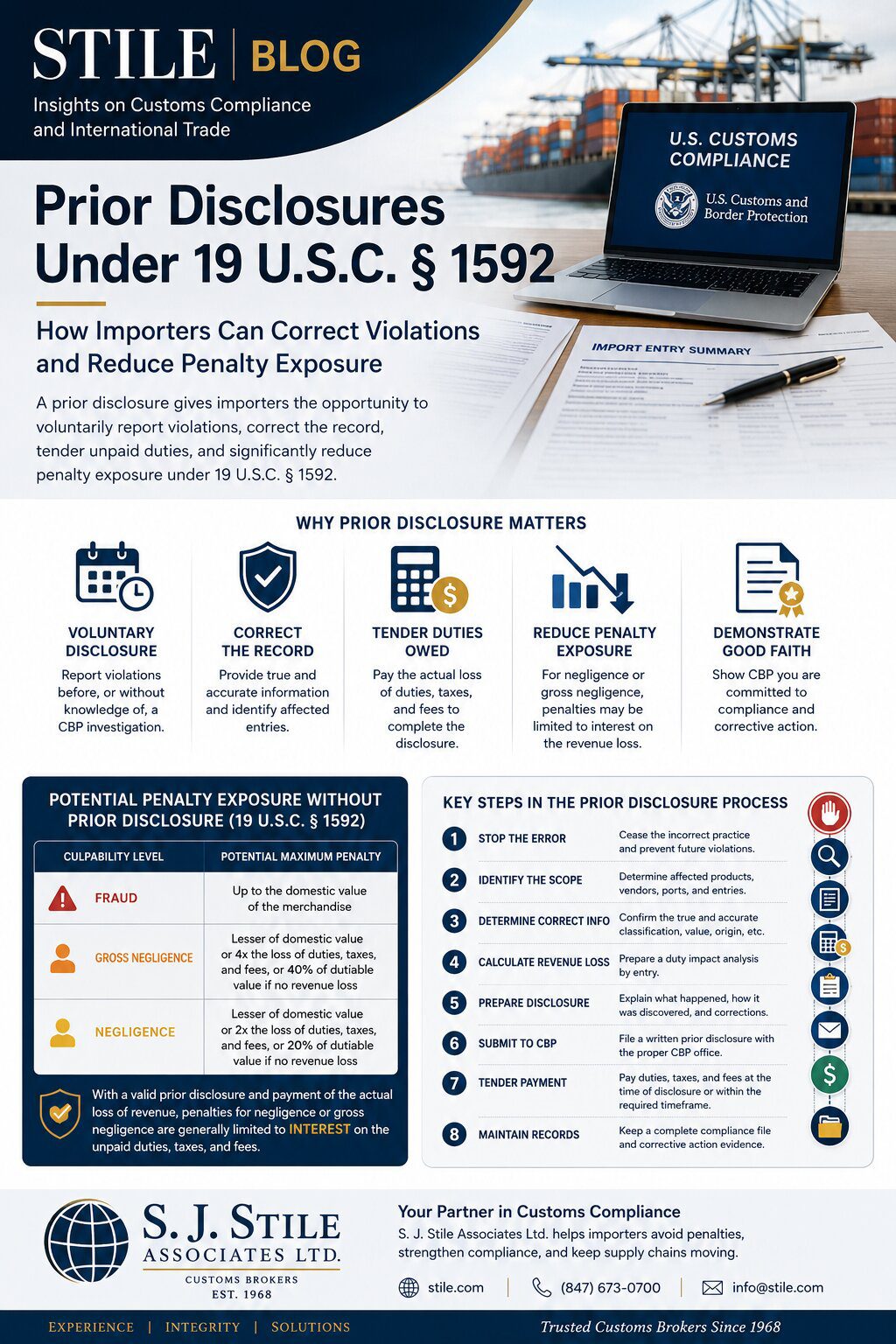
Without a valid prior disclosure, the statutory maximum penalties can be significant.
Under 19 U.S.C. § 1592:
| Culpability Level | Potential Maximum Penalty |
| Fraud | Up to the domestic value of the merchandise |
| Gross negligence | Lesser of domestic value or two times the loss of duties, taxes, and fees, or 20% of dutiable value if no revenue loss |
| Negligence | Lesser of domestic value or two times the loss of duties, taxes, and fees, or 20% of dutiable value if no revenue loss |
These penalty levels are stated directly in the statute.
This is why importers should not ignore discovered customs errors. If the issue is material and involves prior entries, the exposure may grow quickly across multiple shipments.
How Prior Disclosure Reduces Penalty Exposure
The principal benefit of a valid prior disclosure is penalty mitigation.
For negligence or gross negligence, if the importer properly discloses the violation and tenders the unpaid duties, taxes, and fees, the monetary penalty is generally limited to the interest on the revenue loss, calculated from the date of liquidation at the applicable interest rate.
For fraud, prior disclosure does not eliminate exposure, but it can still substantially reduce the maximum penalty. In a fraud case, the penalty generally may not exceed 100% of the lawful duties, taxes, and fees of which the United States was or may have been deprived, provided the unpaid amount is tendered as required. If the violation did not affect duties, the statute provides a different cap based on dutiable value.
This distinction is critical. Prior disclosure is especially powerful where the issue involves negligence or gross negligence, which are common in classification, valuation, origin, and trade remedy errors.
Timing Is Critical
A disclosure must be made before, or without knowledge of, the commencement of a formal CBP investigation. Once CBP has already begun a formal investigation and the importer has knowledge of it, the importer may lose the most favorable prior disclosure treatment.
Under 19 CFR § 162.74, a formal investigation is considered commenced when CBP records in writing the date on which it discovered facts or received information causing CBP to believe a possible violation existed.
An importer may be presumed to have knowledge of an investigation if, before the claimed prior disclosure, CBP has already informed the importer of the type or circumstances of the violation, a CBP Special Agent has made an inquiry, CBP has requested specific records related to the violation, CBP has issued a pre-penalty or penalty notice, or the merchandise has been seized.
For practical purposes, this means importers should act quickly once they identify a possible violation.espond more effectively when CBP questions an entry.
Common Situations Where Prior Disclosure Should Be Considered
1. Incorrect HTS Classification
An importer discovers that a product has been entered under the wrong HTS code for several years, resulting in underpaid duty.
A prior disclosure may be appropriate if the classification error was material, affected duty, and was not already under CBP investigation.
2. Missing Assists or Royalties
An importer provides molds, artwork, engineering, design work, materials, or tooling to a foreign supplier, but those assists were not included in customs value.
This is a classic valuation issue. If the missing amounts caused undervaluation, the importer should calculate the affected entries and determine whether disclosure is necessary.
3. Incorrect Country of Origin
An importer declares goods as originating from one country, but production records show substantial transformation occurred elsewhere.
This may affect marking, duty rates, Section 301 duties, admissibility, or trade preference claims.
4. Unsupported Free Trade Agreement Claims
An importer claimed preferential duty treatment without valid certificates, supplier support, or origin analysis.
Certain trade agreement claims have specific correction provisions, but importers should still evaluate whether a broader prior disclosure is needed. The statute includes special prior disclosure treatment for several free trade agreement origin claims, including USMCA, where corrected declarations and payment of duties may protect against penalties under specific conditions.
5. Section 301 or Additional Duties Not Applied
An importer discovers that additional tariffs should have applied but were not paid because of incorrect classification, origin, or exclusion use.
This can create significant revenue loss and should be reviewed carefully.
What a Strong Prior Disclosure File Should Include
A prior disclosure should be supported by a complete compliance file. CBP will expect the importer to show how the issue was identified, how the affected entries were determined, and how the corrected duty calculation was prepared.
Recommended documentation includes:
| Document | Purpose |
| Entry summaries | Identifies affected import transactions |
| Commercial invoices | Supports value, product description, and parties |
| Packing lists | Supports quantity, weight, and shipment details |
| Bills of lading or airway bills | Supports shipment movement |
| HTS analysis | Explains original and corrected classification |
| Valuation worksheet | Calculates assists, royalties, commissions, or additions |
| Origin analysis | Supports country of origin determination |
| Supplier declarations | Supports product facts, origin, or manufacturing process |
| Duty calculation worksheet | Shows loss of revenue by entry |
| Internal emails or memos | Explains discovery and corrective action |
| Corrective action plan | Shows future compliance controls |
| Tender documentation | Confirms payment of duties, taxes, and fees |
Tendering Duties, Taxes, and Fees
A prior disclosure is not complete only because the importer tells CBP about the issue. The importer must also tender the actual loss of duties, taxes, and fees, or actual loss of revenue.
Under 19 CFR § 162.74, the disclosing party may tender the amount at the time of disclosure, or within 30 days after CBP notifies the party in writing of CBP’s calculation. CBP may extend the 30-day period for good cause. Failure to tender the finally calculated loss can result in denial of prior disclosure treatment.
This is why the financial calculation must be handled carefully. A weak calculation can delay the matter, invite additional CBP questions, or create disagreement over the scope of the disclosure.
Can Sampling Be Used?
Yes, in some cases.
For large entry populations, statistical sampling may be used to disclose the circumstances of a violation and calculate lost duties, taxes, and fees, but the sampling plan and methodology must satisfy regulatory requirements and are subject to CBP review and approval.
Sampling may be useful when an importer has hundreds or thousands of affected entries, but it must be designed carefully. The importer should define the scope, population, time period, methodology, assumptions, and calculations in a way that CBP can evaluate.
What CBP Will Look For
CBP will generally look at whether the disclosure is timely, complete, accurate, and properly supported.
Important factors include:
- Was the disclosure made before CBP investigation knowledge?
- Did the importer identify the affected merchandise and entries?
- Did the importer clearly explain the false statement, omission, or act?
- Did the importer provide the correct information?
- Did the importer calculate and tender the revenue loss?
- Did the importer implement corrective action?
- Did the importer cooperate with CBP verification?
The mitigation guidelines under Appendix B to Part 171 provide that penalties under Section 592 may be remitted or mitigated where mitigating circumstances justify that result, although payment of actual loss of duty remains a condition of mitigation.
Practical Prior Disclosure Workflow for Importers
Step 1: Stop the Error Prospectively
Before filing, the importer should stop the same mistake from continuing. This may require updating HTS codes, valuation instructions, origin records, broker instructions, supplier documentation, or internal controls.
Step 2: Identify the Scope
Determine the affected products, vendors, ports, entry numbers, dates, invoices, and business units.
Step 3: Determine the Correct Information
Confirm the correct classification, value, origin, duty rate, trade remedy applicability, or PGA data.
Step 4: Calculate Revenue Loss
Prepare a spreadsheet by entry showing the original declaration, corrected declaration, duty difference, taxes, fees, and interest if applicable.
Step 5: Prepare the Disclosure Narrative
Explain what happened, how it was discovered, the time period involved, the affected entries, and the corrected information.
Step 6: Submit to the Proper CBP Office
A written prior disclosure should be addressed properly and clearly marked as a prior disclosure. For multi-port issues, the disclosure should identify all ports involved so CBP can coordinate handling.
Step 7: Tender Payment
Tender unpaid duties, taxes, and fees at the time of disclosure or within the regulatory timeframe after CBP calculates the loss.
Step 8: Maintain the Compliance File
Keep the disclosure package, calculations, supporting documents, CBP correspondence, payment records, and corrective action evidence.
Mistakes Importers Should Avoid
Filing Too Late
If CBP has already begun an investigation and the importer knows about it, prior disclosure treatment may be denied.
Filing Without Enough Detail
A disclosure that does not identify the merchandise, entries, false statements or omissions, and corrected data may not satisfy the regulatory requirements.
Ignoring the Tender Requirement
Failure to pay the actual loss of duties, taxes, and fees can defeat the disclosure.
Disclosing Too Narrowly
If the importer only discloses part of the problem and CBP later finds related undisclosed violations, those additional violations may not receive prior disclosure treatment. Under the regulations, additional violations not covered within the scope of the original disclosure are not entitled to prior disclosure treatment if discovered during CBP investigation or verification.
Continuing the Same Error
CBP will view corrective action as important. If the importer continues making the same mistake after discovering it, the matter becomes more serious.
Why Importers Should Work With an Experienced Customs Broker
Prior disclosures involve legal, operational, and entry-level customs issues. A customs broker can help organize the import data, identify affected entries, review entry summaries, coordinate duty calculations, and prepare the documentation needed to support the disclosure process.
At S. J. Stile Associates Ltd., we help importers evaluate customs issues before they become larger enforcement problems. Our role includes reviewing entry data, identifying exposure areas, coordinating documentation, assisting with duty impact analysis, and helping importers strengthen internal controls.
A prior disclosure should not be treated as a simple letter. It should be treated as a structured compliance project.
What Stile Can Do for Importers
S. J. Stile Associates Ltd. can assist importers with:
| Area | Support Provided |
| Entry Review | Identify affected entries, products, ports, and time periods |
| Classification Review | Compare original HTS codes against corrected classifications |
| Valuation Review | Identify assists, royalties, commissions, and additions to value |
| Origin Review | Review supplier documentation and origin support |
| Duty calculation | Prepare loss of revenue schedules |
| Documentation | Organize invoices, packing lists, entry summaries, and worksheets |
| Corrective action | Update procedures to prevent repeat violations |
| Broker coordination | Align future entries with corrected instructions |
| Compliance file support | Build a record that supports importer reasonable care |
FAQ
What is a prior disclosure under 19 U.S.C. § 1592?
A prior disclosure is a voluntary disclosure to CBP of a potential customs violation before, or without knowledge of, a formal CBP investigation. It allows the importer to correct the issue and potentially reduce penalty exposure.
Does a prior disclosure eliminate all penalties?
Not always. For negligence or gross negligence, a valid prior disclosure can significantly reduce the monetary penalty, often limiting it to interest on the unpaid duties, taxes, and fees if the importer tenders the revenue loss as required. Fraud cases are treated more severely.
Can an importer file a prior disclosure after receiving a CBP request?
It depends. If the request shows that CBP has already commenced a formal investigation and the importer has knowledge of it, prior disclosure treatment may be unavailable. Timing must be reviewed carefully.
What must be included in the disclosure?
The disclosure must identify the merchandise, affected entries or approximate dates and ports, the material false statement, omission, or act, and the true and accurate information that should have been provided.
Can a customs broker file the disclosure for the importer?
A customs broker can assist with data, calculations, documentation, and coordination. The importer should also consult customs counsel when legal exposure is significant, especially where fraud, gross negligence, AD/CVD, forced labor, or major revenue loss may be involved.
Should every customs error be disclosed?
Not every error requires a prior disclosure. Some issues may be corrected through post summary correction, reconciliation, protest, corrected declaration, or other mechanisms. The correct path depends on liquidation status, materiality, revenue impact, and whether a violation under Section 1592 may have occurred.
Conclusion
Prior disclosure is one of the most important tools available to importers who discover customs violations. It allows a company to come forward, correct inaccurate information, pay any duties owed, and reduce the risk of severe penalties.
However, the benefit depends on timing, accuracy, scope, documentation, and payment. Importers should move quickly, preserve records, define the affected entries, calculate the duty impact, and implement corrective controls.
A well-prepared prior disclosure shows CBP that the importer is acting responsibly, exercising reasonable care, and taking compliance seriously.
S. J. Stile Associates Ltd. helps importers review customs issues, strengthen compliance files, and manage entry-level documentation before problems become enforcement actions.
References
- 19 U.S.C. § 1592, Penalties for fraud, gross negligence, and negligence.
- 19 CFR § 162.74, Prior disclosure.
- Appendix B to 19 CFR Part 171, Guidelines for the Imposition and Mitigation of Penalties for Violations of 19 U.S.C. § 1592.


We’re not just a broker; we’re your strategic compliance partner.
Since 1968, our clients have trusted us to:
- Navigate regulatory shocks
- Deliver personal service from our NYC, Miami, and LA offices
- Build resilient import strategies that drive growth
In this new trade era, trust is everything , and that’s why importers stay with Stile for years.

Call to Action
At Stile Associates, we combine over 55 years of experience with the latest technology to keep your imports compliant and efficient.
Contact us today to explore how AI-driven solutions can optimize your customs operations.


📣 Final Call to Action:
Ready to take control of your shipping costs?
Let’s talk. Contact Stile Associates for a free consultation and let our experts audit your current process, to help you streamline your operations, stay compliant, and save money.

💼 Choose Stile, Your Smartest Move in Global Trade
Whether you’re shipping across the country or across continents, Stile Associates is your strategic partner for building a smarter, more resilient supply chain.
📍 Since 1968, we’ve been delivering peace of mind and performance. Let’s take your logistics to the next level together.
🌐 Visit us at www.stileintl.com
📩 Or contact: stevenheid@stileintl.com
Stile Associates – Trusted. Proven. Personal.
Stile Real Time Cargo Tracking with Global Visibility.

