

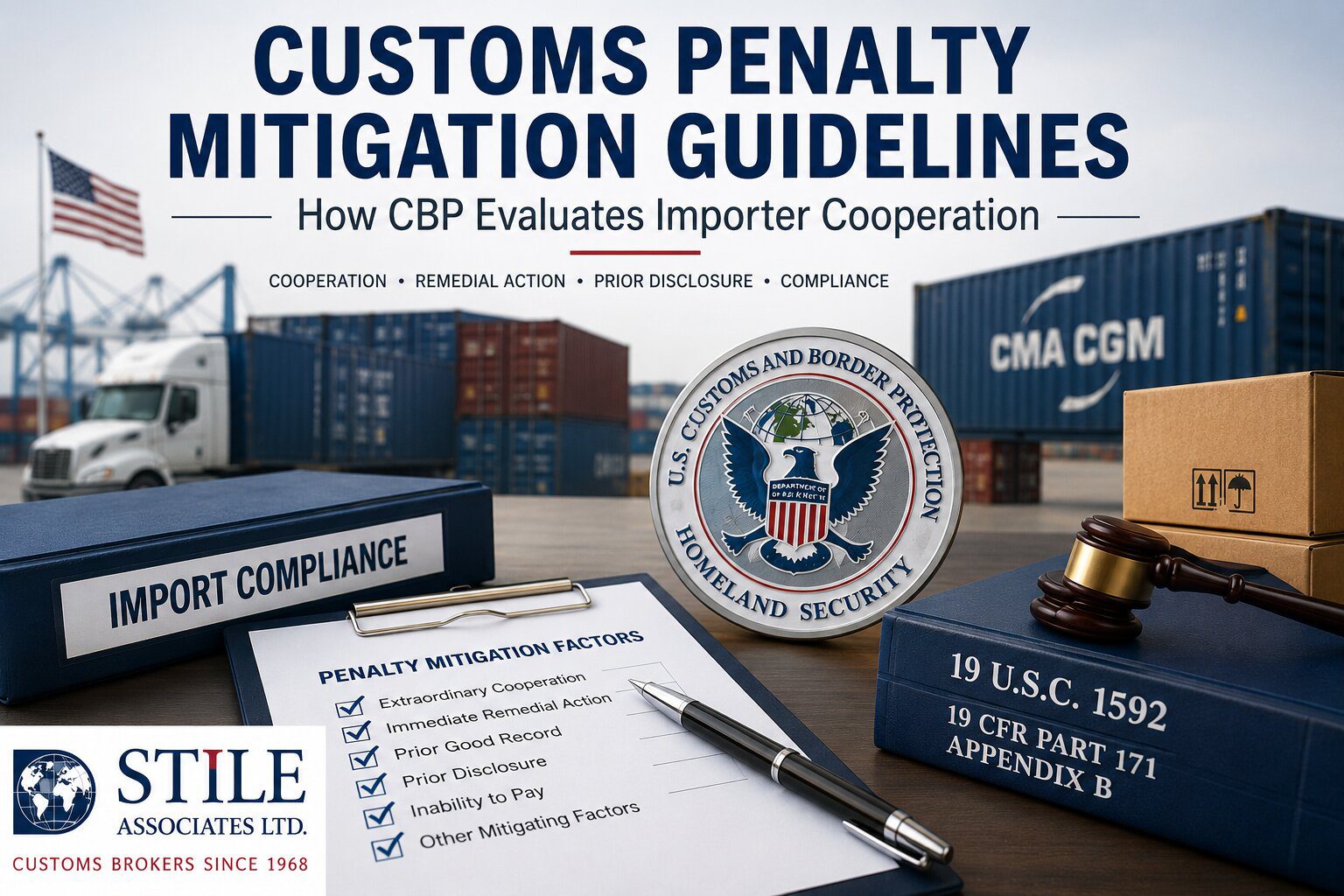
Customs Penalty Mitigation Guidelines, How CBP Evaluates Importer Cooperation
Trusted Customs Brokers Since 1968
Introduction
When U.S. Customs and Border Protection identifies a possible import violation, the final penalty outcome often depends on more than the error itself. CBP evaluates the facts, the importer’s level of culpability, the duty impact, the seriousness of the violation, and whether the importer acted responsibly after the issue was discovered.
For importers, cooperation is important, but CBP does not treat ordinary compliance with a document request as extraordinary cooperation. The regulations make clear that simply providing books and records is generally not enough to justify mitigation, because CBP already has authority to examine importer records. To receive mitigation credit for cooperation, the importer must usually show effort beyond what is normally expected during an investigation.
Why Importer Cooperation Matters
CBP does not evaluate cooperation as a public relations gesture. It evaluates whether the importer helped CBP understand the facts, calculate the duty impact, identify the scope of the issue, and prevent future violations.
Under the mitigation guidelines, cooperation may be considered when the importer provides extraordinary cooperation beyond what is expected from a party under investigation. Examples include assisting CBP to an unusual degree during an audit, providing special data runs for complex entry reviews, or helping CBP obtain additional information about the violation or related violations.
This distinction is critical. An importer who responds late, submits incomplete documentation, or provides only minimum required records may not receive meaningful cooperation credit. A company that organizes the facts, explains the root cause, provides entry data, identifies affected transactions, and implements corrective controls is in a much stronger position.
What CBP Considers Mitigating Factors
CBP’s mitigation guidelines list several factors that may reduce a proposed or assessed penalty, provided the case record supports them. These include contributory CBP error, extraordinary cooperation, immediate remedial action, inexperience in importing under limited circumstances, prior good record, inability to pay, and CBP knowledge in certain non fraud cases.
For importers, the most practical mitigation factors are usually:
1. Extraordinary Cooperation
CBP looks for cooperation beyond routine compliance. This may include:
- Providing organized entry data by entry number, date, HTS classification, value, origin, supplier, and duty impact.
- Preparing a clear explanation of how the error occurred.
- Identifying all affected entries, not only the entry CBP questioned.
- Making knowledgeable personnel available.
- Producing records in a format that helps CBP review them efficiently.
- Helping CBP understand the supply chain, product details, valuation method, or origin analysis.
The stronger the documentation, the easier it is for CBP to see that the importer is acting in good faith.
2. Immediate Remedial Action
CBP may consider immediate remedial action when the importer pays the actual loss of duty before the penalty notice, or within 30 days after CBP notifies the importer of the duty loss. CBP may also consider substantial corrective action taken after learning of the violation, especially when the importer corrects organizational or procedural weaknesses.
Examples include updating classification procedures, correcting invoice review workflows, training staff, revising broker instructions, improving supplier documentation, and strengthening internal controls.
3. Prior Good Record
A prior good record may help when the importer can demonstrate a consistent pattern of importations without violations of 19 U.S.C. 1592 or similar statutes. However, this factor is not considered in alleged fraudulent violations.
A clean compliance history should be documented, not merely asserted.
4. Prior Disclosure
A prior disclosure can significantly reduce exposure when made before, or without knowledge of, the commencement of a formal investigation. For negligence and gross negligence cases involving duty loss, the penalty may be limited to interest on the loss of duties, taxes, and fees, provided the unpaid amount is tendered as required.
This is one reason importers should review potential errors quickly. Waiting until CBP discovers the issue can reduce the importer’s options.
What Can Hurt an Importer’s Mitigation Request
CBP also considers aggravating factors. These may not raise the level of culpability by themselves, but they may offset mitigating factors. Aggravating factors include obstructing an investigation, withholding evidence, providing misleading information, prior substantive violations, illegal transshipment in textile cases, motive to evade admissibility restrictions, and failure to comply with lawful record demands or a CBP summons.
From a practical standpoint, the worst mistakes importers can make are:
- Ignoring CBP deadlines.
- Submitting incomplete or inconsistent records.
- Blaming the broker without providing facts.
- Failing to identify the root cause.
- Continuing the same practice after discovering the issue.
- Providing explanations that are not supported by documents.
CBP expects importers to exercise reasonable care. When an importer cannot explain its classification, valuation, origin, or documentation process, the penalty risk increases.
Practical Steps Importers Should Take When a Penalty Issue Arises
When an importer receives a CBP inquiry, pre penalty notice, request for information, or penalty notice, the response should be organized and strategic.
Recommended Action Plan
- Identify the exact issue
- Determine whether the matter involves classification, valuation, country of origin, antidumping or countervailing duties, forced labor, marking, admissibility, or another compliance area.
- Secure all records immediately
- Collect commercial invoices, packing lists, purchase orders, payment records, product specifications, broker instructions, supplier communications, entry summaries, and prior rulings if any.
- Determine the scope
- Review whether the issue affects one entry, multiple entries, one supplier, one product line, or a broader import program.
- Calculate potential duty exposure
- If duties, taxes, or fees were underpaid, calculate actual and potential loss carefully.
- Evaluate prior disclosure options
- Before responding casually, determine whether a valid prior disclosure may be available.
- Prepare a documented mitigation record
- Explain the facts, show cooperation, identify corrective action, and support every statement with evidence.
- Correct internal procedures
- Update classification databases, supplier document requirements, broker instructions, and internal review controls.
How S. J. Stile Associates Helps Importers
S. J. Stile Associates Ltd. helps importers reduce customs risk by supporting accurate entry processes, organized documentation, and responsible communication with CBP. When penalty issues arise, a customs broker’s role is not to replace legal counsel, but to help the importer understand the entry facts, gather documentation, review entry data, and support a compliant response strategy.
Stile can assist with:
- Entry data review.
- HTS classification support.
- Country of origin documentation review.
- Valuation and invoice consistency checks.
- Duty impact summaries.
- Broker instruction review.
- Compliance file organization.
- Coordination with customs counsel when legal representation is needed.
The importer remains responsible for reasonable care, but a knowledgeable customs broker can help the importer maintain stronger records, reduce avoidable mistakes, and respond more effectively when CBP questions an entry.
Conclusion
CBP penalty mitigation is not automatic. Importers must prove, through documents and conduct, that they acted responsibly. Cooperation must be meaningful, timely, and well supported. The strongest mitigation position usually comes from early action, full documentation, accurate duty calculations, corrective measures, and a clear explanation of how the importer will prevent the issue from recurring.
For importers, the lesson is simple: do not wait for a penalty notice to build a compliance file. The best defense begins before the problem occurs.
FAQ
What is customs penalty mitigation?
Customs penalty mitigation is the process by which CBP may reduce or remit a proposed or assessed penalty when the facts support relief under CBP’s mitigation guidelines.
Does cooperation always reduce a CBP penalty?
No. CBP distinguishes ordinary compliance from extraordinary cooperation. Merely providing books and records is usually not enough because CBP has authority to examine importer records.
What is the most important mitigation factor?
There is no single factor that applies to every case. However, immediate remedial action, extraordinary cooperation, prior good record, and valid prior disclosure can be very important when supported by evidence.
Can a prior disclosure reduce penalty exposure?
Yes. In negligence and gross negligence cases involving duty loss, a valid prior disclosure can significantly reduce penalty exposure, often limiting the penalty to interest on the duty loss, provided the legal requirements are met.
Should an importer respond to CBP without reviewing the full facts?
No. A quick but incomplete response can create additional risk. Importers should collect records, review the affected entries, calculate duty impact, and prepare a documented response.
References
- U.S. Customs and Border Protection, Informed Compliance Publication, Mitigation Guidelines.
- 19 U.S.C. 1592, Penalties for fraud, gross negligence, and negligence.
- 19 CFR Part 171, Appendix B, Guidelines for the Imposition and Mitigation of Penalties for Violations of 19 U.S.C. 1592.
- 19 CFR 162.73, Penalties under section 592.
The Stile Associates Advantage
- More than 55 years of continuous industry experience
- Family leadership with modern trade vision
- Licensed Customs Brokers and compliance professionals
- CTPAT certified supply chain security
- Full service customs and logistics solutions
- Technology driven visibility and control
- Dedicated, personalized client service
- Nationwide U.S. coverage with global support
Choosing S.J. Stile Associates means partnering with a customs broker that understands the realities of today’s trade environment and is fully invested in protecting your business.
Contact S.J. Stile Associates today to learn how we can strengthen your compliance posture and streamline your supply chain.


We’re not just a broker; we’re your strategic compliance partner.
Since 1968, our clients have trusted us to:
- Navigate regulatory shocks
- Deliver personal service from our NYC, Miami, and LA offices
- Build resilient import strategies that drive growth
In this new trade era, trust is everything , and that’s why importers stay with Stile for years.

Call to Action
At Stile Associates, we combine over 55 years of experience with the latest technology to keep your imports compliant and efficient.
Contact us today to explore how AI-driven solutions can optimize your customs operations.


📣 Final Call to Action:
Ready to take control of your shipping costs?
Let’s talk. Contact Stile Associates for a free consultation and let our experts audit your current process, to help you streamline your operations, stay compliant, and save money.

💼 Choose Stile, Your Smartest Move in Global Trade
Whether you’re shipping across the country or across continents, Stile Associates is your strategic partner for building a smarter, more resilient supply chain.
📍 Since 1968, we’ve been delivering peace of mind and performance. Let’s take your logistics to the next level together.
🌐 Visit us at www.stileintl.com
📩 Or contact: stevenheid@stileintl.com
Stile Associates – Trusted. Proven. Personal.
Stile Real Time Cargo Tracking with Global Visibility.

