

1. Introduction
For U.S. importers, “reasonable care” is not just a general compliance idea. It is a legal responsibility tied directly to how merchandise is entered, classified, valued, documented, and reported to U.S. Customs and Border Protection. Under 19 U.S.C. 1484, the importer of record, either directly or through an authorized agent, must use reasonable care when making entry and when filing the information CBP needs to determine release, assess duties, collect accurate statistics, and confirm whether other legal requirements are met.
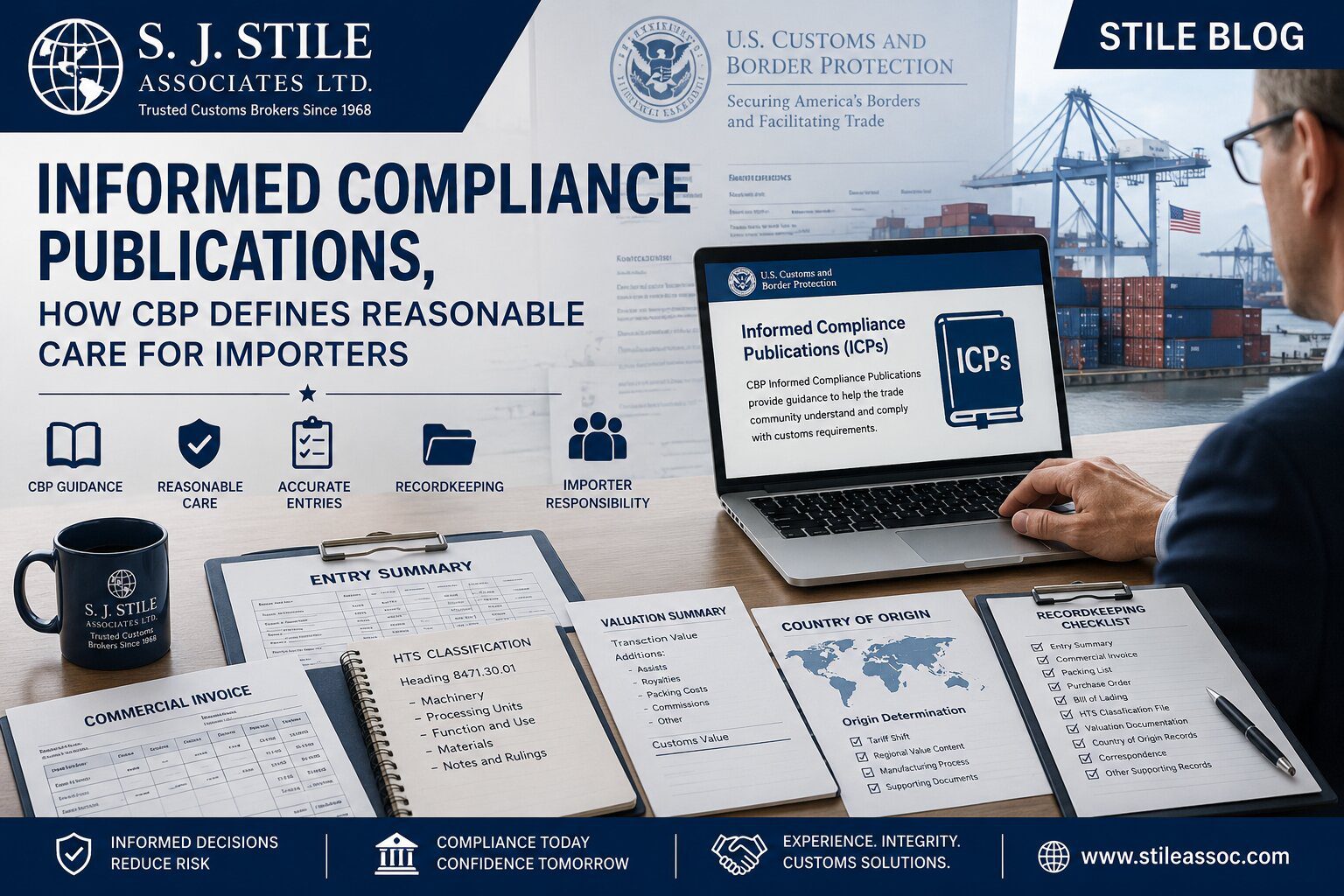
CBP’s Informed Compliance Publications, commonly called ICPs, are one of the most important public tools importers can use to understand CBP expectations. CBP maintains ICPs on topics such as reasonable care, recordkeeping, rules of origin, tariff classification, valuation, marking, and other trade compliance subjects.
For importers, the practical issue is clear. CBP does not expect perfection in every transaction, but it does expect importers to make informed, documented, and defensible decisions. A company that imports without reviewing classification, valuation, origin, invoice accuracy, partner government agency requirements, and recordkeeping obligations may struggle to show that it exercised reasonable care if CBP later questions an entry.
2. Regulatory and Policy Context
2.1 The Legal Foundation, 19 U.S.C. 1484
The reasonable care standard is grounded in 19 U.S.C. 1484. The statute requires the importer of record to use reasonable care to make entry by filing documentation or electronic information necessary for CBP to determine whether merchandise may be released. It also requires the importer to complete the entry by filing the declared value, classification, rate of duty, and other information needed for CBP to assess duties, collect statistics, and determine whether other applicable legal requirements are met.
This means reasonable care applies to more than one field on an entry summary. It reaches the entire entry process, including product description, tariff classification, customs value, duty rate, origin, admissibility, quantity, invoice data, supporting documents, and any agency requirements connected to the imported product.
2.2 CBP’s Informed Compliance Framework
CBP’s informed compliance approach is based on shared responsibility. CBP publishes guidance so the trade community can better understand customs requirements, while importers are expected to apply that information to their own transactions. CBP’s importing guide describes informed compliance as a key component of the relationship between CBP and the trade community, with CBP communicating requirements to importers and importers being responsible for using reasonable care.
CBP’s ICP page confirms that the agency publishes ICPs and other guidance materials for the trade community. These publications do not replace statutes, regulations, rulings, or legal advice, but they are highly relevant evidence of what CBP has told importers to consider.
2.3 Entry Documentation and Invoice Requirements
Reasonable care also connects directly to entry documentation rules. Under 19 CFR Part 141, CBP sets the general requirements and procedures for the entry of imported merchandise.
Commercial invoices are especially important. Under 19 CFR 141.83, a commercial invoice must generally be filed for each shipment unless exempted, and it must contain the information required by the applicable invoice regulations.
Under 19 CFR 141.86, invoices must include information such as a detailed merchandise description, quantities, marks and numbers, and other required data. Weak invoice descriptions, incomplete product details, and missing transaction information can affect classification, valuation, admissibility, and duty accuracy.
2.4 Recordkeeping Requirements
Reasonable care does not end when an entry is filed. CBP’s recordkeeping regulations in 19 CFR Part 163 govern the maintenance, production, inspection, and examination of customs records. The regulation also connects recordkeeping to audits, investigations, duty liability, penalties, and compliance with laws administered or enforced by Customs.
For importers, this means a correct entry is not enough if the company cannot later support it with records. Classification analysis, valuation support, purchase orders, assists, royalty agreements, origin documents, bills of materials, freight records, broker instructions, and internal review notes may become critical if CBP asks questions months or years after importation.
3. What CBP Expects From Importers
CBP’s reasonable care standard is practical, not theoretical. Importers should be able to show that they used an informed process before filing entry data. In many cases, that process should include review of CBP ICPs, regulations, rulings, product documents, supplier information, and internal controls.
3.1 Classification Review
Importers should not rely only on supplier descriptions or past practices. A reasonable classification process should include product specifications, materials, function, use, technical literature, and review of the Harmonized Tariff Schedule. When uncertainty exists, importers should consider whether a binding ruling request is appropriate.
3.2 Valuation Review
Reasonable care requires importers to evaluate whether the declared customs value reflects the proper transaction value or another legally acceptable valuation method. Importers should review whether assists, royalties, proceeds, packing costs, commissions, discounts, related party pricing, and indirect payments may affect the declared value.
3.3 Origin and Marking Review
Country of origin affects marking, duty rates, trade remedies, free trade agreement claims, Section 301 exposure, antidumping and countervailing duty risk, and admissibility. CBP’s ICP library includes guidance on topics such as rules of origin and marking, which importers should use when evaluating origin claims.
3.4 Invoice and Document Accuracy
Invoices should describe the merchandise clearly enough to support classification, valuation, and admissibility. Generic invoice descriptions such as “parts,” “samples,” “accessories,” or “machines” may be insufficient if they do not allow CBP or the broker to determine what is being imported.
3.5 Broker Instructions and Oversight
Using a customs broker does not eliminate importer responsibility. Under 19 U.S.C. 1484, entry may be made by the importer or by an authorized agent, but the reasonable care obligation remains tied to the importer of record’s entry responsibilities.
Importers should give brokers accurate product descriptions, invoices, purchase information, classification instructions, origin support, and any special agency information. Importers should also review broker filings, especially for recurring items, high value shipments, regulated goods, and products subject to special duties or enforcement priorities.
4. Common Compliance Gaps.
4.1 Treating ICPs as Optional Reading
Many importers know CBP publishes guidance but do not incorporate ICPs into their compliance procedures. This is a mistake. ICPs show what CBP has publicly communicated to the trade community. When an importer has never reviewed relevant guidance, it may be harder to explain how the company made an informed compliance decision.
4.2 Relying on Supplier Classifications
Foreign suppliers may provide tariff codes, but those codes may be based on another country’s tariff schedule, commercial convenience, or incomplete product knowledge. The U.S. importer must ensure the classification is correct for U.S. customs purposes.
4.3 Weak Product Descriptions
A broker cannot classify accurately if the importer provides incomplete product descriptions. For example, “metal bracket” does not explain material composition, end use, dimensions, whether it is a part of a machine, or whether it has a specialized function.
4.4 Failing to Review Valuation Additions
Assists, royalties, tooling, molds, engineering, selling commissions, and related party transactions are common areas of valuation risk. If these are handled outside the customs team, the entry value may not reflect all required additions.
4.5 Poor Record Retention
If CBP requests records and the importer cannot produce them, the company may face exposure even if the original entry was believed to be correct. 19 CFR Part 163 establishes CBP’s recordkeeping framework and ties record production to audits, investigations, duty liability, penalties, and other compliance inquiries.
4.6 No Internal Escalation Procedure
Import teams often know when something looks unusual, such as a sudden change in supplier, invoice value, country of origin, product description, or tariff treatment. Without an escalation process, those warning signs may never reach management, the broker, or trade counsel.
5. Practical Steps for Importers
5.1 Build an ICP Review Library
Importers should identify which CBP ICPs apply to their product lines. At a minimum, many importers should review ICPs related to reasonable care, recordkeeping, tariff classification, valuation, country of origin, and marking.
5.2 Create a Classification File
For each recurring product, maintain a classification file that includes product specifications, photos, bills of materials, technical descriptions, prior rulings if applicable, classification rationale, and the person or department responsible for the decision.
5.3 Review Commercial Invoice Quality
Invoices should be tested periodically to confirm they include complete descriptions, quantities, values, currency, seller and buyer details, country of origin information, and any required additional data. Since 19 CFR 141.83 and 141.86 address invoice requirements, invoice quality should be treated as a compliance control, not just an accounts payable issue.
5.4 Document Valuation Decisions
Importers should document how customs value is determined. The file should address related party status, assists, royalties, commissions, rebates, discounts, and other adjustments where relevant.
5.5 Confirm Origin Before Importation
Origin should be reviewed before goods ship, especially when the product is subject to special duties, free trade agreement claims, marking requirements, forced labor enforcement, antidumping or countervailing duties, or partner government agency review.
5.6 Monitor Broker Filings
Importers should review entry summaries, especially for high value products, new products, new suppliers, regulated commodities, and entries involving special tariff programs. Broker review should include HTS classification, value, origin, duty rate, importer of record, bond information, and PGA data.
5.7 Maintain Records in a Searchable Format
Records should be organized by entry number, supplier, product, purchase order, invoice, and shipment date. The goal is not only to keep records, but to produce them quickly and accurately if CBP requests them.
5.8 Correct Errors Promptly
When an importer discovers an error, the company should evaluate the available correction mechanism. Depending on timing and facts, this may involve a Post Summary Correction, protest, reconciliation, tender of duties, or prior disclosure analysis. If the issue may involve a material false statement, omission, or incorrect declaration, the importer should evaluate 19 U.S.C. 1592 exposure carefully. That statute addresses fraud, gross negligence, and negligence in connection with customs declarations, documents, and information.
6. How S.J. Stile Associates Can Help
S. J. Stile Associates Ltd. helps importers translate CBP’s informed compliance expectations into practical import procedures. As a customs broker serving importers since 1968, Stile can assist with entry review, broker communication, document coordination, classification support, invoice review, admissibility checks, and compliance workflow improvement.
Stile’s role is not limited to filing data. A strong customs broker helps importers identify missing information, ask the right questions before entry, maintain consistency across shipments, and reduce avoidable errors that may create duty exposure, delays, holds, requests for information, or audit concerns.
For importers, reasonable care is strongest when the importer and broker work from accurate product data, complete documents, clear instructions, and documented compliance procedures.
7. FAQs
7.1 What are CBP Informed Compliance Publications?
CBP Informed Compliance Publications are guidance documents published by CBP to help the trade community understand customs requirements. CBP maintains ICPs on topics such as reasonable care, recordkeeping, rules of origin, tariff classification, valuation, and marking.
7.2 Does reading an ICP automatically prove reasonable care?
No. Reading an ICP is helpful, but reasonable care requires applying the guidance to the importer’s actual merchandise, records, transactions, and entry process. Importers should document how they reached their compliance decisions.
7.3 Is the customs broker responsible for reasonable care?
The broker has professional responsibilities, but the importer of record remains responsible for using reasonable care under 19 U.S.C. 1484. The importer must provide accurate information and should review the broker’s filings.
7.4 What is the most common reasonable care failure?
One common failure is treating customs data as clerical information instead of regulated compliance data. Classification, value, origin, and invoice descriptions should be reviewed through a controlled process.
7.5 Should importers request binding rulings?
When classification, origin, or other customs treatment is uncertain, a binding ruling may be appropriate. CBP’s tips for importers note that importers can request written rulings from CBP for proper HTSUS classification.
7.6 Why are records so important?
CBP may ask an importer to support an entry after the shipment has cleared. Under 19 CFR Part 163, CBP’s recordkeeping rules govern maintenance, production, inspection, and examination of records connected to customs compliance, audits, investigations, duties, fees, taxes, penalties, and other inquiries.
7.7 Can reasonable care reduce penalty exposure?
Reasonable care is not a guarantee against duty collection or enforcement action. However, documented reasonable care may help show that an importer acted responsibly if CBP later questions whether an error resulted from negligence, gross negligence, or fraud under 19 U.S.C. 1592. e errors.
8. References
- CBP, Reasonable Care, Informed Compliance Publication.
- CBP, Informed Compliance Publications.
- 19 U.S.C. 1484, Entry of Merchandise.
- CBP, Importing into the United States, A Guide for Commercial Importers.
- 19 CFR Part 141, Entry of Merchandise.
- 19 CFR 141.83, Type of Invoice Required.
- 19 CFR 141.86, Contents of Invoices and General Requirements.
- 19 CFR Part 163, Recordkeeping.
- 19 U.S.C. 1592, Penalties for Fraud, Gross Negligence, and Negligence.
The Stile Associates Advantage
- More than 55 years of continuous industry experience
- Family leadership with modern trade vision
- Licensed Customs Brokers and compliance professionals
- CTPAT certified supply chain security
- Full service customs and logistics solutions
- Technology driven visibility and control
- Dedicated, personalized client service
- Nationwide U.S. coverage with global support
Choosing S.J. Stile Associates means partnering with a customs broker that understands the realities of today’s trade environment and is fully invested in protecting your business.
Contact S.J. Stile Associates today to learn how we can strengthen your compliance posture and streamline your supply chain.


We’re not just a broker; we’re your strategic compliance partner.
Since 1968, our clients have trusted us to:
- Navigate regulatory shocks
- Deliver personal service from our NYC, Miami, and LA offices
- Build resilient import strategies that drive growth
In this new trade era, trust is everything , and that’s why importers stay with Stile for years.

Call to Action
At Stile Associates, we combine over 55 years of experience with the latest technology to keep your imports compliant and efficient.
Contact us today to explore how AI-driven solutions can optimize your customs operations.


📣 Final Call to Action:
Ready to take control of your shipping costs?
Let’s talk. Contact Stile Associates for a free consultation and let our experts audit your current process, to help you streamline your operations, stay compliant, and save money.

💼 Choose Stile, Your Smartest Move in Global Trade
Whether you’re shipping across the country or across continents, Stile Associates is your strategic partner for building a smarter, more resilient supply chain.
📍 Since 1968, we’ve been delivering peace of mind and performance. Let’s take your logistics to the next level together.
🌐 Visit us at www.stileintl.com
📩 Or contact: stevenheid@stileintl.com
Stile Associates – Trusted. Proven. Personal.
Stile Real Time Cargo Tracking with Global Visibility.

